Search This Blog

Showing posts with label January Intersession 2018. Show all posts

22 March 2018

Experiential Learning in Indian Agriculture #TBT #HogsAbroad in India

To an outside observer, it may have looked questionable visiting three educational and / or research institutions lest the experiences start overlapping and become monotonous.  However, these academic visits were among my favorite parts of my study abroad experience in India as each location offered different facilities, different research subjects, and most interestingly, different approaches to common problems.  At the Dayalbagh Educational Institute in Agra, I had the chance to witness multiple academic fields and to visit with multiple faculty about current work in manners that demonstrated the values that the institution was striving to instill in its students.
Dayalbagh Educational Institute (DEI) was the last of our three visits and by far the most diverse.  Besides the first few days with jet lag, this day’s itinerary exhausted me the most as our group trekked back and forth between various parts of the campus.  In the morning, we began with a visit to the dairy farming facilities, and I learned about the distribution of the herd of cattle between milk producers and grazers, witnessed the more traditional practices for improving weight gain and milk production (including playing soothing music over the grounds and approaching each of the cows by name), and taste-tested some of the products.  Later, we also had the chance to present our findings on some of the main differences between the United States and India to the current graduate and PhD students working in the botany department who then presented about their current research.  Much later in the afternoon, we encountered departments with projects including an online wiring testing source, Alzheimer’s treatments, and constructions of 3D printers.
As a biochemistry major, it was admittedly shocking that the arts department left the one of the biggest impressions on me out of the entire campus.  The Faculty of Arts was situated towards the back side of campus, and two stories of dry, red brick surrounded a courtyard full of many lounging and conversing students as we entered.  The dean of the campus dedicated much of the afternoon to eagerly leading us through each of the specialties in this department which involved walking around the inner side of the building and climbing up and down the stairs.
In each department, I loved how each of the faculty described not only what sorts of assignments the arts students commonly handled but also how these assignments either tackled problems in society or incorporated pieces of traditional Indian culture.  For instance, in the fashion design department, the teacher explained that some of the students ventured into creating stuffed animals and small toys in addition to clothing in order to expand their artistic skills, recycle products like stuffing and textiles, and presumably create cheaper toys for youth.
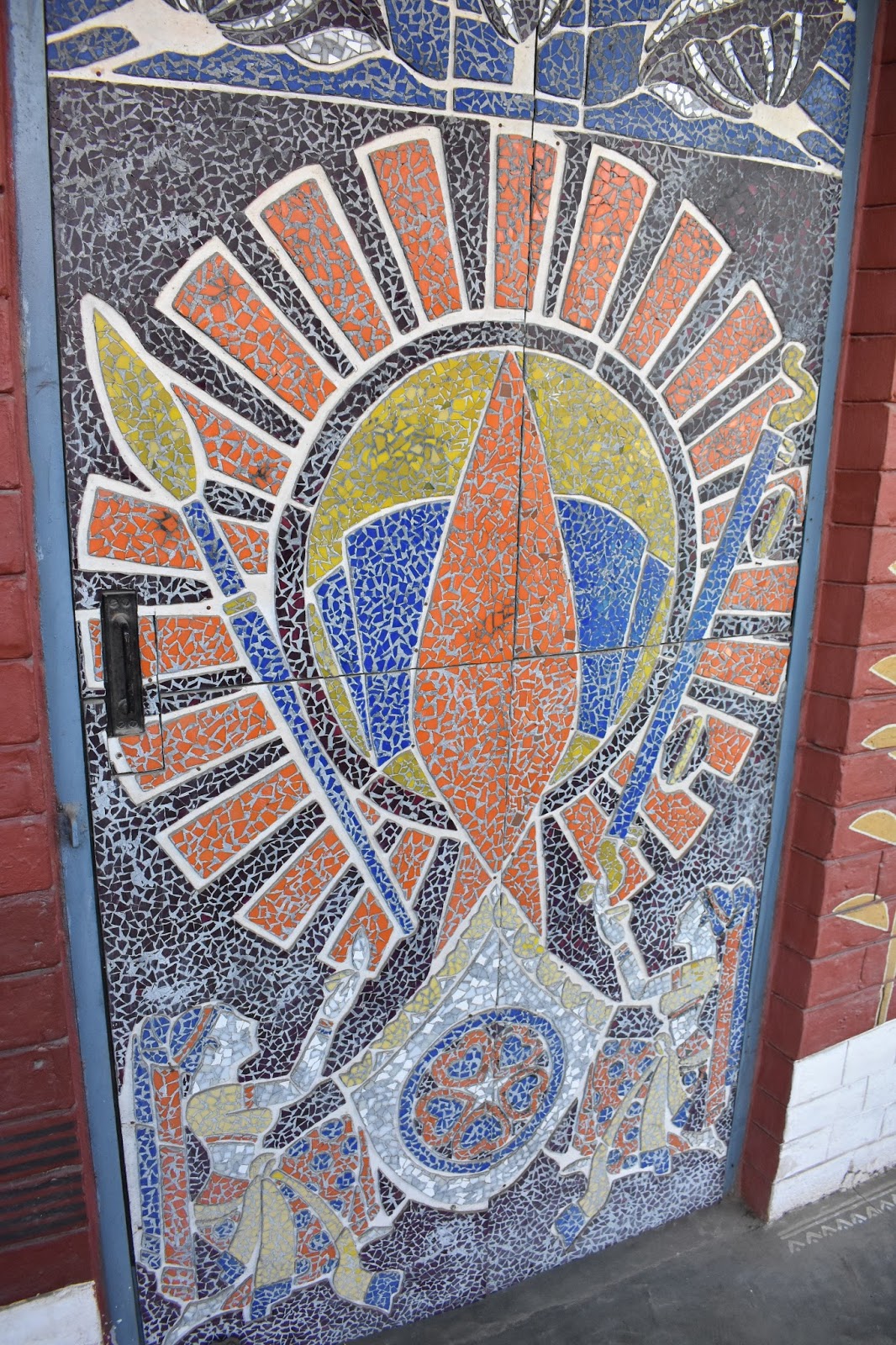
My absolute favorite part of my experience here was witnessing the persistence and integration of traditional Indian culture within the modern education.  Among the drawing department, there was a specific class for miniature painting, a form of classic Indian painting characterized by fine brushstrokes and often times ornate colors.  Even in the short time standing amid the students and the walls lined with these pictures, I was impressed by the talent and detail evident in each piece.  Another class focused on murals and mosaics, and I loved that the students utilized all of the doors and some of the hallways for their canvases.
Finally, we were fortunate enough to be able to hear a short music recital delivered by three students and some accompanying professors.  Even before we walked into the makeshift performance room, I had heard some girls practicing a modern choir arrangement of “Mary, Did You Know?” in another room.  However, after we were seated and settled, our group was privy to a small concert with traditional Indian instruments including the tabla and the sitar.  It was incredible to experience music with unfamiliar beats and harmonies, and I found it incredible that this art not only has persisted for ages but is still being taught and performed passionately today.
Though the day was long, the experience at DEI left me feeling full.  I came to India wanting to learn more about the culture, and the institute allowed me to observe components of traditional and modern culture at one site.  In particular, the arts facilities created a new appreciation for some styles of art that I had seen before but had never understood their history or techniques.  After leaving DEI, I realized that I can only hope all educational institutions strive to instill this love for both traditional and modern disciplines.
--
Students spent the January Intersession with our Experiential Learning in Indian Agriculture faculty-led program. For information about Bumpers College study abroad programs, go to Bumpers' international page. Bumpers College offers faculty-led programs to Belgium, India, Mozambique, New Zealand, Australia and Italy; courses and exchanges in France and Austria; internships in Greece and Scotland; and research in Brazil, Costa Rica, the Philippines and Greece.

26 January 2018

Ayurveda: The Unexpected Relationship Between Agriculture and Medicine #HogsAbroad in India

As a pre-medical biochemistry major, I knew that I was taking a step outside of my comfort zone by joining an agricultural studies study abroad program. As a result, I spent the entirety of my time in India not only learning about a new culture, but also genuinely learning about unfamiliar topics like irrigation systems, vertical farming, and solar panels. However, I was surprised to discover that the topic of medicine kept reoccurring throughout the program. The UA Faculty Led Program for Experiential Learning in Indian Agriculture, therefore, was the perfect example of how students from diverse disciplines can find, learn, and make connections to aspects of their academic degree and their professional future.

Originally, I went to India expecting to make connections to medicine by observing how the different types of food and the farm-to-table process impact overall health of a population. However, I quickly realized that a traditional form of Indian medicine, Ayurveda, was a much more obvious and prevalent application with implications in both medicine and agriculture. Ayurveda is a traditional form of medicine with emphasis on mind-body wellness and balance, and it is based on multiple Sanskrit writings that are more than 2,000 years old. There are traditionally eight branches (including internal medicine, pediatrics, toxicology, etc.) and two categories (including curative and preventative), but the most widespread application during my program in India concerned preventative treatments.

Mostly these treatments involved common herbs and spices and some other common crops for a spectrum of different medicinal purposes. At the National Research Centre for Seed Spices, I received the most comprehensive overview of the different effects. For example, fenugreek is believed to help with joint pain, to limit the complications of type II diabetes, and to increase the blood oxygen levels, and as a result, it is evidently used by many climbers and travelers to prevent altitude sickness. Ajwain (or carom seeds) are believed to purify the blood and are used by countless new mothers immediately postpartum. Even here, there were about ten different spices mentioned, each with different effects.


One of the most fascinating aspects of the discovery of this marriage between medicine and agriculture in India was that almost every academic visit involved this aspect of Ayurveda. The spokespersons at each farming community, each greenhouse, and each garden mentioned the value of the medicinal benefits of whatever was grown there. At the student farms at Dayalbagh Educational Institute (DEI) in Agra, separate spices were denoted by signs displaying their names and their medical purpose – a feature that at the time seemed slightly misplaced in the middle of large fields purposed for agricultural learning. Furthermore, at the small garden in the center of the campus, a student gave us a tour, and while passing around different leaves to feel and smell, I found it interesting that he was sure to mention of the medicinal benefits of each plant.


I think the reason that I found the concept of Ayurveda so surprising and exciting was that I am from a country in which the general population is quite divided about alternative medicine. I asked one of our academic hosts whether most Indians subscribed to belief in Ayurveda, and she replied that most everyone she knew believed in some aspect of it, particularly in the dietary preventative treatments. Also, she mentioned how it was common to all Indians despite a large variation in socioeconomic status since most herbs and spices central to these treatments were very cheap. It was encouraging to see something as simple as preventative steps for general health fundamental to a culture.

Much of traditional Ayurvedic medicine has been passed down by word of mouth, and as a result, each family may have their own variations on a treatment or remedy. However, because this form of medicine has its roots in tradition and is most prevalent in developing regions of the world, there are not many experimental studies to support all the claimed medicinal benefits. As alternative medicines are gaining popularity in Western culture, experimenters are performing more scientific studies, and it is going to be fascinating to see how many of these claims are proven or disproven.

Overall, this program perfectly demonstrates how a student from a non-related discipline can make connections to their major and draw applications for a future career. This agricultural studies program in India afforded me so much more than I expected toward my understanding of the connection between agriculture and medicine. As a future physician, I can only hope that my patients and my community begin to adopt the value that Indians placed on preventative medicine through Ayurveda.

--
Madison Shaw, Chemistry major

--
Students spent the January Intersession with our Experiential Learning in Indian Agriculture faculty-led program. Read more from the U of A Faculty-Led: Experiential Learning in Indian Agriculture program at https://ipo.uark.edu/india/

For more information about Bumpers College study abroad programs, go to Bumpers' international page. Bumpers College offers faculty-led programs to Belgium, India, Mozambique, New Zealand, Australia, and Italy; courses and exchanges in France and Austria; internships in Greece and Scotland; and research in Brazil, the Philippines and Greece.

25 January 2018

Sheroes Hangout #HogsAbroad in India


Sheroes Hangout is a café run by acid attack survivors and spearheaded by the Stop Acid Attacks campaign. The café serves food and drinks all day, hosts various events and parties, and has a wall of fully stocked bookshelves for visitors to read. Everyone ordered warm drinks and we got a couple of orders of masala fries for the table. While we waited we passed around some of the articles on the table and learned more about the café we’d walked into and the organization behind it. For more information visit their website at https://www.sheroeshangout.com/agra

Once our drinks came our waitress told us a little more about herself and the café and put on an informational video for us. We learned about the lack of laws set up to protect survivors and prosecute perpetrators of acid attacks and the lack of regulation surrounding sale of acid. Our waitress told us a main reason behind acid attacks is when a woman rejects a man. We heard interviews from various survivors in the video and learned the reasons given for their attacks: in one case a woman’s in-laws urged her husband to throw acid at her because she hadn’t had any sons. Another woman was at work when she was attacked by a customer.

Through watching the video we learned more about the Stop Acid Attacks campaign and how they work to bring more attention and regulation to this issue and empower women who are survivors. They help survivors rebuild their lives after their attacks and try to help them financially through the long process of healing and the multiple surgeries that usually entails. They also work with these women to help them build skills and secure employment. In many cases survivors isolate themselves and many are ostracized from their families because of the reaction in the wider community. This is where Sheroes Hangout comes in. The café employs many women as waitresses and cooks and also serves as a space for women to promote the trades they work on. One girl in the video told about how she was able to pursue her passion of fashion design and opened up a small boutique in the sheroes hangout to sell the dresses she designs. The language used by the women in the café emphasized the point that they were not victims, they were survivors, and they were stepping up to make good of a bad situation.

Sheroes Hangout was very unique among our experience in India for several reasons. One thing that stood out about Sheroes was the fact that this is the only restaurant we ever saw female waitstaff. Throughout India we always had waiters and never waitresses. I think this is because young men who were from more rural backgrounds or had less schooling were able to go for these kinds of jobs when it might not be considered respectable for a young woman. We met many female students at the undergraduate level and graduate level universities we visited, and high-skill jobs for both genders exist in the fields they were pursuing, but at lower skill levels there is a big gender disparity in the work force. The Stop Acid Attacks campaign works with Sheroes Hangout to provide these occupational opportunities to survivors while creating a safe work environment for them. Throughout this study abroad program we were shown the very best of what India had to offer in its beautiful monuments and scenery and the technological advances we were told about at the various farms, universities, and institutes. Our perspective was made richer by learning from the women at Sheroes about this widespread issue.

*feature image borrowed from culturetrip.com*

--
Jaden Talley, Biological Engineering major
--
Students spent the January Intersession with our Experiential Learning in Indian Agriculture faculty-led program. Read more from the U of A Faculty-Led: Experiential Learning in Indian Agriculture program at https://ipo.uark.edu/india/

For more information about Bumpers College study abroad programs, go to Bumpers' international page. Bumpers College offers faculty-led programs to Belgium, India, Mozambique, New Zealand, Australia, and Italy; courses and exchanges in France and Austria; internships in Greece and Scotland; and research in Brazil, the Philippines and Greece.

Nadi Village - India Agri #HogsAbroad in India

The day started early in New Delhi as we prepared for our bus ride to Ajmer. The whole trip took roughly five hours. When we arrived in Ajmer, we met our hosts next to a gate off the side of the road and they led us through the tiny, curvy dirt roads of Nadi Village.

From the bus we could see vast fields of yellow, white, and orange and could smell the flowers sweet aroma, a welcomed contrast from the tightly packed city of New Delhi.


After about 10 minutes of amazing maneuvering by our bus driver through the village, we came to a stop in the road slightly past an intersection. Through the large windows we could see men, women, and children gathering around the bus and excitedly waiting for us to step off. After shuffling to gather our things and some chocolates we had bagged to hand out to the children, we began to file off of the bus.

As soon as the first person stepped onto the sandy Nadi Village soil, a parade began. Two young men beat on drums hanging by their sides from around their necks as the villagers showered us with the delicate, beautiful, intensely colored petals of marigolds and chrysanthemums from their fields. There wasn’t a single person in our presence that didn’t radiate joy, happiness, and celebration.

Occasionally you could feel the thump of an entire flower and look back to find the person who threw it at you; it was more than likely the adolescent attempting to stifle a mischievous grin, surrounded by their friends who were giggling uncontrollably.

After we had walked for a few minutes, we were signaled to come to a stop where we then formed a haphazard semicircle around one of our hosts, Dr. Ravindra Singh, a principal scientist at the National Research Centre on Seed Spices (NRCSS). The drumming and throwing of flower petals continued, however, and Dr. Singh explained to us that this was a typical welcome for guests and that it was being done in our honor. The villagers began to freely dance in the circle to the beat, or not, of the drums, and the elders swept rupees (money) over the heads of each person in the semi circle before stuffing it into the shirt pockets of the boys beating on the drums.

After observing this joyous and fascinating experience for several minutes, a petite woman displaying a wide, beautiful smile and dressed in a bright yellow saree motioned me with some English to make my way to seats that had been set out just for the guests, and were placed so that we would be face to face with the villagers. Stationed a few yards away were large solar panels used to supply energy throughout the agricultural processes in the village.

A mat of green turf had been rolled out for everyone else to sit on. When the villagers went to sit they arranged themselves by gender. The males occupied the front of the turf while the females occupied the space behind them.

Some of the women had their faces covered with the stunning, colorful fabrics we had started to become familiar with. This, we later learned, signified that these women were in the presence of their mother in law and is a quickly fading custom in more urban areas of India, but in rural and remote areas such as Nadi Village, the custom is still practiced.


Once everyone was adjusted, young women were asked to place beautiful handmade leis comprised of flowers harvested from their own fields around all of our necks, one by one.

Following this small ceremonial gesture, Dr. Singh began to explain to us that NRCSS has been working with the people of Nadi Village on implementing multiple sustainable farming practices with the hope that the farmers are able to increase their outputs while decreasing the inputs necessary such as irrigation water, fertilizers and pesticides.

The farmers rely largely on composting from recycled materials to deliver much of the nutrients needed to the plants and soil. Of the supplemental fertilizers and pesticides the farmers do have to use, all of them are organic, Dr. Singh tells us. This decreases the damage done to the ecosystems around the area and is better for the soil, as well as for the farmers and laborers working with the products as they are frequently at risk of being poisoned by the more harmful synthetic products.

To reduce the amount of wasted irrigation water in the fields, drip irrigation lines were used throughout them. The drip irrigation lines looked like hoses with small holes equidistant from each other and were onto the soil next to the plant roots. This increases the efficiency of water that reaches the plants root systems by decreasing the amount of evaporation seen in the relatively common sprinkler irrigation systems.


Other practices used by the farmers include rotating their fields every year to few years, and something similar to agroforestry where they sow smaller plant varieties under the canopies of orchards. This increases the use efficiency and productivity of the land in many different ways, and also works to provide more crops that the farmers can sell or use themselves.

After Dr. Singh gave us this brief but informative overview, we passed out chocolate candies to the children and others, and we were taken on a tour around a few of the fields. As we were guided through the fields, people were taking pictures of us, asking for selfies, and even sneaking videos and pictures of all of the students.

When we all had our share of pictures and information from the fields we started back towards the bus, as the sun was about to set. Along the way we were able to star in a few more photographs and were handed gooseberries from the trees to enjoy on our short walk.

From looking at the fields and from the proud looks on the villager’s faces, it was obvious these practices have been working well for them. I think there is a lot to be said for their success, and I think this is a fantastic example for farmers in the United States to look to and learn from when contemplating their own agricultural practices.

Our group is extremely grateful to our hosts and the people of Nadi Village who were the essence of open and inviting. The short time we had in the village was a wonderful learning experience and the interactions and connections we made were priceless.

--
Holly Wren, Environmental Soil & Water Science major

--
Students spent the January Intersession with our Experiential Learning in Indian Agriculture faculty-led program. Read more from the U of A Faculty-Led: Experiential Learning in Indian Agriculture program at https://ipo.uark.edu/india/

For more information about Bumpers College study abroad programs, go to Bumpers' international page. Bumpers College offers faculty-led programs to Belgium, India, Mozambique, New Zealand, Australia, and Italy; courses and exchanges in France and Austria; internships in Greece and Scotland; and research in Brazil, the Philippines and Greece.

12 January 2018

The Albatross Encounter & the International Antarctic Centre #HogsAbroad in New Zealand

Living life on the sea: The Albatross Encounter
What started as a dreary, slow day in the quaint beach town of Kaikoura quickly morphed into one of the most action-packed and awe-inspiring experiences involving nature I have ever had. While the rest of the group elected to walk a nearby beach, Dr. Jogan and I decided to go on an albatross encounter, hoping to intersect these majestic birds on their migratory paths while on a boat a few miles into the Pacific. Our skillful boat driver, Gary, navigated the choppy waters with finesse, safely (but rather bumpily) guiding us to the (Antarctic ridge?) where he promised birds would discover the fish livers he had thrown overboard. Within minutes, hundreds of enormous, majestic birds were swooping around our craft, angling themselves and attacking each other to get a share of the delicacy Gary had brought for them. Seeing this show and knowing that the very birds I was looking at would be on the other side of the world a few months later was simply awe-inspiring. After half an hour of watching this incredible display of avian might, Gary guided us out of the area and into waters not known for its bird activity, but frequented for another equally-mesmerizing animal: the dolphin. After a few minutes of waiting, they appeared and did not disappoint. Seemingly curious of our boat, the dolphins performed dazzling displays of acrobatic defiance that I had only seen on television. Seeing these graceful animals in such coordinated finesse was an emotional experience and one that I will never forget. Overall, the albatross encounter was one of the highlights of the trip and one that I would highly recommend for anyone even remotely interested in nature.

International Antarctic Centre
On Saturday, we took a trip to the International Antarctic Centre in Christchurch. Here, we got to experience a simulated Antarctic storm and subzero Antarctic water, pet huskies, learn about the special relationship between New Zealand and Antarctica, as well as the history of scientific research in Antarctica, and my favorite, a little blue penguin encounter.

Antarctica is only 2000 km from New Zealand. It was fascinating to see stuff so close that we usually think of as being impossibly far away.

--
Read more from the 2018 Human and Animal Interactions students at https://uarkhumanandanimalinteractionsinnewzealand18.wordpress.com/
Find out more about the U of A Faculty-Led: Human & Animal Interaction in New Zealand program.
Get started today! Search for your study abroad opportunity at http://studyabroad.uark.edu/search/
For scholarships for study abroad, check out http://studyabroad.uark.edu/funding

11 January 2018

Red Deer & Dunedin Botanic Gardens #HogsAbroad in New Zealand

Red Deer Genetics
Today we visited the Red Deer Genetics farm in New Zealand. We rode on hay barrels throughout the red deer farm to feed the deer and watch them interact with one another. Throughout the tour, we learned the when, why, and how of deer farming. We learned that they cut the antlers of the deer using intricate gate systems and a stress free environment. There are also ideal times to cut the antlers so that they have the maximum amount of weight and they can be cut twice in a season. Additionally, we learned how deer antlers have immune-boosting properties and are generally consumed by the Asian market. The farm had 1500 deer ranging from $150-$100,000+ New Zealand dollar per deer. Older deer are auctioned off and moved to a large fenced in area during the mating season to be hunted– usually by the American market. Red deer stags are known for their notoriously large antlers and meticulously bred through artificial insemination and embryo transfer for improved genetics.

Dunedin Botanic Garden


Some of us decided to spend part of our free day in Dunedin exploring the Botanic Gardens. There are many plant collections within the Botanic Gardens including a rose garden, an herb garden, an arboretum, and many others. A greenhouse in the garden is home to many carnivorous plants and cacti. I have never seen such a large collection of pitcher plants! These plants catch insects with sweet smelling liquid in their pitchers. The insects fly in looking for a meal and cannot get out. It was a great day for a walk through this diverse and beautiful garden.
--
Read more from the 2018 Human and Animal Interactions students at https://uarkhumanandanimalinteractionsinnewzealand18.wordpress.com/
Find out more about the U of A Faculty-Led: Human & Animal Interaction in New Zealand program.
Get started today! Search for your study abroad opportunity at http://studyabroad.uark.edu/search/
For scholarships for study abroad, check out http://studyabroad.uark.edu/funding

Twilight in Zealandia/Jurassic Park #HogsAbroad in New Zealand


Unfortunately, no T-Rex’s were spotted in Zealandia but there were some Tuatara! As we walked through the first third of their sanctuary the guide emphasized the impacts of humankind on New Zealand ecosystems. Direct hunting and introduction of species as well as accidental introduction has greatly altered the success of native flora and fauna. They explained some of their efforts to keep their sanctuary exotic free (well they only remove the harmful species) so the natural landscape will return. With a mere 500-year view plan, Zealandia wants to slowly reach beyond its fence to create a native environment surrounding their fenced-in square mile. Listening to the guides and seeing their passion for this conservation effort was heartwarming. And, we got tea!

--
Read more from the 2018 Human and Animal Interactions students at https://uarkhumanandanimalinteractionsinnewzealand18.wordpress.com/
Find out more about the U of A Faculty-Led: Human & Animal Interaction in New Zealand program.
Get started today! Search for your study abroad opportunity at http://studyabroad.uark.edu/search/
For scholarships for study abroad, check out http://studyabroad.uark.edu/funding

10 January 2018

Massey Vet School #HogsAbroad in New Zealand

Yesterday the Animal Science students took a trip up to Palmerston North to visit Massey’s Veterinarian School. There we met the Vet School’s Dean, Dr. Jenny Weston, and the Assistant Dean Dr. Eloise Jillings, both are graduates of the Massey Vet School and gave excellent advice. After talking with Jenny and Eloise, they gave us a tour of their small animal hospital, necropsy, CT scanner, recovery room, equine facilities, and the large animal teaching unit, where we were able to see the cannula being changed from a fistulated cow. We also were given a tour of Massey’s Dairy 4 from the farms manager and facility manager. After the tour of their facilities, we had coffee with the Dean at Cafe Cuba near the square in Palmerston North. The entire trip was amazing, and we would like to thank Jenny and Eloise for the tour, the time you spent with us, and the knowledge and advice you gave us.

--
Read more from the 2018 Human and Animal Interactions students at https://uarkhumanandanimalinteractionsinnewzealand18.wordpress.com/
Find out more about the U of A Faculty-Led: Human & Animal Interaction in New Zealand program.
Get started today! Search for your study abroad opportunity at http://studyabroad.uark.edu/search/
For scholarships for study abroad, check out http://studyabroad.uark.edu/funding

04 January 2018

Maori Culture and Wai O Tapu #HogsAbroad in New Zealand

Maori Culture
The Maori welcomed us into a sneak peak of their culture with a powhiri, a traditional welcoming. The show was centered around the Hangi, which is a meal prepared in an underground oven. It was a fantastic feast with lamb, chicken, and many more New Zealand foods. However, only the sweet potatoes are a food that the Maori would have eaten at a Hangi. It’s also good not to confuse Hangi with Hongi, which is a form of greeting where the noses of two people are touched together as well as their foreheads. Thankfully I was well aware of that before I had to do a Hongi with the chief of the Maori. He was worried I might bump him in the head! The Maori performed many cultural dances and games including the famous Haka War dance. I think one of the most important points the chief made was that the Maori people are very much a part of modern society, but they have kept much of their culture alive and they cherish it. The Maori make up about 14% of the New Zealand population. We, as pakeha (white people/outsiders), tend to believe indigenous populations are either living completely in their old ways or finally joining real society but the truth is they are dynamic people with a very dynamic culture.
Chief Naseer
Our last stop in Rotorua was a Maori cultural experience. The Maori people were the first inhabitants of New Zealand, and continue to hold a strong cultural presence. For this experience, the Maori people showed us many of the historical traditions of their culture, including sacred springs, the ways in which the warriors traveled, customary greetings, songs and dances, and of course food. It is also customary for the Maori tribes to have a male figurehead, or chief. Our “tribe” (meaning our group and the other guests partaking in the experience), consisting of nearly 100 people from 14 different nations including Germany, China, Japan, Sweden, Romania, and others, chose Naseer to be the Chief of our tribe. He had several responsibilities throughout the experience, some of which included leading the tribe on walks, greeting the Maori Chief with two nose touches (pictured above), and giving a speech not only in front of our tribe, but in front of another “tribe” of one-hundred people during the greeting ceremony. Naseer did a great job representing the University of Arkansas and the United States and is now being referred to as Chief Naseer for the rest of the trip. In a quote from Naseer in regards to the experience, he stated, “The honor of Chief is great. It will be my stepping stone to becoming the Hegemon of the world. I will always remember the Maori for this.”

Wai O Tapu: Thermal Wonderland
A notable consequence of the vast volcanic caldera region of northern New Zealand is the 18 sq. kilometer underground geothermal system. Massive amounts of heat generated beneath the earth’s crust is released through natural springs and mud pools. In New Zealand, this natural phenomenon is personified at Wai O Tapu, an area just south of Rotorua. Meaning “sacred waters” in Maori, these pools previously served as a homebase for the Ngati Whaoa tribe before European colonization.

In person, these pools are an awesome site. The Lady Knox Geyser shoots a water stream 4-5 meters tall at 10:15am every morning. The Champagne Pool, Artist’s Palette, Devil’s Bath, and other geothermal formations are brightly colored green, yellow, orange, and red due to the presence of various metal oxides. Overall, Wai O Tapu was a super cool spectacle and just another example something completely unique to the beautiful landscape of New Zealand.

--
Read more from the 2018 Human and Animal Interactions students at https://uarkhumanandanimalinteractionsinnewzealand18.wordpress.com/
Find out more about the U of A Faculty-Led: Human & Animal Interaction in New Zealand program.
Get started today! Search for your study abroad opportunity at http://studyabroad.uark.edu/search/
For scholarships for study abroad, check out http://studyabroad.uark.edu/funding

New Year's Day in New Zealand #HogsAbroad #TransformYourClassroom

Rainbow Springs: Kiwi Bird
Last night, we ventured to Rainbow Springs, a nature park (not a zoo), which facilitates kiwi bird existence. We entered the sanctuary at twilight, just when the kiwis began running around. As we walked along the trail, the subtle noises of darting and foraging announced their presence. Although no photography was allowed, the images of kiwi silhouettes were burned in our memories. The kiwi bird is a flightless, nocturnal bird which forages on spiders and freshwater crayfish. Its most striking features are its small wings and long nose. The kiwi bird uses its powerful legs to hatch from its egg, scratch threatening predators, and burrow into the ground.
Rhyolitic Rocks
Kia Ora! We are having an amazing second day in NZ! While driving across Rotorua this morning, our driver, Earl the GOAT, was kind enough to point out some amazing rhyolitic rocks. These huge rock formations have formed a looooooong time ago as a result of tectonic plates crashing together. There was so much pressure underneath the earth that the ground pushed up, however, there was not quite enough pressure to form a full volcano. They are very beautiful and I am so grateful that we were able to see them!
Iron Art
While we made our way into Rotarura, we passed several pieces of art by a New Zealand artist. Jeff Thomson creates art from corrugated iron. This material is commonly used in New Zealand for roofing material. He utilizes it to create signs and statues. Some of his most iconic pieces are a shepherd for a local church, a dog with its tongue out, and a sheep shaped building which contains a wool shop.
From Feeding to Fleecing - Our Day at the Agrodome
While biting into an Angus burger at McDonald's, the last thing I think about is the source of the delicious, juicy beef that is revered by meat lovers around the world. Today’s trip to the Agrodome Rotorua opened my eyes to the process involved in making such a burger and other commodities, such as wool, that are common in our lives. The most entertaining part of the experience was feeding the sheep and alpacas on the farm. This was especially special to me, as it was my first time venturing so close to such livestock. The show that followed was thoroughly fascinating, as I had never seen a sheep being fleeced. Born and raised in an urban environment and never really seeing the ‘behind the scenes’ workings of a farm, spending time at the Agrodome was eye-opening and really fun.

(Above: Lauren feeding the most adorable alpaca on the farm)
Agrodome
The entire group took a trip to the Agrodome today to see the world famous sheep of New Zealand. After a tour of the farm containing different breeds of sheep, alpacas, and red deer we settled down inside to watch a show. The show consisted of a brief description of the 19 sheep breeds of New Zealand including Merino, Suffolk, and Drysdale. The man running the show performed on stage how to sheer a sheep using the Bowen Technique which can take less than 40 seconds! Herding dogs were also shown to showcase their excellent herding instincts. All in all, we left the Agrodome with more knowledge about the sheep industry and and smelling slightly of damp wool.
Hobbiton: We’re Going On An Adventure!
Today we got to step into Middle-Earth at Hobbiton! The Alexander sheep and cattle farm was selected by Sir Peter Jackson and his location scouts in 1998 to serve as the home of the furry footed stars J.R.R. Tolkien’s magical world in the then upcoming adaptation of The Lord of the Rings. The temporary set was later permanently reconstructed on an even grander scale for The Hobbit trilogy in the late 2000’s. Today, a staff of dozens of prop managers and groundskeepers maintain the grounds, while also operating a fully functioning sheep and cattle business. Servicing hundreds of tourists a day, Hobbiton offers fans the chance to relive their favorite moments from the films, seeing the sites of Gandalf’s entrance to the Shire, Bilbo’s race down the hill as he joins the Dwarves for his grand adventure, the Sackville Baggins’ orchard, and, of course, Bag End, with its beautiful Green door and great oak tree above the ceiling. This was a moment that we shan’t soon forget.
Whakarewarewa Forest – Redwood Grove
To ring in the new year, we went to the Whakarewarewa Forest here in New Zealand to see the redwood trees. Planted in 1901, six hectares redwood trees are protected within the 5,600 hectare forest. The redwood trees were incredibly tall and majestic. They can grow to a height of more than 350 feet and a diameter of more than 24 feet! Redwoods are conifers and produce pine cones approximately 1 inch long containing 14-24 seeds per cone. The seeds of these large trees are tiny with 240,000 seed weighing only a kilogram.

I had never seen or touched a redwood tree before this trip. The bark is a lighter red color, very soft, and fibrous. It is important to treat these trees with respect when touching them due to their soft bark which is easily damaged and does not grow back. The bark can grow to 30 centimeters thick, giving the tree insulation as well as protection against insects and fires caused by lightning strikes.

I was amazed at the magnificence of the trees. Standing in their presence I felt completely dwarfed and insignificant. I was so excited to be able to see these hundred-year-old redwood trees in New Zealand.
--
Read more from the 2018 Human and Animal Interactions students at https://uarkhumanandanimalinteractionsinnewzealand18.wordpress.com/
Find out more about the U of A Faculty-Led: Human & Animal Interaction in New Zealand program.
Get started today! Search for your study abroad opportunity at http://studyabroad.uark.edu/search/
For scholarships for study abroad, check out http://studyabroad.uark.edu/funding

03 January 2018

Auckland Zoo and New Year's Eve #HogsAbroad in New Zealand #TransformYourClassroom


Kia Ora, everyone! We had an exciting first day today in New Zealand. Right after our 15 hour flight, we laced up our walking shoes (and put on plenty of SPF30) for a day of sun and fun at the world-renowned Auckland Zoo. I personally enjoyed learning about the New Zealand fur seal at an animal encounter session presented by an interactive zookeeper. In addition, we were able to visit with a Kiwi bird – the national bird of New Zealand. After a couple hours of observing various exotic and native animals, we all gathered together at Darwin’s Cafe in the middle of the zoo for a selection of gourmet burgers, sandwiches, salads, you name it! We are looking forward to an exciting day tomorrow. Happy New Year from across the globe!


After our day at the zoo and trip to see the redwoods we headed back to check into our hotel. Some of us, however, could not get enough of the beauty of the Whakarewarewa forest. So after dinner we headed back up to see the great trees lit by the craft of David Trubridge. A casual walk through the trees on a walkway 6-12 meters above ground yielded fantastic views, a night to put all past New Year's Eves to shame…

--
Read more from the 2018 Human and Animal Interactions students at https://uarkhumanandanimalinteractionsinnewzealand18.wordpress.com/
Find out more about the U of A Faculty-Led: Human & Animal Interaction in New Zealand program.
Get started today! Search for your study abroad opportunity at http://studyabroad.uark.edu/search/
For scholarships for study abroad, check out http://studyabroad.uark.edu/funding

21 December 2017

Three Things #HogsAbroad in New Zealand #TransformYourClassroom


Students participating in our U of A Faculty-Led: Human & Animal Interaction in New Zealand program were asked to name three things that they most wanted to get out of their experience before they left.

Abigail

Most excited to swim with seals!

Super excited to learn about daily conservation practices I could adapt, to
make friends (maybe with some seals), and to learn about Maori culture!


Thomas
I want to learn New Zealand sustainability practices, because my Biology degree has not focused on conserving ecosystems in a sustainable way.

I want to learn about the New Zealand culture and learn their views of medicine and the body.

Since the natural life on New Zealand represents of 80 million years of genetic isolation, I am excited to witness the unique life such as the kiwi bird and yellow eyed penguin.

Kira
I hope to learn more about sustainability and wildlife in New Zealand.

I hope to get ideas for topics for my honors thesis.
I want to have fun and meet new people.

Tony
I hope to learn about conservation efforts in New Zealand and how they uphold and enforce these policies.

I hope to learn about a variety of animal species that are native to New Zealand and if deforestation, climate, or pollution have any negative effects on these populations.

I hope to be fully immersed in the New Zealand culture and way of life. I hope to learn about New Zealand cuisine, and I want to have a chance to interact with the local people and ask them questions about their daily life.

--
Read more from the 2018 Human and Animal Interactions students at https://uarkhumanandanimalinteractionsinnewzealand18.wordpress.com/
Find out more about the U of A Faculty-Led: Human & Animal Interaction in New Zealand program.
Get started today! Search for your study abroad opportunity at http://studyabroad.uark.edu/search/
For scholarships for study abroad, check out http://studyabroad.uark.edu/funding

13 December 2017

The Adventure Awaits... #HogsAbroad in New Zealand #WanderlustWednesday #TransformYourClassroom

The Adventure Awaits...
Our group, still in the thick of finals, is preparing to travel to New Zealand. We will be posting on this blog to recount our experiences and memorable moments. Family and friends are encouraged to follow us on our journey!

-Morgan Stanley

Three Things: Kylie
I hope during the Human and Animal Interactions in New Zealand trip that I will branch out, not being afraid to explore a new place with new and old friends alike. I am most excited to see the topic of my tour guide assignment, Milford Sound, which I have included a photo of (source). New Zealand offers amazing opportunities to learn about a unique culture and wildlife, so I hope to fully take advantage of the educational components of this trip. Enjoying the moment is one of my greatest goals, and I will strive to do this throughout this experience of a lifetime!

Three Things: Morgan
I hope to gain leadership skills while assisting Dr. Jogan and fellow students.

I hope to gain greater knowledge about conservation in New Zealand.

I hope to gain confidence and independence.

--
Read more from the 2018 Human and Animal Interactions students at https://uarkhumanandanimalinteractionsinnewzealand18.wordpress.com/
Find out more about the U of A Faculty-Led: Human & Animal Interaction in New Zealand program.
Get started today! Search for your study abroad opportunity at http://studyabroad.uark.edu/search/
For scholarships for study abroad, check out http://studyabroad.uark.edu/funding

29 September 2017

#HogsAbroad in the January Intersession

Community Development in Vietnam
January Intersession 2018 Faculty-Led Program Application Deadline, October 1
For more information, visit the program websites.
Human & Animal Interactions
Read what students had to say about our January Intersession programs!

Vietnam
Winston Robson, a finance major, spent January 2017 in Vietnam
Eric S. Williams, an accounting major, spent January 2017 in Vietnam.

New Zealand
Anna Castleberry, an animal science major, studied abroad in Australia & New Zealand.
Students in the U of A's Dale Bumpers College of Agricultural, Food and Life Sciences participated in the college's first Human and Animal Interactions in Australasia International Programs faculty-led trip to Australia and New Zealand.

India
Students from various disciplines recently participated in the Dale Bumpers College of Agricultural, Food and Life Sciences' international experiential learning program in India. 

Experiential Learning in Indian Agriculture
--
Don't miss your opportunity to study or intern abroad! Start your search at http://studyabroad.uark.edu/search/