Search This Blog

Showing posts with label Biochemistry. Show all posts

02 June 2018

Birding with the Experts #HogsAbroad in Belize

My name is Kelsey Marr and I am a honors Biochemistry major at the University of Arkansas! I am a pre-med student and participated in the Coastal Caribbean Biology program in Belize during May Intersession. While I am not a biology major, I was able to obtain a biology minor with this program!

Belize was incredible and jam packed with activities such as going to the Belize zoo, five am bird walks, seeing black howler monkeys in their natural habitat, snorkeling, and seeing Mayan ruins. We drove around the middle part of the country in a week with going from Belize City to Crooked Tree Wildlife Sanctuary to San Ignacio near the Guatemala border back out to the island of Caye Caulker.

My favorite part of the program would be watching Dr. Kannan, the University of Arkansas Fort Smith faculty leader, watching for birds while driving around Belize. There were two fifteen passenger vans packed with 25 students, 2 TAs, 1 faculty leader, and 2 Belize tour guides driving down the Belize dirt roads for about four hours everyday. Dr. Kannan would watch the road and if he saw a bird, he would yell very excitedly to pull over the van, jump over students with binoculars in hand to get out, and document the bird he was looking at with his recorder. This happened quite often, especially on the way to and from Crooked Tree at the beginning of the trip.

The most impressive bird he saw while driving was the Potoo bird. It looks exactly like a tree and he saw this bird from the road! Even with binoculars, it was difficult to make sure you were actually seeing the bird and not just the tree so it was staggering how he was able to see it from the road!

--
Kelsey spent the May intersession 2018 in Belize with our U of A Faculty-Led: Coastal Caribbean Biology program with the help of our our Office of Study Abroad Scholarship and scholarships through the Fulbright College Honors Program and the Honors College.

Don't miss your opportunity to study or intern abroad! Start your search at http://studyabroad.uark.edu/search/

22 March 2018

Experiential Learning in Indian Agriculture #TBT #HogsAbroad in India

To an outside observer, it may have looked questionable visiting three educational and / or research institutions lest the experiences start overlapping and become monotonous.  However, these academic visits were among my favorite parts of my study abroad experience in India as each location offered different facilities, different research subjects, and most interestingly, different approaches to common problems.  At the Dayalbagh Educational Institute in Agra, I had the chance to witness multiple academic fields and to visit with multiple faculty about current work in manners that demonstrated the values that the institution was striving to instill in its students.
Dayalbagh Educational Institute (DEI) was the last of our three visits and by far the most diverse.  Besides the first few days with jet lag, this day’s itinerary exhausted me the most as our group trekked back and forth between various parts of the campus.  In the morning, we began with a visit to the dairy farming facilities, and I learned about the distribution of the herd of cattle between milk producers and grazers, witnessed the more traditional practices for improving weight gain and milk production (including playing soothing music over the grounds and approaching each of the cows by name), and taste-tested some of the products.  Later, we also had the chance to present our findings on some of the main differences between the United States and India to the current graduate and PhD students working in the botany department who then presented about their current research.  Much later in the afternoon, we encountered departments with projects including an online wiring testing source, Alzheimer’s treatments, and constructions of 3D printers.
As a biochemistry major, it was admittedly shocking that the arts department left the one of the biggest impressions on me out of the entire campus.  The Faculty of Arts was situated towards the back side of campus, and two stories of dry, red brick surrounded a courtyard full of many lounging and conversing students as we entered.  The dean of the campus dedicated much of the afternoon to eagerly leading us through each of the specialties in this department which involved walking around the inner side of the building and climbing up and down the stairs.
In each department, I loved how each of the faculty described not only what sorts of assignments the arts students commonly handled but also how these assignments either tackled problems in society or incorporated pieces of traditional Indian culture.  For instance, in the fashion design department, the teacher explained that some of the students ventured into creating stuffed animals and small toys in addition to clothing in order to expand their artistic skills, recycle products like stuffing and textiles, and presumably create cheaper toys for youth.
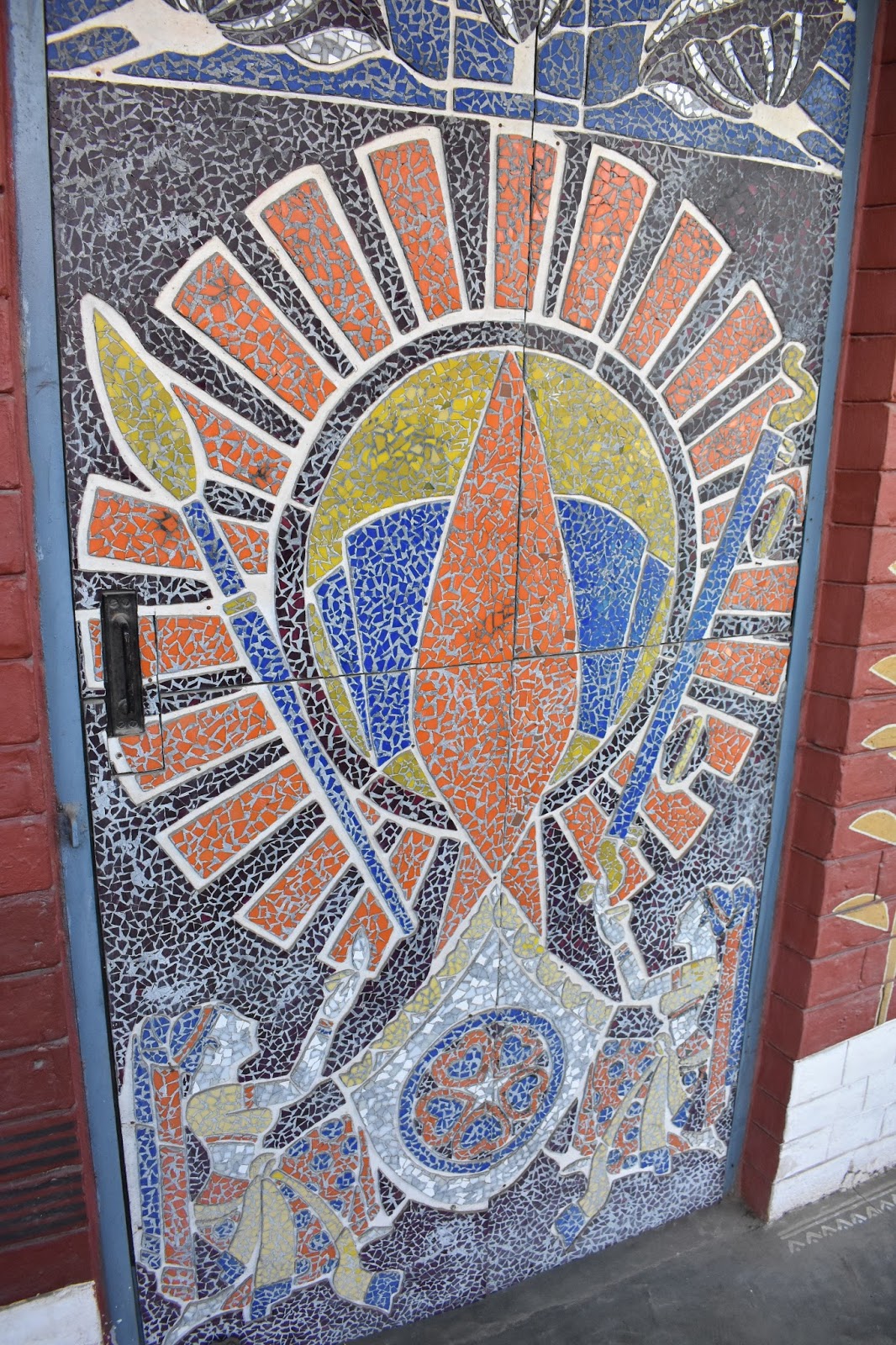
My absolute favorite part of my experience here was witnessing the persistence and integration of traditional Indian culture within the modern education.  Among the drawing department, there was a specific class for miniature painting, a form of classic Indian painting characterized by fine brushstrokes and often times ornate colors.  Even in the short time standing amid the students and the walls lined with these pictures, I was impressed by the talent and detail evident in each piece.  Another class focused on murals and mosaics, and I loved that the students utilized all of the doors and some of the hallways for their canvases.
Finally, we were fortunate enough to be able to hear a short music recital delivered by three students and some accompanying professors.  Even before we walked into the makeshift performance room, I had heard some girls practicing a modern choir arrangement of “Mary, Did You Know?” in another room.  However, after we were seated and settled, our group was privy to a small concert with traditional Indian instruments including the tabla and the sitar.  It was incredible to experience music with unfamiliar beats and harmonies, and I found it incredible that this art not only has persisted for ages but is still being taught and performed passionately today.
Though the day was long, the experience at DEI left me feeling full.  I came to India wanting to learn more about the culture, and the institute allowed me to observe components of traditional and modern culture at one site.  In particular, the arts facilities created a new appreciation for some styles of art that I had seen before but had never understood their history or techniques.  After leaving DEI, I realized that I can only hope all educational institutions strive to instill this love for both traditional and modern disciplines.
--
Students spent the January Intersession with our Experiential Learning in Indian Agriculture faculty-led program. For information about Bumpers College study abroad programs, go to Bumpers' international page. Bumpers College offers faculty-led programs to Belgium, India, Mozambique, New Zealand, Australia and Italy; courses and exchanges in France and Austria; internships in Greece and Scotland; and research in Brazil, Costa Rica, the Philippines and Greece.

26 January 2018

Ayurveda: The Unexpected Relationship Between Agriculture and Medicine #HogsAbroad in India

As a pre-medical biochemistry major, I knew that I was taking a step outside of my comfort zone by joining an agricultural studies study abroad program. As a result, I spent the entirety of my time in India not only learning about a new culture, but also genuinely learning about unfamiliar topics like irrigation systems, vertical farming, and solar panels. However, I was surprised to discover that the topic of medicine kept reoccurring throughout the program. The UA Faculty Led Program for Experiential Learning in Indian Agriculture, therefore, was the perfect example of how students from diverse disciplines can find, learn, and make connections to aspects of their academic degree and their professional future.

Originally, I went to India expecting to make connections to medicine by observing how the different types of food and the farm-to-table process impact overall health of a population. However, I quickly realized that a traditional form of Indian medicine, Ayurveda, was a much more obvious and prevalent application with implications in both medicine and agriculture. Ayurveda is a traditional form of medicine with emphasis on mind-body wellness and balance, and it is based on multiple Sanskrit writings that are more than 2,000 years old. There are traditionally eight branches (including internal medicine, pediatrics, toxicology, etc.) and two categories (including curative and preventative), but the most widespread application during my program in India concerned preventative treatments.

Mostly these treatments involved common herbs and spices and some other common crops for a spectrum of different medicinal purposes. At the National Research Centre for Seed Spices, I received the most comprehensive overview of the different effects. For example, fenugreek is believed to help with joint pain, to limit the complications of type II diabetes, and to increase the blood oxygen levels, and as a result, it is evidently used by many climbers and travelers to prevent altitude sickness. Ajwain (or carom seeds) are believed to purify the blood and are used by countless new mothers immediately postpartum. Even here, there were about ten different spices mentioned, each with different effects.


One of the most fascinating aspects of the discovery of this marriage between medicine and agriculture in India was that almost every academic visit involved this aspect of Ayurveda. The spokespersons at each farming community, each greenhouse, and each garden mentioned the value of the medicinal benefits of whatever was grown there. At the student farms at Dayalbagh Educational Institute (DEI) in Agra, separate spices were denoted by signs displaying their names and their medical purpose – a feature that at the time seemed slightly misplaced in the middle of large fields purposed for agricultural learning. Furthermore, at the small garden in the center of the campus, a student gave us a tour, and while passing around different leaves to feel and smell, I found it interesting that he was sure to mention of the medicinal benefits of each plant.


I think the reason that I found the concept of Ayurveda so surprising and exciting was that I am from a country in which the general population is quite divided about alternative medicine. I asked one of our academic hosts whether most Indians subscribed to belief in Ayurveda, and she replied that most everyone she knew believed in some aspect of it, particularly in the dietary preventative treatments. Also, she mentioned how it was common to all Indians despite a large variation in socioeconomic status since most herbs and spices central to these treatments were very cheap. It was encouraging to see something as simple as preventative steps for general health fundamental to a culture.

Much of traditional Ayurvedic medicine has been passed down by word of mouth, and as a result, each family may have their own variations on a treatment or remedy. However, because this form of medicine has its roots in tradition and is most prevalent in developing regions of the world, there are not many experimental studies to support all the claimed medicinal benefits. As alternative medicines are gaining popularity in Western culture, experimenters are performing more scientific studies, and it is going to be fascinating to see how many of these claims are proven or disproven.

Overall, this program perfectly demonstrates how a student from a non-related discipline can make connections to their major and draw applications for a future career. This agricultural studies program in India afforded me so much more than I expected toward my understanding of the connection between agriculture and medicine. As a future physician, I can only hope that my patients and my community begin to adopt the value that Indians placed on preventative medicine through Ayurveda.

--
Madison Shaw, Chemistry major

--
Students spent the January Intersession with our Experiential Learning in Indian Agriculture faculty-led program. Read more from the U of A Faculty-Led: Experiential Learning in Indian Agriculture program at https://ipo.uark.edu/india/

For more information about Bumpers College study abroad programs, go to Bumpers' international page. Bumpers College offers faculty-led programs to Belgium, India, Mozambique, New Zealand, Australia, and Italy; courses and exchanges in France and Austria; internships in Greece and Scotland; and research in Brazil, the Philippines and Greece.