Search This Blog

Showing posts with label Middle East Studies. Show all posts

29 October 2018

Feeling at Home #HogsAbroad in Morocco

Hi! My name is Avery Phillips, and I am a Fulbright Honors student, majoring in International Studies with a concentration on Middle Eastern Relations and Arabic. For the academic year 2018-19, I am studying abroad in Meknes, Morocco.

Since arriving, I have felt at home with the other students and a host family that has welcomed me with open arms. The first week upon arriving, we traveled across Morocco, which was both riveting and exhausting. Then we jumped into classes - the classes here are in a much more condensed format than those in the States, so the work load for courses is typically heavier. The classes are an average of 10 students, and the professors prefer an interactive classroom dynamic.

Travelling around Morocco is incredibly cheap!! Coffee starts at $1 and trains run for $2-3. Exploring different foods and cities within Morocco has been a delight. (Flights to Europe are really cheap also!!) The food in Morocco is heavily meat oriented, but being a vegetarian has been feasible. There is a lot of really delicious couscous, which is usually a celebratory meal every Friday, the holy day for Muslims.

If you’re considering traveling to Morocco, keep in mind that it is a patriarchal monarchy. The social dynamic is much different than in the States. Men dominate most social places and street harassment is common. That being said, I have yet to feel unsafe, rather just a frustration with the different dynamic.

Morocco is a beautifully diverse country with anything from beaches to mountains offered to visitors. The hospitable, welcoming nature of the culture is truly one to indulge in, and I have personally felt so much joy experiencing it!
--
Sophomore International Studies major Avery Phillips is spending the 2018-19 academic year in Morocco with International Studies Abroad (ISA). Learn more about Avery's ISA program in Meknes, Morocco.

Don't miss your opportunity to study or intern abroad! Start your search at http://studyabroad.uark.edu/search/

06 April 2017

Student Wins Scholarship to Study Arabic in Oman #HogsAbroad

Christopher Cowan, a senior honors student at the University of Arkansas, earned a nationally competitive scholarship to take part in the Summer Arabic Language and Media program in Manah, Oman.
Photo by Nani Verzon. Christopher Cowan earned a nationally competitive scholarship
to take part in the Summer Arabic Language and Media program in Manah, Oman.
Christopher Cowan, a senior honors student at the University of Arkansas, earned a nationally competitive scholarship to take part in the Summer Arabic Language and Media program in Manah, Oman. Cowan is one of just 24 applicants selected from a pool of hundreds.
 
Originally from Kansas City, Cowan is an International Studies and Middle East Studies double major, with a minor in Arabic, in the J. William Fulbright College of Arts and Sciences.

He first became interested in the Middle East in high school for its longstanding geopolitical relevance and rich historical and cultural traditions. This interest was reaffirmed once he enrolled at the University of Arkansas, taking courses in Arabic and other Middle East-related subjects. He plans to continue his study of the region as a graduate student in geography, beginning fall 2017.

"Chris is an enthusiastic student, and a promising scholar in Middle East Studies," says professor Tom Paradise, director of the King Fahd Center for Middle East Studies. "He has an amazing capacity for learning, and has been an energetic participant of the MEST program, helping to revive extracurricular programming for students like the Arabic Conversation Table and the Al-Bisat Middle East Discussion Group." Cowan is also the president of Gamma Theta Upsilon, the geography honors society, and is an active member of Students for Refugees, an RSO that focuses on refugee resettlement advocacy.

The Summer Arabic Language and Media program is a fully-funded intensive Arabic language scholarship program administrated by the Sultan Qaboos Cultural Center, an organization established in 2005 by the Sultanate of Oman dedicated to promoting mutual respect and understanding between the United States and Oman. Participants in the SALAM program will study at the Sultan Qaboos College for Teaching Arabic Language to Non-Native Speakers from July to August 2017, and will develop a deeper knowledge of Arabic, while becoming familiar with Omani history and culture.

About the King Fahd Center for Middle East Studies: The King Fahd Center for Middle East Studies is an academic and research unit in the J. William Fulbright College of Arts and Sciences at the University of Arkansas. An interdisciplinary and interdepartmental area studies center that offers diverse cultural, intellectual, and educational opportunities for the U of A community, the Center promotes research and teaching in interdisciplinary Middle East Studies. The center offers an undergraduate major in Middle East Studies through the Middle East Studies (MEST) Program and supports graduate studies in related departments with graduate assistantships. The center also awards competitive grants for summer language study, field research, and conference travel, and routinely sponsors lectures and other programming by visiting scholars from affiliated universities and programs. More information about the King Fahd Center can be found at mest.uark.edu. For ongoing news, follow the Center on Facebook and Twitter.
--
If you need help getting started with study abroad, take a look at the first steps: http://studyabroad.uark.edu/getting-started/first-steps.php.    

For more scholarships for study abroad, please check out http://studyabroad.uark.edu/funding. 

27 October 2016

I told you Morocco was good for my soul #HogsAbroad #TBT

We get settled in by playing guitar on the roof, and Hussain, the key holder, began telling us about a celebration going on in the village. 
(Omar takes better pictures than me on my own camera)

A Moroccan wedding. Yes, we’ve been fortunate enough to attend two of them in the past month. I can’t explain how much I’ve learned from them.

These occasions are rich with so much tradition and community. Everyone is invited. When I say everyone, I mean even strange American girls staying in a farm for the night.


Hussain welcomed us to his house with open arms and even Standard Arabic for us to practice. I met about 5 or 6 Moroccan girls that were between the ages of 12 and 15 who lived in this village. They were in school, so they spoke French, Arabic, and their native language Berber. It was incredible communicating with them because we had no other way than to slowly practice my fusHa Arabic. Within minutes, they warmed up to me with questions about America, my Habibi (boyfriend), and every little detail about my life.

I kept telling them thank you and how nice they were to me (I need to practice my vocabulary). They were confused because I was so welcome and being nice wasn’t something foreign to them. It was who they are. Their character. They circled around me with questions and sang my favorite Arabic song, Zina. I’m in awe with how much these sweet young girls taught me in such little time. I will try my best to post pictures and videos for you to witness how beautiful this weekend was.

I told you Morocco was good for my soul.


I want to thank three guys who have become some amazing friends of ours since we’ve arrived in Meknes: Omar, Tarek, and Zyad. They have showed us the hidden gems and everything in between. Not only have we had the most fun with them, but every day they teach me something new about myself.

These are friends I hope to have for life and one day show them around my hometown. I’ll introduce them to our customs, traditions, friends, and way of life. Shukran bzaaf boys!!

21 October 2016

Discovering the Daily Life of an Emirati #HogsAbroad in UAE #APIabroad

392981_10151645955745996_1947640395_n
The United Arab Emirates is a country only 40 years old that has seen rapid economic and social change due to the discovery of oil in its capital Emirate, Abu Dhabi. A once Bedouin society that survived economically on pearl diving has become an economic and tourist powerhouse of the Middle East. The people of the UAE are made up of 20% citizens and 80% expatriates, who came into the country for the enormous job market. 

The Emirati citizens isolate themselves from the rest of society both financially and culturally. Citizens do not pay for taxes or land, they receive the best jobs, and they get a lot of support from the government. Also, they tend to keep their culture to themselves by only socializing with other locals, having large walls around their houses, and marrying amongst each other. I chose to go to the UAE so I could learn about Arab culture and was surprised to discover this isolation. Therefore, I made a goal for myself to have the opportunity to see the inside of an Emirati home.

It wasn’t the second week before I accomplished this goal. My study abroad coordinator in the UAE introduced me to a local that had just gotten out of the English program at my university. He was unlike most Emiratis and immediately included me in his social sphere. I went over to his house, met his family, and became friends with all of his friends. 

It wasn’t a few weeks before I had been in countless Emirati homes and learned so much about their culture. They taught me a lot of new Arabic words, took me to the desert many times, introduced me to lots of new foods, and showed me the life of an Emirati.

My favorite experience from my time here in the UAE was the Youth Entrepreneur Competition in Dubai and Abu Dhabi. My local friend, another American, and I built a 3D printer and created a business at this competition where we printed custom solid 3D designs as well as 3D busts of our costumers. We had high hopes for our idea placing us in the competition but were facing the obstacle of being against 800 other teams of which 80% were Emirati teams. Nevertheless, after 48 hours of manning our booth, we were awarded second place! 

We attended the awards ceremony a few days later where Sheikh Majid, Crown Prince of Dubai, handed us our trophy as well as a large monetary award. It was a proud moment for the other American and I as we were the only non-Emiratis standing on the stage. Experiences like this in the UAE has provided me with many new skills that will help me out greatly in the future.
58110_364679356971702_84531816_n-e1367250226692

Alex Moix is a student at the University of Arkansas and a guest contributor to the API Blog. Alex is studying abroad with API in Sharjah, United Arab Emirates. 
--
Find our more about Alex' program with API in Sharjah, United Arab Emirates at https://www.apistudyabroad.com/programs/united-arab-emirates/sharjah/. 

Or find your own study abroad program to accomplish your personal and academic goals at: http://studyabroad.uark.edu/search 

12 October 2016

Scholarships Awarded for Middle East Studies #HogsAbroad


The King Fahd Center for Middle East Studies at the University of Arkansas is pleased to announce the recipients of its competitive Middle East Studies Academic Scholarship for academic year 2016-17.

Scholarships range between $5,000 and $10,000 per academic year, and are awarded only to undergraduate students majoring in Middle East Studies who have demonstrated serious commitment to study and excellence in their coursework and scholarship.

"We are very proud of our incredible students," says Tom Paradise, director of the King Fahd Center for Middle East Studies. "It is our privilege to support their endeavors in academia, and to facilitate the long-term effects of their education on the world beyond the University of Arkansas campus."

Awardees for the 2016-2017 academic year reflect a continual trend of excellence among Middle East Studies majors:
  • Sarah Cory is a senior Honors student majoring in Geography and Middle East Studies.
  • Christopher Cowan is a senior Honors student majoring in International Relations and Middle East Studies, with a minor in Arabic.
  • Shelli Daniel is a senior majoring in International Relations and Middle East Studies, with minors in Arabic and Political Science.
  • Natalie Ellis is a senior majoring in International Relations, Middle East Studies, and Political Science, with a minor in Arabic.
  • Antonia Greet is a junior majoring in Anthropology and Middle East Studies.
  • Joseph Largent is a senior Honors student majoring in Geography, International Relations and Middle East Studies, with minors in Arabic and Political Science.
  • Amy Lyon is a junior Honors student majoring in History, International Studies and Middle East Studies, with minors in Arabic, Medieval and Renaissance Studies, and Religious Studies.
  • Meagan Mosier is a junior Honors student majoring in Geography and Middle East Studies, with minors in Arabic and Foundations of Sustainability.
  • Jamie Nix is a senior majoring in International Relations and Middle East Studies, with minors in Arabic and Political Science.
Students are encouraged to apply for funding in the upcoming academic year if they will be undergraduate juniors with a minimum of 60 credit hours. Scholarship applicants must have a minimum GPA of 3.25 and a GPA of 3.5 in MEST-related courses. In granting scholarships, the King Fahd Center considers the applicant's academic record, letters of recommendation, and financial need. An informational session on funding available from the King Fahd Center will be offered at 2 p.m. Oct. 21, in Old Main room 319.

Please address any questions about the application process to Nani Verzon, Program Coordinator for the King Fahd Center for Middle East Studies at hverzon@uark.edu or 479-575-2175.  Applications may be picked up in hardcopy in the Middle East Studies Office, 202 Old Main, or may be requested electronically via email.  Completed applications must be received by the Middle East Studies office no later than February 1, 2017.

About the King Fahd Center for Middle East Studies: The King Fahd Center for Middle East Studies is an academic and research unit in the J. William Fulbright College of Arts and Sciences at the University of Arkansas. An interdisciplinary and interdepartmental area studies center that offers diverse cultural, intellectual, and educational opportunities for the University of Arkansas community, it promotes research and teaching in interdisciplinary Middle East studies. The Center offers an undergraduate major in Middle East Studies and supports graduate studies in related departments through the Middle East Studies Program, as well as summer language study and research assistantships for graduate students and teaching and research by visiting scholars from affiliated universities and programs.  More information about the King Fahd Center can be found at mest.uark.edu.  For ongoing news, follow the Center on Facebook and Twitter.
Contacts
Nani Verzon, HEI Program coordinator
Middle East Studies Program
479-575-2175, hverzon@uark.edu

07 October 2016

Jordan A Game Changer #HogsAbroad

Delaney Morgan
Al-Ahliyya Amman University, Jordan, summer 2013
Article courtesy of University of Nebraska-Lincoln

Hans Christensen


Delaney Morgan (left) riding a camel in the Wadi Rum desert.

"Studying abroad in Amman, Jordan was a life changing experience.  Every day was a new adventure that was completely different from my life at home. 

While I was there I studied US Foreign Policy in the Middle East, History of the Arab World, and was tutored for Arabic.  People often ask me what my favorite memory from abroad was, but that is so hard to answer because there are so many! 
However, riding camels in the Wadi Rum desert and camping out, an excursion to Petra, and getting the opportunity to visit with Syrian refugees are at the top of my ‘favorites list’. The environment was completely different from anything I had ever experienced, which is why I loved it so much.


Jordan is a third world country, and because of this I was able to learn so much and get more out of my study aboard experience by being immersed in a such a unique culture. Of course, because it was the Middle East, there were challenges and cultural norms I had to adapt to, though everyone from Jordan was exceptionally understanding and welcoming.  I studied through International Studies Abroad (ISA), and they were incredibly helpful and made the process less stressful and overwhelming.

My recommendation for people studying abroad is to go to a country that is completely different from any culture you have experienced before and to stay as long as you can.  Studying abroad gave me a new outlook and perception on life and other cultures around me. I hope everyone gets the opportunity to experience a unique education abroad experience, too."
--
Search for study abroad opportunities in Jordan, Morocco and over 40 other countries: http://studyabroad.uark.edu/search

14 April 2016

Travel Increases Cultural Awareness

Nine-year-old Amanda Simmons lies on the floor of a small home in the middle of India flipping through an American Girl magazine. While she can’t communicate with the girl sitting with her, she enjoys pointing at different pictures and laughing despite their language barrier. This is just one of the many positive experiences Simmons has had while going abroad.


Now 22 years old, the UA senior traveled to more than 19 countries, and she said that the world is still a safe place to travel in.

Her experiences in parts of the world such as the Middle East, South America and Europe have led her to understand how to prepare for travel and to stay safe in dangerous countries, she said.
“It is important to travel because otherwise you don’t look at your life as appreciatively,” said Simmons, a peer advisor for the Office of Study Abroad and International Exchange.

“Going abroad is one of the best gifts you can give yourself because of how much you learn,” she said.
Amanda with fellow student, Deshaun Artis, in Bolivia
When studying abroad or traveling to another country, it is important for students to research the country they are going to in order to learn more about the area, Simmons said. There are multiple outlets and resources for students to utilize during their trips to stay safe and learn about a country’s cultures, customs and laws.

“It always helps to look up where you are going, what specific cities are like, and try and find resources from the people that are from there and have been there before because you will get a feel for it and get to see before you go what you should do,” Simmons said.

Senior Cordarius Enright, a peer advisor for the Office of Study Abroad and International Exchange, studied with the faculty-led program, Global Community Development in Vietnam. Before leaving, he was prepared on different customs the group needed to know beforehand to avoid any situations, Enright said.

“We were prepped about the Vietnam War to not really talk about it because it is still a sensitive subject for people like the elderly in the country,” Enright said.

“Not many young people know about the Vietnamese War so we were kind of prepped to be aware to not say much about it, and not wear American clothing and not wave our flag around. That was a big thing because Americans love doing that,” Enright said.

The group was also taught to take off their shoes before entering someone’s home, being polite and how to conduct business in Vietnam, he said.

Even though research is important to learning about countries and their cultures there are other resources students can use to travel safely, and keep in touch with loved ones and those familiar with certain cultures, especially for women. Technology has changed the way people communicate, and give them the opportunity to tell their loved ones they are safe, Simmons said.

In some countries, there are different outlooks and rules for women than in the United States, and the Study Abroad Office give tips and some preparation for women traveling abroad, such as never traveling alone, said DeDe Long, Director of the Office of Study Abroad and International Exchange.
“If a student was traveling to the Middle East we would want them to read up on how women are perceived and expectations on attire for women in countries. We don’t want anybody being disrespectful showing up in shorts when the cultural norms suggests otherwise,” Long said.

While Simmons was traveling in Dubai, she used a Facebook group called Travelettes, an exclusive group for women travelers only. Simmons was able to use this group to communicate with women living in Dubai to find out how to safely get to her hotel from the airport at night. It felt more comfortable for Simmons to ask those women in the Facebook group rather than approach someone random at the airport in the middle of the night, she said.

Despite being in a different culture, Simmons utilized these resources for her trip to travel efficiently through the area, Simmons said.

“I do remember feeling very safe in Dubai; there were women-only taxis and women-only subway cars. No one harassed me and my mother for any reason,” Simmons said.
Amanda and her mother at a Dubai mosque

The Office of Study Abroad and International Exchange has resources and material on their Hogs Abroad portal page, and keeps their students updated on the information they need pertaining to the countries they are traveling to. The office has also begun creating pamphlets about certain programs from students’ feedback with tips from how to dress to what kind of currency to use, Long said.

Meetings are also a large part for students to prepare for anything that might come their way such as understanding the laws of that country, tips for female students and country-specific advice such as cultural norms, Long said.

Read the full article by Lauren Randall with the Arkansas Traveler

12 April 2016

Champion of International Education Retires from U of A

Professor Hoyt Purvis reads a 1970s Soviet newspaper
in which he was featured March 31.
Hoyt Purvis sits on his desk in an office that has accumulated every newspaper he has ever read and every piece of paper he has ever received. His office has been described as “one of the wonders of the world” by long-time friend Skip Rutherford, who suggested it be opened to the general public for tours.


“The same empty Diet Coke can that I encountered on my first visit stayed in the exact location for at least three years,” said Rutherford, Dean of the UA Clinton School of Public Service.

After more than 30 years teaching at the UofA, Purvis, 76, will retire at the end of this semester.

Purvis has become a fundamental part of the journalism department during his time at the UofA. He has brought his personal experiences, knowledge and passion to the university, former UA chancellor Dan Ferritor said.

“He lived out his passions each day through educating us,” said Brandi Moore, senior advertising and public relations student. “At the time, you might have thought it was silly that he took the time to check roll on each and every row of his lecture hall. But looking back, I see it more of a notion that he truly cared about who was there, who was willing to learn about something he enjoys, who was committed to being a journalism student. It was his way of rewarding those for their commitment to him.”

Although Purvis has followed a career in journalism, he is also recognized by his distinguished career serving as press secretary and special assistant to Sen. J. William Fulbright and by his position as council/senior adviser on foreign and defense policy to Senate Majority Leader Robert Byrd.
Purvis brought an enormous amount of recognition to the university, Ferritor said.

“When you look at the two senators he worked with, Sen. Fulbright and Sen. Byrd, Hoyt was in the midst of American politics and American relations and he brought it to the university. How very lucky were we?” Ferritor said.

Purvis was involved in several major events while serving as senior adviser for Sen. Byrd. In 1979, Vice Chairman and Vice Premier Deng Xiaoping visited Washington and met with Sen. Byrd in his office.

Xiaoping was a very short guy, Purvis said, and he was sitting in a big stuffed chair in Byrd’s office. When the meeting was over and it was time to get up, Xiaoping was having trouble getting out of the chair because his feet wouldn’t reach the floor.

“So I decided the right thing to do was reach over and give him a tug to get out of the chair,” Purvis said. “I’ve always told my students that was my contribution to U.S.-China relations,” Purvis said.
After attending the University of Texas and moving on to graduate school, Purvis wanted to follow his goal of working in Washington D.C. because of his interest in politics and international relations.
“I admired Sen. Fulbright because of his involvement with international relations, educational and cultural exchange,” Purvis said. “I really wanted to work for Sen. Fulbright.”

Purvis was in constant contact with Lee Williams, the administrative assistant for Sen. Fulbright and contacted him once he arrived in Washington D.C.

“The time came where I was going to have to either get a job with Fulbright or do something else,” Purvis said.

While visiting Washington D.C., Purvis had the opportunity to meet with Williams and sit in on a foreign relations committee hearing about the Vietnam War. After the hearing broke, Williams asked Purvis to go back to Fulbright’s office and have lunch. At the end of the lunch, Purvis was offered the job as press secretary. He was 27 years old.

“He told me later on that Sen. Fulbright wanted to make sure that I was the right man and they had already decided before the luncheon that they were going to offer me a job,” Purvis said.

While Purvis was press secretary for Sen. Fulbright, Washington D.C. was overseeing matters related to the Vietnam War and other issues such as the Watergate affair.

“Every day was a busy, busy day,” Purvis said.
Hoyt Purvis and Sen. J. William Fulbright speak in 1986 at the UofA.
After being Fulbright’s secretary for six years, Purvis decided to leave Washington D.C and go back to Austin, Texas, to be on the faculty at the Lyndon B. Johnson School of Public Affairs and work on some projects, Purvis said.

“One of the things that was most important about the whole experience – Fulbright was a great guy to work for,” Purvis said.

Before becoming senior adviser for Majority Leader Byrd, Purvis worked on the Carter campaign and contemplated going back to Washington D.C and becoming part of the administration.

Then, he got a call from Byrd.

“He wanted to play a major role in foreign and defense policy matters and I had been recommended to him as someone who might be the staff member responsible for foreign and defense policy,” Purvis said.

After meeting with Byrd he was offered the job as council/senior adviser and foreign and defense policy. While working for Byrd, Purvis became a key figure in “many of the major foreign policy issues at the time,” Purvis said.

“I worked on the Panama Canal treaties, U.S.-Soviet relations, U.S.-China relations, Middle East, lots of big issues and had the opportunity to travel with Sen. Byrd to meet many of the important world leaders of that time,” Purvis said.

Purvis reflected on some of the experiences he was a part of while working for Sen. Byrd such as trips to China, the Middle East, Egypt, Japan and meetings with world leaders like Leonid Brezhnev and Anwar Sadat.

“We spent the 4th of July of 1979 meeting with Soviet leader Leonid Brezhnev,” Purvis said. “We flew on a special Soviet plane down to that region and we traveled over to the area where Brezhnev was staying and we were riding in the big black limousines, they cleared all the traffic off the roads, right in the Black Sea.”

Purvis worked with Sen. Byrd full time for more than four years but kept working on side projects for years after he left Washington D.C.

“I went back to UT and I was teaching there again but also working on some projects in Washington,” Purvis said. “Writing reports and speeches for several years after that.”

Purvis’s long legacy and remarkable experiences began years before he arrived at the UofA in 1982. A graduate from the University of Texas, Purvis served as sports editor and editor of the Daily Texan.
“You’re 20 years old and you’re the editor of a daily newspaper and writing editorials and covering stories and meeting people,” Purvis said. “I got to meet Martin Luther King and a lot of other interesting and famous people. It turned out to be a very good thing.”

During his time at UT, Purvis participated in the Texas-Chilean student leaders exchange where he was able to study at the University of Chile in Santiago.

“That was my first extended time abroad and I learned a lot from that experience and that had a lot of impact on my life,” Purvis said. “In a sense, I found out there was a lot to see and know in the rest of the world and it was important to understand the rest of the world.”

After receiving his bachelor’s degree and leaving UT, Purvis studied as a graduate student in France on a Rotary Fellowship for a year. He then went on to Nashville, Tennessee, where he became a graduate student at Vanderbilt and worked on reporting about school desegregation in the south, Purvis said.

Other aspects of Purvis’s journalistic career included his work as a political reporter for the Houston Chronicle. In the last 20 years, Purvis has written regular political and public affairs opinion columns for Northwest Arkansas newspapers. He has also done political commentary for the local KNWA station for the last 15 years.

Before becoming part of the faculty at the UofA, Purvis encountered his first teaching experience in Kenya where he taught journalism and was able to travel through most of Africa.

“I was continually in the process of trying to understand what was happening in the world, why it was happening and what it might mean,” Purvis said.

Though he was dividing his time between Austin and Washington D.C., his loyalty was still in Arkansas, he said.

“I was really happy when I had a chance to come back to Arkansas and when I came back, I didn’t leave,” Purvis said.

Purvis came to Arkansas during the commemoration for Sen. Fulbright. After his visit, the dean of Fulbright College contacted Purvis.

“He asked me if I would possibly be interested in being in the faculty here and to devote some time to help establish Fulbright Institute,” Purvis said.

After his arrival, Purvis began his work as director of Fulbright Institute of International Relations from 1982 through 2000 and started the International Relations major at the UofA.

“I’m very proud of the success that it has had. I’ve put a lot of effort and energy in that because I thought it was extremely important,” Purvis said. “Especially in a college honoring Sen. Fulbright, it seemed to me very important to have a strong international relations academic program.”

He worked on strengthening international emphasis on campus and assisted DeDe Long, director of the Study Abroad Office, in helping the study abroad program become stronger.

During his time in the journalism department, he has taught thousands of students through Media and Society, a prerequisite for all journalism sequences. It is the first class journalism students attend where they are introduced to the various types of media and where they learn the importance of it in today’s society. Purvis has become one of the first journalism professors students encounter when starting work on their journalism degree.

“He is such an exceptional professor. When he speaks, you are compelled to listen to what he says because he has had so many interesting experiences in his life,” Moore said. “His wisdom on politics, media and foreign policies is admirable. He has influenced me to engage myself deeper into our new realm of media especially in connection with politics.”

Read the full article by Andrea Zepeda with the Arkansas Traveler

28 March 2016

Building Relationships in Oman

U of A professors Dr. Adnan Haydar and Dr. Paula Haydar, along with the director of study abroad, DeDe Long, visited Noor Majan Training Institute in Ibri, Oman last week to explore Arabic language options abroad for our students. Stay tuned for more on this exciting opportunity!


In the meantime, what benefit is there to study other languages?

Improve your skills and grades in math and English and improve entrance exam scores -- SATs, ACTs, GREs, MCATs, and LSATs
  • Studying a second language can improve your skills and scores in math and English, which can lead to improved exam scores. Research shows that math and verbal SAT scores rise with each additional year of foreign language study.
Greater opportunities in government, business, law, medicine and health care, teaching, technology, the military, communications, industry, social service, and marketing
  • Every career path is entirely transferable to another culture and country, and it is certainly possible that any of these careers would have contact with each other. Studying a foreign language can provide you with better opportunities because of your ability to effectively communicate with the foreign cultures.
Improve your communication skills
  • By learning a foreign language you become better at expressing yourself. Additionally, your interpersonal skills will improve because of interaction with people of different cultures.
Improve your English by learning another language
  •  As you study another language's grammar, you will improve your own understanding of English grammar. Your speaking skills will also increase as you learn and practice the language's pronunciation and thus speak more clearly.
Become better at multitasking
  • Those who study multiple languages are skilled to switching between two systems of speech, writing, and structure. This, as research shows, makes those people better at multitasking.
Reduce your risk of Alzheimer's and dementia
  • Adults who speak multiple languages are show signs of dementia on average 4 years later than those who only speak one language. Other research shows that  
Meet new people and cultures
  •  Broaden your horizons by meeting people from around the world just by having a shared language. People are more likely to open up to you while abroad when you speak their native language instead of yours.
Have a better understanding of world news events and how they impact not only you, but also the people involved and impacted 
  •  Become a more global citizen by learning a new language and understanding the culture and people associated with it. By understanding them, their culture, and their history, you can understand how news pertaining to them really affects them and their region.
--
Learn more about studying a foreign language through the World Languages, Literature and Culture dept at: http://fulbright.uark.edu/departments/world-languages/
 
Use our search to look for programs in more than 50 countries, at: http://studyabroad.uark.edu/search/

08 March 2016

Confronting Stereotypes in Dubai #HogsAbroad

My classmates and I with our hosts in Oman

Article courtesy of Kristen Coppola, originally published on the Honors College blog in January 2015
 
Junior Zach Schwermann has majors in International Relations and Middle Eastern Studies and has tacked on two minors as well – Arabic and International Business. So it makes sense that he would be drawn to the Intensive Arabic Language Seminar in the United Arab Emirates. Along with a better knowledge of speaking Arabic, Zach learned a lot about the culture of the Middle East, including how U.S. food chains adapt to meet Islamic dietary restrictions and how Muslims celebrate their holy days. 
 
Hot, sandy and dangerous; these are all stereotypical adjectives that people use to describe the Middle East. While some of these are indeed true (I experienced 112 degrees Fahrenheit once or twice!) some of them aren’t (Dubai has a lower crime rate than most modern, Western, industrialized countries). My experiences while studying abroad in the United Arab Emirates allowed me to confront these stereotypes first hand, and by doing so I was able to greatly expand my understanding of the Middle Eastern way of life and the people that live it. My name is Zach Schwermann, and I received the Honors College Study Abroad Grant, which helped to fund my study of the Arabic language at the American University of Sharjah, in Sharjah, UAE. Prior to my trip, I had studied Arabic at the University of Arkansas since my freshman year, but this seven-week trip allowed me to grow my understanding of both the language and the people who speak it more than the prior two years at Arkansas had, combined.

Myself and my fraternity's flag (Kappa Alpha Order) in front of the main administrative building at the American Univeristy of Sharjah-web
Myself and my fraternity’s flag (Kappa Alpha Order) in front of the main administrative building at the American Univeristy of Sharjah

Landing in Dubai’s international airport was a surreal experience that had me feeling nervous, yet also anxious, because I was stepping into a world that I thought was astronomically different than the one I had just left behind. It turns out I was wrong, because while there were many differences about the culture of the UAE, there were many similarities too. This is because, just like back at home McDonalds was on every other corner, IHOP was always there for late-night breakfast cravings, and all of the teenagers loved to flaunt their cars and were obsessed with selfies. However, the strictness of Islamic law during the holy month of Ramadan (not being able to publicly eat or drink during the day) and the vast amount of wealth being publicly shown, made this homelike world feel like Mars. That, though, is what I loved about the UAE, because while it felt like home, it really wasn’t, and it allowed me to see that the incorporation of American culture into a foreign country was possible, if the society was allowed to make it their own. For example, Pizza Hut: Pizza Hut was very popular in the UAE, but while pepperoni, bacon, and ham are essential ingredients in the US, they were replaced with chicken, in about every form possible, because the consumption of pork is not allowed in Islam and the UAE is a predominantly Islamic society.

In addition to the reduction in the usage of pork, Islamic culture was very prevalent during the holy month of Ramadan where Muslims fast from sunrise to sunset. The month of Ramadan is one of the most important times during the Islamic calendar, so the rules of fasting were taken very seriously in a country that was usually very relaxed to the often non-Islamic, Western ways. While it was still possible to find places to eat and drink during the day, they were often fenced off and hidden from public view, which was a very weird feeling in a mall food court that is usually very open and bustling with people. Another cultural aspect that was different from America was the large variety of people from all around the world. Throughout my trip I counted, hearing 12 different languages ranging from Urdu (a Pakistani language) to Russian. Urdu was surprisingly the third most-used language in the UAE (following English and Arabic) and was the foreign language I encountered the most while abroad. This is because most of the blue collar work force, of taxi drivers and restaurant workers, come from Pakistan and often knew only Urdu and broken English. However, this did not hinder my ability to grow in my Arabic language skills, because I still found many opportunities to speak the language outside of class.

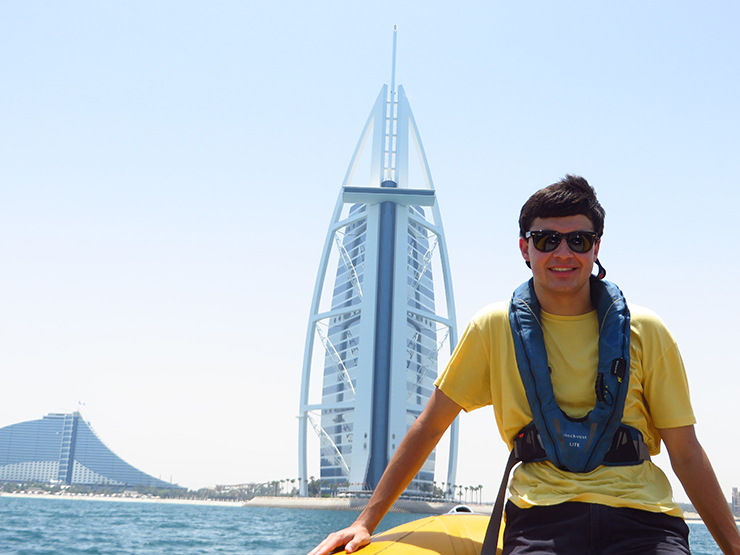
In front of the world's most expensive hotel, the Burj Al Arab-web
In front of the world’s most expensive hotel, the Burj Al Arab
My favorite experience speaking Arabic happened on a beach in Oman, during a trip that some of my classmates and I decided to take on our last weekend abroad. While in Oman we got the unique experience of getting a personal tour of the country by some natives who were friends with one of my classmates. They introduced us to some of their friends who happened to be Bedouins, who lived in the Omani desert. They met us for dinner out on that beach and I was able to talk with them, in Arabic, about their views of America and what they liked to do for fun. This ended up being one of the coolest experiences of the entire trip and the best usage of my Arabic skills while abroad. These experiences are only a small sampling of my entire seven-week adventure, but I believe that they represent the overall experience well because they show both the similarities and differences of the UAE and how I was able to use what I was learning in the classroom to enhance my study abroad experience.

While the experiences I had there were limited to a finite time period, the lessons I learned gave me an infinite amount of possibilities of how I can further expand my understanding of the Middle East and hopefully be able to go back, either during college or afterwards for a job opportunity.
--
For the full article and more information about scholarships for international travel through the Honors College, please visit the HonorsCollege blog. 
 
Learn more about studying abroad through the Middle East Studies department at: http://cavern.uark.edu/rd_arsc/mest/4777.php


17 February 2016

Afghanistan's fate #HogsAbroad #GSIE

Fulbright program sows hope

By French Hill Special to the Democrat-Gazette
This article was published January 8, 2016 


This year, we will celebrate the 70th anniversary of the Fulbright program. Established in 1946 by then-Arkansas U.S. Sen. J. William Fulbright, this exceptionally American contribution to the world has educated over 360,000 students from 165 countries, including 52 Nobel Laureates and 31 heads of state.

Little known is the contribution of this program to the relationship between America and Afghanistan. Starting in 1952 and all the way through 1979, 250 Afghans studied in the U.S., and 105 Americans studied in Afghanistan.

Following the Russian invasion of Afghanistan and the subsequent takeover of the country by the Taliban, the Fulbright program became absent in Afghanistan until recently. Since 2003, there has been a rebirth of the program, with over 450 Afghans pursuing professional and graduate study in the United States.

Recently, I had the good fortune of having tea in Kabul with one of those students, Naheed Esar, a native of Jalalabad, Afghanistan.

At four months old, she and her family were forced to flee to Pakistan, where they lived in a refugee camp. In 1999, she moved back to her native country and studied in an underground school in Herat Province. In meeting with her, I quickly realized I was in the presence of a remarkable individual, one whose story should remind all of us that there can be a future with a free Afghanistan.

During our time together, I learned that she comes from a long line of extraordinary women. Her inspiration for her own success was her grandmother, a freedom fighter and founder of three schools. The indomitable spirit of her and her family has resulted in Naheed's successful graduation from the University of Arkansas as a Fulbright Scholar with a master's degree in cultural anthropology.
Today, she is in her home country pursuing a career as an independent researcher and writer. She has completed a longitudinal research project on the lives of widows in Kabul and, as a result, has founded a "Widows Association" to help the many women who have struggled with loss from decades of strife in Afghanistan.

In November, we were reminded of the extent to which women have been oppressed in Afghanistan when the long trial of a young woman accused of adultery ended in her gruesome murder by stoning in Ghor Province at the hands of Taliban zealots.

While this paints a picture of the challenges that still exist in Afghanistan, we also have seen major improvement in the last 14 years. In 2001, no girls attended school, and only one million young boys did. Since that time, according to the World Bank, Afghanistan has seen 560 new schools built with over eight million enrolled--more than one-third of which are girls. Likewise, life expectancy in 2001 was 44, and today it is 64.

Naheed is a leader of this mini-renaissance, and it is the education she has received that has made her an integral part in the fight for a hopeful and economically independent Afghanistan. However, with a literacy rate of only 38.2 percent, there is no chance for a great democracy until Naheed's experience becomes the rule and not just the exception--just as we know in our own country.

And, while education is important for their entire population, it is particularly critical for the women of Afghanistan. For not only does education advance their lives and opportunities, but it enriches the entire culture, building better communities and families.

Many have questioned America's continued involvement in Afghanistan, and this is understandable given that when we invest so much in something we want to see immediate returns on that investment. But even the most cynical among us should be able to look at stories like Naheed's and be proud of the work America is doing to provide young men and women in Afghanistan the power to control their own destiny.

Recently, the president made the decision to continue America's military investment in Afghanistan. While I agree with his decision, we need to acknowledge that this is not a mission American men and women in uniform can win all on their own. Access to education will ultimately be what makes or breaks the future of liberty and democracy in this war-torn country.

There is no better time to sing this message than on the 70th anniversary of a program that has resulted in amazing advances for people all across the globe, including many in Afghanistan.

The road is long, but the future is in the hands of Naheed and the other brave young people who will not concede their futures to terror.

I take inspiration from a beautiful poem published in a 2015 collection of works by the Afghan's Women Writing Project titled "Washing the Dust from Our Hearts." Masuama's poem, "Yesterday, Today, Tomorrow," contains these verses for the future: "Yesterday my sister was stoned, today she is studying to be a doctor, and tomorrow she will save a life."
------------v------------
U.S. Rep. French Hill represents Arkansas' 2nd District.
Print Headline: Afghanistan's fate

27 November 2015

#HogsAbroad Photo Contest Winner: Selfie


Mikenna Marin took home 1st place honors -and some Razorback gear from the U of A Bookstore-
with her photo, When in Morocco, Dress as the Moroccans do


On an excursion to Morocco, we spent 2 days in Fez and took a tour of the medina (the city center and market place).
While there, we visited a textile shop, specializing in scarves, and traditional dress. We got to see one of the weavers in action, making a scarf and learn how the threads are made. We also got to pick a scarf of our choice and learn the proper way to tie and wear it. In this picture, I am wearing my scarf while the weaver sits at his loom in the background.


19 November 2015

Critical Language Scholarship Deadline Looming! #HogsAbroad


Andrew Walchuk, past CLS recipient, in Tangiers, Morocco
Only 4 days left until the deadline for the Critical Language Scholarship (CLS) competition! Applications are due Monday, November 23, 2015 by 7:59 p.m. Eastern time.

The U.S. Department of State is pleased to announce the scholarship competition for the 2016 CLS Program in fourteen critical foreign languages. The CLS Program provides fully-funded group-based intensive language instruction and structured cultural enrichment experiences for seven to ten weeks for U.S. citizen undergraduate and graduate students.

Languages offered: Arabic, Azerbaijani, Bangla, Chinese, Hindi, Indonesian, Japanese, Korean, Persian, Punjabi, Russian, Swahili, Turkish, and Urdu.

The application is available online at http://www.clscholarship.org. Applications will be due November 23, 2015 by 7:59 p.m. Eastern time. Prior to preparing their application, interested students should review the full eligibility and application information on the CLS Program website. Arabic, Chinese, Persian, Russian, and Japanese institutes have language prerequisites, which can also be found on the website.

Students from all academic disciplines, including business, engineering, law, medicine, science, social sciences, arts and humanities are encouraged to apply. While there is no service requirement attached to CLS Program awards, participants are expected to continue their language study beyond the scholarship period, and later apply their critical language skills in their professional careers.

Prior to preparing their application, interested students should review the full eligibility and application information on the CLS Program website: http://www.clscholarship.org/information-for/applicants.

The application is available online at:  http://www.clscholarship.org
Applications will be due November 23, 2015 by 7:59 pm EST.
--
For more funding opportunities for study abroad, check out http://studyabroad.uark.edu/funding