Search This Blog

Showing posts with label Tanzania. Show all posts

02 July 2019

Jambo! The tales from my African Safari #HogsAbroad in Tanzania

Hey there! My name is Emma Wiest and I am a junior Fulbright Honors Student who is studying Biology and German with the intent to pursue a career in human medicine. This summer I had the opportunity to travel to Tanzania with 12 other students to study ecology, evolution, and the peoples of East Africa for two and a half weeks! I’m the one in the back, by the way.

Prior to the start of the program there was a week of class aimed at educating us about the biology and anthropology of what we were about to see, including the East African Rift System, the various animals of Africa, the native tribes of the area, and tracking human evolution back to Africa. Throughout the program we had the opportunity to visit 12 different locations across the country and go on safaris, participate in traditional activities from the Datoga and Hadzabe tribes, examine dig sites, and explore the island of Zanzibar. While we were not able to spend long periods of time in any one of the locations we visited, the early mornings and abundance of traveling allowed us to experience each aspect of Tanzania.

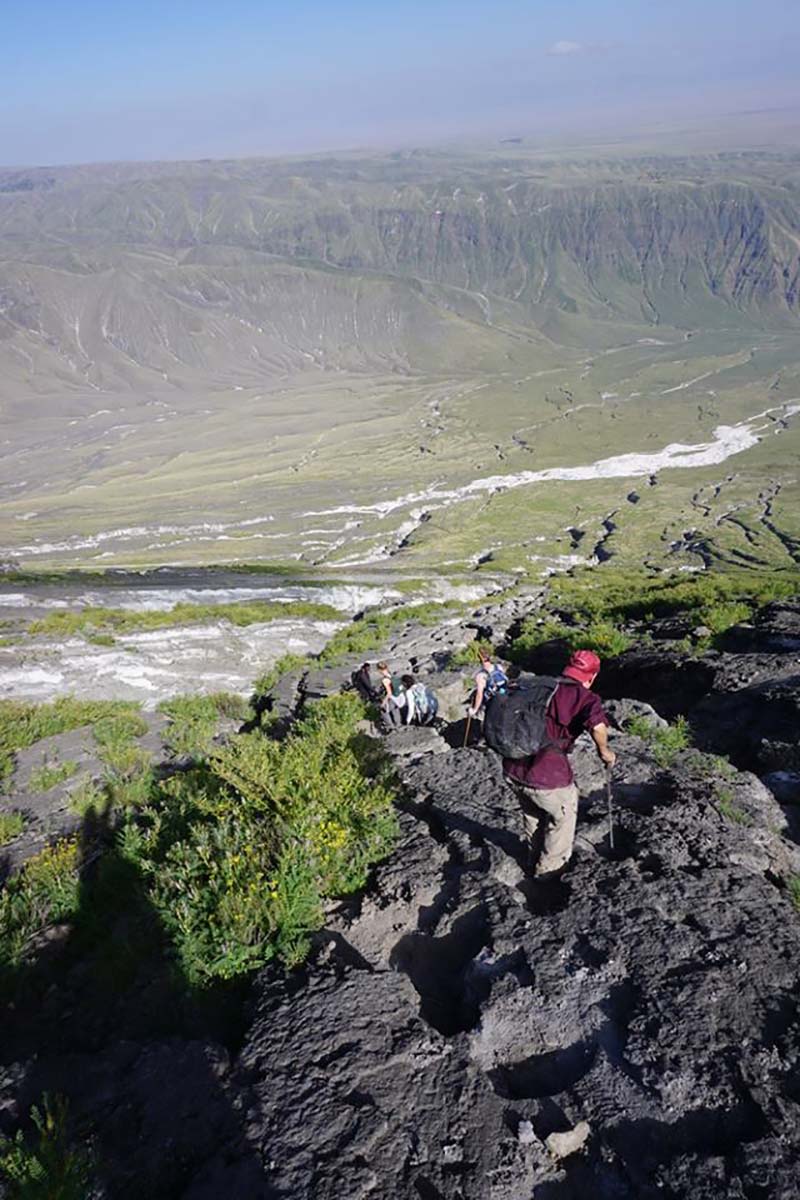
Our cohort hit the ground running when we landed at Kilimanjaro, as we were all anxious to see the spoils of Africa. Our first day consisted of driving and hiking to Lake Natron, which is a shallow soda lake in Arusha that serves as a breeding ground for lesser flamingos. We were fortunate enough to be shown around by some Masai men who knew the area like the back of their hands.
While we saw some recognizable wildlife in the following days of safaris (giraffes, zebras, etc.), things really started to heat up once we arrived in the Ngorongoro crater. We were immediately welcomed by herds of gazelles and wildebeest, and even spotted Pumbaa and Simba as soon as we descended into the crater! The best part of this stop, however, was when my safari truck pulled over to stop and look at a rhino that even stood up and posed for us to take photos. And while I thought the crater was impressive, it was nothing in comparison to the Serengeti! From the moment we drove into Serengeti National Park, I was mesmerized. Upon our arrival, we were fortunate enough to see three cheetahs lounging under a young acacia tree, but the two cubs weren’t feeling too photogenic.

This was only the beginning. Throughout our time in the park our class was able to see hyenas, lions, the wildebeest migrations, leopards, and even a giant herd of elephants.

If seeing all of these incredible animals and how they coexist with each other wasn’t enough, we had the opportunity to visit the Datoga and Hadzabe tribes in the area and ask questions about their culture. The Datoga were split into a pastoral group and a blacksmithing group, meaning that one earned their livelihood from running cattle all day and the other from creating beautiful arrowheads and bracelets. The Hadzabe tribe is a group of hunter-gatherers and use many different types of arrowheads depending on the type of game being hunted. Members of our class were able to take part in various activities at each of the tribe visits and ask questions regarding daily life and culture.

Another highlight from the trip was our visit to Gombe National Park where Jane Goodall did her research with the chimpanzees. Normally, tracking wild chimpanzees would be exciting enough, however, while crouching down to take the perfect photo of a chimpanzee sitting ten feet in front of me, I was surprised by a gentle touch on the back of my arm. One of the chimps had walked up right behind me practically begging for me to take our photo, and when one of Jane’s chimps wants a selfie
with you, you take a selfie!
We were also able to see red monkeys and baboons on the beach, which wasn’t a bad way to wrap up our time on the mainland. After our trip to Gombe, all that was left was a quick trip to the island of Zanzibar, which was a great way to relax and reminisce on the past two weeks spent on the mainland. The amount of biology and anthropology that we were able to witness while in Africa was incredible, and we were able to see stuff that you won’t be able to experience anywhere else in the entire world.

I highly recommend studying abroad (in Africa especially) to anyone considering it. Not only will you gain vast amounts of knowledge, but you will experience things that you never thought you would be able to and create friendships that will last you a lifetime, as cliché as it all sounds. I now have an infinite supply of anecdotes to apply to the rest of my undergraduate education, and experiences that I’m sure have shaped who I am as an individual for the rest of my life.

--
Emma spent the summer 2019 term in Tanzania with our faculty-led program, Tanzania - Ecology, Evolution, and Peoples of East Africa with the help of our Office of Study Abroad Scholarship.

Don't miss your opportunity to study or intern abroad! Start your search at http://studyabroad.uark.edu/search/

17 May 2019

Living My Dream #HogsAbroad in Tanzania


My study abroad experience started as most peoples' do. CHAOTIC. The night before, I realized that not everything would fit in my traveling backpack so the day of my flight I had to pack in the REI store while buying a new backpack. After that problem was solved I then had to catch a 29-hour flight to Tanzania. Once landing, I realized that my brand-new travel backpack was nowhere to be found… the airline had lost it. So yes, I was in a foreign country, with no clothes, no tent, no sleeping bag, and basically none of the essential things that I was going to need. I WAS DEFEATED. However, the story does not stop there. After, the first couple of minutes of pure panic, fear, and even a little regret, I was greeted by 24 new friends and staff that over time would become my family… I KNEW THAT I WOULD BE OK. 

The other 4 months of my study abroad trip were a lot less chaotic. I was basically living my dream. I was able to study wildlife as close as possible. I got to see the big 5 of Africa (even the white rhino which is very rare), and through experiential learning, I got to grow academically as well as personally. There was nothing like camping in the middle of a national park, being able to look up and see the incredible night sky and hear all the animal sounds. It was truly an unforgettable experience. 

Although the start of my study abroad semester did not go as planned, it helped me come to terms with the fact that not everything is going to be perfect while abroad, and even if you plan something to a T, it still has the possibility of getting messed up. The biggest lesson I learned while abroad is to expect the unexpected and just roll with the punches because usually the things that do not go as planned make for the best stories! I think that no matter what program you choose for studying abroad it will have its challenges. However, it’s those challenges that allow you to grow and become a better version of yourself. There is truly nothing like studying abroad, so I am here to tell you if you are even remotely thinking about it JUST DO IT. There is no doubt in my mind that it will be the best experience that you will get in college. So if you are looking for a sign that you should study abroad, here it is…STUDY ABROAD!!!
--
Junior Biology major Kayla Lane spent the spring 2019 term in Tanzania studying wildlife conservation and political ecology with SIT with the help of our Office of Study Abroad Scholarship.

Don't miss your opportunity to study or intern abroad! Start your search at http://studyabroad.uark.edu/search/

07 October 2017

Upcoming Study Abroad Info Sessions

Mark your calendars for these upcoming info sessions for some of our faculty-led programs. Come meet the faculty leaders and hear more about these study abroad opportunities!

Monday, October 9


For more information, and to apply, visit the Medieval England program brochure.

Thursday, October 12


For more information, and to apply, visit the Tanzania program brochure.

Monday, October 16


For more information, and to apply, visit the Panama program brochure.

--

22 August 2017

#HogsAbroad at the University of Arkansas #TravelTuesday

Learning isn't limited to classrooms at the University of Arkansas. Opportunities abound for students wishing to expand their horizons and study abroad. More than 1,000 students will travel around the globe on study programs this year, alone. It is a rare opportunity, as less than 3 percent of American students study abroad, but these experiences open a world of opportunities.

Brooke Collins, a senior biology major, gives us a glimpse into her experience this summer in a note from Tanzania:
Today we arrived at Gombe. Gombe is such a special part of the study tour because very few universities get to send students. When we arrived I found my room, threw my bags down, and plopped back on the bed. I looked up through the window and noticed an entire tree shaking. The baboons seemed to have come to say "karibu" which is "welcome" in Swahili. Within three hours of being here we have observed a family of chimpanzees and seen the house Jane Goodall stays in when she visits. All of the images from science books seem to leap out of the page here at Gombe as well as all the other places we have visited so far. I've never had an experience like this and to think we are already halfway through the trip is unbelievable.

Options abound, with programs that last from two weeks up to a full year abroad. The U of A has one of the largest endowments of any public university in the nation providing scholarships for study abroad. The Honors College offers grants to offset the cost of study abroad as well.

The U of A sent students to more than 50 countries last year, and every college — including STEM programs — has study abroad opportunities. Students heading to the Rome, Italy program take core classes while abroad.

The U of A's Rome Center allows students of all levels and in all majors to take classes and live in the heart of Rome, Italy. Established in 1989, the U of A Rome Center in the Palazzo Taverna has been a haven for architecture study with recently expanded curriculum to feature a variety of core credits and upper-level electives.

The U of A works hard to bring the world into the classroom and the classroom into the world. Studies show the study abroad experience improves grades, retention and graduation rates.

But it's not just us. According to AIM Overseas, 61 percent of employers agree that an overseas study experience builds a resume.

Our top destinations are Italy, Spain, England and Belize. We reach every continent but Antarctica. Come join the Hogs Abroad.

Follow U of A study abroad students on Twitter at #HogsAbroad

18 May 2016

One Last Night #HogsAbroad

Tomorrow morning at 3:30 am, my phone alarm will go off, beginning a marathon of flights that will eventually lead me to Brussels, Belgium.  At the moment, I’m a swirly mix of different emotions.  I’m ready to leave, and I’m excited to be there.  However, I’m also cranky from the previous nights of studying caused by dreaded final exams, and I’m both nervous and anxious to experience a totally new culture and society.

My original reason for attending this study abroad experience was so that I could help spread sustainable practices all over the world.  As a computer engineering major, my degree field doesn’t necessarily align with sustainability, nature, or man’s impact on Earth.  Despite that, I am on a mission to unite my degree and my love for nature and the outdoors so that perhaps I can make a difference with respect to how our societies affect the planet and the other creatures that call this pale, blue dot home.

I think that the lectures and excursions on sustainable energy practices might be most useful for me, as I hope that my degree might relate with those topics the most.  Even though some of the lectures we will hear might not be suited for any sort of obvious computer engineering application, I am sure I will constantly be pondering how my degree could be useful for or relate to each topic.  I fully expect every sustainability topic that we will cover in Ghent to captivate me, and this is not just because I love nature.  The United States is (embarrassingly) years behind its European counterparts in the European Union as far as sustainable practices and a sustainable society are concerned.

For that, I am NOT proud to be an American, but don’t misunderstand me.  I’m fortunate and happy to call the United States my birthplace and home.  For many reasons, in fact, I am very proud to be an American, but this nation’s carelessness about over consumption (in all areas of our society) is NOT one of those reasons.  It appalls me that an entire major political party of the United States can deny the existence of climate change outright and without giving a second thought to the sustainable progress being hindered by their ignorance.

On a different note (and attempting to hold off the crankiness brought forth by the previous paragraph), I am thrilled to be in a country so culturally different from the United States while still remaining in a Western nation. Last summer, I attending a study abroad program to Tanzania in  Africa, and while I had a truly life altering experience there, I didn’t connect with the people as much as I would have liked.  I made a couple of friends as we traveled across the Tanzania, but communication wasn’t the easiest.  Also, the cultural difference between myself and the friends I met there was exponential compared to the differences between U.S. culture and Belgian culture.  I hope that the people I meet while abroad the next few weeks can not only become far away friends of mine, but I hope that I can communicate well with them and relate with them so that I can better understand their culture and the life that they live.

I want to immerse myself in Belgian culture not only with the intent to understand it, but to gain travel experience in Europe so that I can feel comfortable visiting Belgium and other European countries in the future.  During my lifetime, I want to experience as many different cultures and see as many different vistas as I am physically able.  Starting tomorrow, I begin continent number three and country number four on a list that’s (hopefully) not even close to being done.
--
Read more from Mark at https://wanderinghogblog.wordpress.com/blog/
To find out more about the U of A Faculty-Led: European Agriculture-Food Chain Sustainability program at http://studyabroad.uark.edu/SUSTEurozone/

11 May 2016

Oh, The Places I've Been... #HogsAbroad

Emma Ridings
Study Abroad Alumnus and Class of 2016
As I finish up my last finals of undergrad and look forward to graduation in just a few short days, it seems like it’s been a lifetime since I applied for college. There are many things I think about when I look back over these last four years, but I can say without a doubt that it is my experiences abroad that I cherish the most. I know it seems like a cliché to say that study abroad changed my life, but I’m saying it anyways so just hear me out.

Because I decided to go to the University of Arkansas, which is right down the road from my hometown, I made a deal with my mother: since I wasn’t branching out with my university choice, I had to branch out while I was in college by studying abroad (she’s a pretty great mom, I know). I obviously did not have a hard time accepting this deal. In fact, I went on to take full advantage of it by studying abroad three different times, and each trip abroad made a positive impact on almost every aspect of my life.

My freshman year, I saw a flyer advertising an Anthropology study abroad trip to Tanzania (Anthropology is one of my majors). I immediately called my mom to tell her I had found my first program, and the following summer I was on my way to Tanzania.

This marked my first experience in Africa and my first experience traveling without my family. Less than three weeks later, I came back to the United States feeling like a completely different person: my worldview had broadened, my interest in Anthropology had grown, and I had met my very best friend in college who went on to be my roommate for the next three years. This is also when I fully developed the restlessness that I experience on a daily basis because I am constantly thinking about the next place I want to go. 

Sophomore year, I decided I wanted to go on a longer summer trip. I knew I wanted to go to Europe this time around, but I didn’t really want to go to Western Europe since I figured I would be able to travel there later in my life. I eventually decided on an external program in Prague, Czech Republic where I would be taking a course on the Holocaust. This program was wonderful because it allowed me to travel to multiple European countries and experience a lot of new places in a relatively short period of time. It also opened my eyes to a part of the world that I had never been to, and I got to explore these new places with incredible friends that I still keep in touch with today. 

After that summer I decided I was finally ready to study abroad for a full semester, and I wanted to go back to Africa. I stumbled upon an external program in Rwanda that focused on post-Genocide restoration and peacebuilding and needless to say, I was immediately enthralled. However, I was also extremely nervous. Yes, I am restless and suffer from chronic wanderlust, but four months away from my friends and family was something that pushed me way out of my comfort zone. As you can probably guess, by the time my semester came to an end, I was not at all ready to come back home.


It has been a year since I returned from this trip and not a day goes by when I don’t think about Rwanda and the experiences I had there. Aside from making lifelong friends (and I really do mean it when I say lifelong), it was in Rwanda that I found the career path I wanted to go down. Before my semester abroad, I did not have any clear ideas about postgraduate studies or what I wanted to do with my life in general. But once I spent four months learning about post-conflict restoration, I realized that I had never been more passionate about anything else I had studied up to that point. 

This fall, I will be starting the next chapter of my life in Washington, DC where I will be a graduate student at Georgetown University, working toward my Masters’ in Conflict Resolution. If you had asked me four years ago where I would be after graduation, I wouldn’t know what to tell you (I know this is true because I was actually asked that many times). 

Without study abroad, I would not have found my best friend, I would not have had the opportunity to experience different parts of the world, and I would not have found what it is that I am truly passionate about. So hopefully you believe me now when I say that study abroad changed my life, and hopefully you can find a way for it to change yours, too. 
--
Find out how to join the U of A Tanzania-Ecology, Evolution, and Peoples of East Africa program at http://studyabroad.uark.edu/tanzania
For more about the Rwanda: Post-Genocide Restoration and Peacebuilding program with SIT, check out http://studyabroad.sit.edu/sn/programs/semester/fall-2016/rwr/
-
If you need help getting started with study abroad, take a look at the first steps: http://studyabroad.uark.edu/getting-started/first-steps.php.   

23 February 2016

Top 3 Myths about Africa #HogsAbroad

There are many misconceptions when it comes to Africa, and unfortunately most of these negative stereotypes dissuade people from traveling there and seeing all of the wonderful things this vast continent has to offer. Although I have personally only visited three of its fifty-four countries, I can firmly deny the most common misconceptions that come to mind when one thinks of Africa. 

Myth # 1 Africa is one large country.
This is one of the most common misconceptions and it's far from the truth. Africa is the world’s second largest continent after Asia and is comprised of fifty-four incredibly unique countries. There is not one homogeneous culture that spans across these countries, as many seem to think when they conjure up images of Africans wearing face paint and animal-printed clothing. Each country has its own rich cultures, languages, food, etc. and it is more common than not for there to be several different ethnic groups and languages within a country’s borders. Landscapes are also extremely diverse, and depending on where you go you can witness beautiful settings ranging from desert to rainforest to grasslands. Africa has it all!

Myth #2 All Africans live in poverty.
A lot of people think all Africans are destitute and live in tiny huts. As in every place across the globe, there are people living at different economic levels, and it is likely you will come in contact with people on both sides of the spectrum, depending on where you go. Africa is also home to many cities and urban areas as well. In my experience living in Kigali, the capital of Rwanda, I was blown away by the beauty and cleanliness of the city, in addition to the abundance of resources for tourists. It is common to believe that you will be completely cut off from the rest of the world once you get to Africa, but that is simply not true! I was able to keep in touch with my family and friends throughout the whole semester by using an internet modem, Wi-Fi, and the cell phone that I bought upon arrival.

Myth #3 Africa is too foreign to visit.
Many people are deterred from visiting African countries because it seems as though the people and places within the continent are too “foreign” for perhaps what you are comfortable with. No matter where go in the world, you are sure to encounter cultural differences. However, one of the beautiful things about traveling to new places is not only embracing these differences, but also having the opportunity to discover similarities that you may not have expected to find. Every cultural exchange is first a human exchange, and you are bound to meet people who have personal traits and preferences that align with your own. During each of my experiences abroad I was able to connect with people on many different levels and even forge friendships that I know will last a lifetime.

These are just a few of the common misconceptions people have about a continent that is much too large and diverse to generalize. The best thing to do is to go and see for yourself how magnificent these places are, you will definitely not regret it!
My study abroad group celebrating our friend Feston’s birthday with his friends and family in Kigali, Rwanda
My roommate and I taking over the drums at the goat races in Dar es Salaam, Tanzania

Taking a boat excursion down the Nile River. We got to see elephants, hippos, crocodiles, and waterfalls!

Our picnic spot in the Ngorongoro Crater in Tanzania

Standing in front of our house (not a mud hut) in Kigali, Rwanda
Emma is a senior at the University of Arkansas, double majoring in Cultural Anthropology and International Relations and double minoring in French and African/African American Studies. She started her travel by spending a summer taking anthropology classes with U of A faculty in Tanzania, followed by another summer learning more about the Holocaust in Prague and capped it off with a spring semester in Rwanda, focusing on peace-building.
--
Use our search to look for programs in Tanzania, Rwanda and over 40 other countries: http://studyabroad.uark.edu/search/
 

08 February 2016

Studying Abroad with Emma Ridings #HogsAbroad


Emma is a senior at the University of Arkansas, double majoring in Cultural Anthropology and International Relations and double minoring in French and African/African American Studies. She started her travel by spending a summer taking anthropology classes with U of A faculty in Tanzania, followed by another summer learning more about the Holocaust in Prague and capped it off with a spring semester in Rwanda, focusing on peace-building. We asked her a few questions about her study abroad and here's what she had to say:

Why did you decide to study abroad?
I decided to study abroad because I knew that it would give me the opportunity to go to unique places and have once-in-a-lifetime experiences and lessons. I chose Rwanda because the program captivated me and fit with my interests and field of study. 

What did you really learn by going abroad? How was it impacted the rest of your college experience/your personal life/your job search?
Studying abroad definitely fostered growth on a personal level. I learned how to be more independent, open-minded, and resourceful. Traveling to places that I had previously known nothing about put a lot of things in perspective for me and sparked my desire to continue meeting new people and hearing their stories. Study abroad gives you very practical life skills that can be translated into skills for any and every job, along with unique experiences to bolster your resumé. Personally, studying abroad in Rwanda helped me to decide the career path I want to go down.

What was the biggest hurdle in getting abroad and how did you overcome it?
The biggest hurdle for me was pushing myself out of my comfort zone. Although the idea of traveling far away is always appealing, I get nervous to leave the people and place that I am so comfortable with. I have found that the best way to overcome this is to not overthink it. Just know that no matter where you're going or who you're going with, you will have the opportunity to stretch yourself and experience wonderful things! 

What is one piece of advice would you give to other students thinking about studying abroad?
I would say: Just go for it! You will not regret this once-in-a-lifetime opportunity, and you will get even more out of it then you expect. The chance to travel around the world and experience new people and cultures is not something to pass up!

What did you learn about yourself/your culture by going abroad?
I personally learned to put everything in perspective and not take myself too seriously. Studying abroad taught me how to be flexible and resourceful when things do not go as planned, and to keep a positive attitude no matter what!

Where did you live while abroad?
In Rwanda I spent the first 10 weeks living with a local homestay family assigned by my program. The last 5 weeks I lived with 3 other girls in my program in a house that we had found with the help of a local real estate agent (the program directors aided us as well). Both experiences were amazing! Being a homestay student was a wonderful opportunity to immerse myself in the culture and learn from my homestay parents and siblings about Rwanda. On the other hand, living with my friends was a lot of fun and gave us the opportunity to become independent and experience the city and country on our own.


Was studying abroad expensive? How did you pay for your experience?
Though studying abroad seems expensive, there are plenty of opportunities to get scholarships, both from your school and your community. In my case, I was able to use my academic scholarships as well as one received from the program.
--
Use our search to look for more programs in Tanzania, Rwanda and the Czech Republic, as well as over 40 other countries: http://studyabroad.uark.edu/search/

If you need help getting started with study abroad, take a look at the first steps: http://studyabroad.uark.edu/getting-started/first-steps.php.   

29 January 2016

Instagram Spotlight Tanzania #HogsAbroad

Education is an ocean (that is, it has no end).
--English translation of a Swahili saying

Zanzibar, Serengeti, Olduvai, Gombe – these are just some of the world-famous treasures of Tanzania, and U of A students get to see them all.  This program is open to all students in all majors interested in the natural, political, and social history of East Africa, specifically the nation of Tanzania. Here are a few shots from a recent participant...

A photo posted by Cassie Schirm (@cassieschirm) on

A photo posted by Cassie Schirm (@cassieschirm) on

A photo posted by Cassie Schirm (@cassieschirm) on

A photo posted by Cassie Schirm (@cassieschirm) on

A photo posted by Cassie Schirm (@cassieschirm) on

A photo posted by Cassie Schirm (@cassieschirm) on

--
See more photos at https://www.instagram.com/explore/tags/hogsabroad/

Find out how to join the U of A Tanzania-Ecology, Evolution, and Peoples of East Africa program at http://studyabroad.uark.edu/tanzania