Search This Blog

Showing posts with label India. Show all posts

22 March 2018

Experiential Learning in Indian Agriculture #TBT #HogsAbroad in India

To an outside observer, it may have looked questionable visiting three educational and / or research institutions lest the experiences start overlapping and become monotonous.  However, these academic visits were among my favorite parts of my study abroad experience in India as each location offered different facilities, different research subjects, and most interestingly, different approaches to common problems.  At the Dayalbagh Educational Institute in Agra, I had the chance to witness multiple academic fields and to visit with multiple faculty about current work in manners that demonstrated the values that the institution was striving to instill in its students.
Dayalbagh Educational Institute (DEI) was the last of our three visits and by far the most diverse.  Besides the first few days with jet lag, this day’s itinerary exhausted me the most as our group trekked back and forth between various parts of the campus.  In the morning, we began with a visit to the dairy farming facilities, and I learned about the distribution of the herd of cattle between milk producers and grazers, witnessed the more traditional practices for improving weight gain and milk production (including playing soothing music over the grounds and approaching each of the cows by name), and taste-tested some of the products.  Later, we also had the chance to present our findings on some of the main differences between the United States and India to the current graduate and PhD students working in the botany department who then presented about their current research.  Much later in the afternoon, we encountered departments with projects including an online wiring testing source, Alzheimer’s treatments, and constructions of 3D printers.
As a biochemistry major, it was admittedly shocking that the arts department left the one of the biggest impressions on me out of the entire campus.  The Faculty of Arts was situated towards the back side of campus, and two stories of dry, red brick surrounded a courtyard full of many lounging and conversing students as we entered.  The dean of the campus dedicated much of the afternoon to eagerly leading us through each of the specialties in this department which involved walking around the inner side of the building and climbing up and down the stairs.
In each department, I loved how each of the faculty described not only what sorts of assignments the arts students commonly handled but also how these assignments either tackled problems in society or incorporated pieces of traditional Indian culture.  For instance, in the fashion design department, the teacher explained that some of the students ventured into creating stuffed animals and small toys in addition to clothing in order to expand their artistic skills, recycle products like stuffing and textiles, and presumably create cheaper toys for youth.
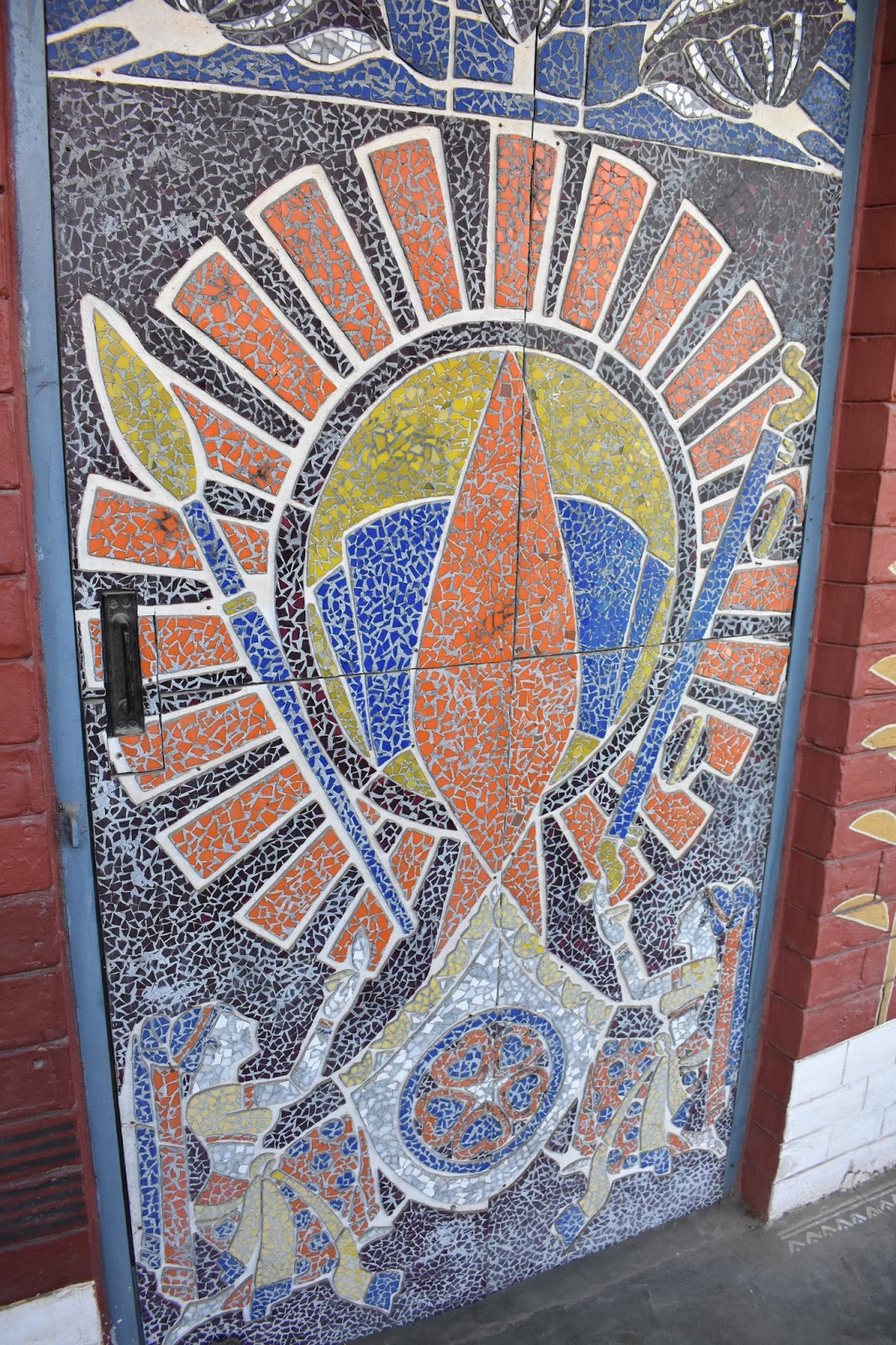
My absolute favorite part of my experience here was witnessing the persistence and integration of traditional Indian culture within the modern education.  Among the drawing department, there was a specific class for miniature painting, a form of classic Indian painting characterized by fine brushstrokes and often times ornate colors.  Even in the short time standing amid the students and the walls lined with these pictures, I was impressed by the talent and detail evident in each piece.  Another class focused on murals and mosaics, and I loved that the students utilized all of the doors and some of the hallways for their canvases.
Finally, we were fortunate enough to be able to hear a short music recital delivered by three students and some accompanying professors.  Even before we walked into the makeshift performance room, I had heard some girls practicing a modern choir arrangement of “Mary, Did You Know?” in another room.  However, after we were seated and settled, our group was privy to a small concert with traditional Indian instruments including the tabla and the sitar.  It was incredible to experience music with unfamiliar beats and harmonies, and I found it incredible that this art not only has persisted for ages but is still being taught and performed passionately today.
Though the day was long, the experience at DEI left me feeling full.  I came to India wanting to learn more about the culture, and the institute allowed me to observe components of traditional and modern culture at one site.  In particular, the arts facilities created a new appreciation for some styles of art that I had seen before but had never understood their history or techniques.  After leaving DEI, I realized that I can only hope all educational institutions strive to instill this love for both traditional and modern disciplines.
--
Students spent the January Intersession with our Experiential Learning in Indian Agriculture faculty-led program. For information about Bumpers College study abroad programs, go to Bumpers' international page. Bumpers College offers faculty-led programs to Belgium, India, Mozambique, New Zealand, Australia and Italy; courses and exchanges in France and Austria; internships in Greece and Scotland; and research in Brazil, Costa Rica, the Philippines and Greece.

26 January 2018

Ayurveda: The Unexpected Relationship Between Agriculture and Medicine #HogsAbroad in India

As a pre-medical biochemistry major, I knew that I was taking a step outside of my comfort zone by joining an agricultural studies study abroad program. As a result, I spent the entirety of my time in India not only learning about a new culture, but also genuinely learning about unfamiliar topics like irrigation systems, vertical farming, and solar panels. However, I was surprised to discover that the topic of medicine kept reoccurring throughout the program. The UA Faculty Led Program for Experiential Learning in Indian Agriculture, therefore, was the perfect example of how students from diverse disciplines can find, learn, and make connections to aspects of their academic degree and their professional future.

Originally, I went to India expecting to make connections to medicine by observing how the different types of food and the farm-to-table process impact overall health of a population. However, I quickly realized that a traditional form of Indian medicine, Ayurveda, was a much more obvious and prevalent application with implications in both medicine and agriculture. Ayurveda is a traditional form of medicine with emphasis on mind-body wellness and balance, and it is based on multiple Sanskrit writings that are more than 2,000 years old. There are traditionally eight branches (including internal medicine, pediatrics, toxicology, etc.) and two categories (including curative and preventative), but the most widespread application during my program in India concerned preventative treatments.

Mostly these treatments involved common herbs and spices and some other common crops for a spectrum of different medicinal purposes. At the National Research Centre for Seed Spices, I received the most comprehensive overview of the different effects. For example, fenugreek is believed to help with joint pain, to limit the complications of type II diabetes, and to increase the blood oxygen levels, and as a result, it is evidently used by many climbers and travelers to prevent altitude sickness. Ajwain (or carom seeds) are believed to purify the blood and are used by countless new mothers immediately postpartum. Even here, there were about ten different spices mentioned, each with different effects.


One of the most fascinating aspects of the discovery of this marriage between medicine and agriculture in India was that almost every academic visit involved this aspect of Ayurveda. The spokespersons at each farming community, each greenhouse, and each garden mentioned the value of the medicinal benefits of whatever was grown there. At the student farms at Dayalbagh Educational Institute (DEI) in Agra, separate spices were denoted by signs displaying their names and their medical purpose – a feature that at the time seemed slightly misplaced in the middle of large fields purposed for agricultural learning. Furthermore, at the small garden in the center of the campus, a student gave us a tour, and while passing around different leaves to feel and smell, I found it interesting that he was sure to mention of the medicinal benefits of each plant.


I think the reason that I found the concept of Ayurveda so surprising and exciting was that I am from a country in which the general population is quite divided about alternative medicine. I asked one of our academic hosts whether most Indians subscribed to belief in Ayurveda, and she replied that most everyone she knew believed in some aspect of it, particularly in the dietary preventative treatments. Also, she mentioned how it was common to all Indians despite a large variation in socioeconomic status since most herbs and spices central to these treatments were very cheap. It was encouraging to see something as simple as preventative steps for general health fundamental to a culture.

Much of traditional Ayurvedic medicine has been passed down by word of mouth, and as a result, each family may have their own variations on a treatment or remedy. However, because this form of medicine has its roots in tradition and is most prevalent in developing regions of the world, there are not many experimental studies to support all the claimed medicinal benefits. As alternative medicines are gaining popularity in Western culture, experimenters are performing more scientific studies, and it is going to be fascinating to see how many of these claims are proven or disproven.

Overall, this program perfectly demonstrates how a student from a non-related discipline can make connections to their major and draw applications for a future career. This agricultural studies program in India afforded me so much more than I expected toward my understanding of the connection between agriculture and medicine. As a future physician, I can only hope that my patients and my community begin to adopt the value that Indians placed on preventative medicine through Ayurveda.

--
Madison Shaw, Chemistry major

--
Students spent the January Intersession with our Experiential Learning in Indian Agriculture faculty-led program. Read more from the U of A Faculty-Led: Experiential Learning in Indian Agriculture program at https://ipo.uark.edu/india/

For more information about Bumpers College study abroad programs, go to Bumpers' international page. Bumpers College offers faculty-led programs to Belgium, India, Mozambique, New Zealand, Australia, and Italy; courses and exchanges in France and Austria; internships in Greece and Scotland; and research in Brazil, the Philippines and Greece.

25 January 2018

Sheroes Hangout #HogsAbroad in India


Sheroes Hangout is a café run by acid attack survivors and spearheaded by the Stop Acid Attacks campaign. The café serves food and drinks all day, hosts various events and parties, and has a wall of fully stocked bookshelves for visitors to read. Everyone ordered warm drinks and we got a couple of orders of masala fries for the table. While we waited we passed around some of the articles on the table and learned more about the café we’d walked into and the organization behind it. For more information visit their website at https://www.sheroeshangout.com/agra

Once our drinks came our waitress told us a little more about herself and the café and put on an informational video for us. We learned about the lack of laws set up to protect survivors and prosecute perpetrators of acid attacks and the lack of regulation surrounding sale of acid. Our waitress told us a main reason behind acid attacks is when a woman rejects a man. We heard interviews from various survivors in the video and learned the reasons given for their attacks: in one case a woman’s in-laws urged her husband to throw acid at her because she hadn’t had any sons. Another woman was at work when she was attacked by a customer.

Through watching the video we learned more about the Stop Acid Attacks campaign and how they work to bring more attention and regulation to this issue and empower women who are survivors. They help survivors rebuild their lives after their attacks and try to help them financially through the long process of healing and the multiple surgeries that usually entails. They also work with these women to help them build skills and secure employment. In many cases survivors isolate themselves and many are ostracized from their families because of the reaction in the wider community. This is where Sheroes Hangout comes in. The café employs many women as waitresses and cooks and also serves as a space for women to promote the trades they work on. One girl in the video told about how she was able to pursue her passion of fashion design and opened up a small boutique in the sheroes hangout to sell the dresses she designs. The language used by the women in the café emphasized the point that they were not victims, they were survivors, and they were stepping up to make good of a bad situation.

Sheroes Hangout was very unique among our experience in India for several reasons. One thing that stood out about Sheroes was the fact that this is the only restaurant we ever saw female waitstaff. Throughout India we always had waiters and never waitresses. I think this is because young men who were from more rural backgrounds or had less schooling were able to go for these kinds of jobs when it might not be considered respectable for a young woman. We met many female students at the undergraduate level and graduate level universities we visited, and high-skill jobs for both genders exist in the fields they were pursuing, but at lower skill levels there is a big gender disparity in the work force. The Stop Acid Attacks campaign works with Sheroes Hangout to provide these occupational opportunities to survivors while creating a safe work environment for them. Throughout this study abroad program we were shown the very best of what India had to offer in its beautiful monuments and scenery and the technological advances we were told about at the various farms, universities, and institutes. Our perspective was made richer by learning from the women at Sheroes about this widespread issue.

*feature image borrowed from culturetrip.com*

--
Jaden Talley, Biological Engineering major
--
Students spent the January Intersession with our Experiential Learning in Indian Agriculture faculty-led program. Read more from the U of A Faculty-Led: Experiential Learning in Indian Agriculture program at https://ipo.uark.edu/india/

For more information about Bumpers College study abroad programs, go to Bumpers' international page. Bumpers College offers faculty-led programs to Belgium, India, Mozambique, New Zealand, Australia, and Italy; courses and exchanges in France and Austria; internships in Greece and Scotland; and research in Brazil, the Philippines and Greece.

Nadi Village - India Agri #HogsAbroad in India

The day started early in New Delhi as we prepared for our bus ride to Ajmer. The whole trip took roughly five hours. When we arrived in Ajmer, we met our hosts next to a gate off the side of the road and they led us through the tiny, curvy dirt roads of Nadi Village.

From the bus we could see vast fields of yellow, white, and orange and could smell the flowers sweet aroma, a welcomed contrast from the tightly packed city of New Delhi.


After about 10 minutes of amazing maneuvering by our bus driver through the village, we came to a stop in the road slightly past an intersection. Through the large windows we could see men, women, and children gathering around the bus and excitedly waiting for us to step off. After shuffling to gather our things and some chocolates we had bagged to hand out to the children, we began to file off of the bus.

As soon as the first person stepped onto the sandy Nadi Village soil, a parade began. Two young men beat on drums hanging by their sides from around their necks as the villagers showered us with the delicate, beautiful, intensely colored petals of marigolds and chrysanthemums from their fields. There wasn’t a single person in our presence that didn’t radiate joy, happiness, and celebration.

Occasionally you could feel the thump of an entire flower and look back to find the person who threw it at you; it was more than likely the adolescent attempting to stifle a mischievous grin, surrounded by their friends who were giggling uncontrollably.

After we had walked for a few minutes, we were signaled to come to a stop where we then formed a haphazard semicircle around one of our hosts, Dr. Ravindra Singh, a principal scientist at the National Research Centre on Seed Spices (NRCSS). The drumming and throwing of flower petals continued, however, and Dr. Singh explained to us that this was a typical welcome for guests and that it was being done in our honor. The villagers began to freely dance in the circle to the beat, or not, of the drums, and the elders swept rupees (money) over the heads of each person in the semi circle before stuffing it into the shirt pockets of the boys beating on the drums.

After observing this joyous and fascinating experience for several minutes, a petite woman displaying a wide, beautiful smile and dressed in a bright yellow saree motioned me with some English to make my way to seats that had been set out just for the guests, and were placed so that we would be face to face with the villagers. Stationed a few yards away were large solar panels used to supply energy throughout the agricultural processes in the village.

A mat of green turf had been rolled out for everyone else to sit on. When the villagers went to sit they arranged themselves by gender. The males occupied the front of the turf while the females occupied the space behind them.

Some of the women had their faces covered with the stunning, colorful fabrics we had started to become familiar with. This, we later learned, signified that these women were in the presence of their mother in law and is a quickly fading custom in more urban areas of India, but in rural and remote areas such as Nadi Village, the custom is still practiced.


Once everyone was adjusted, young women were asked to place beautiful handmade leis comprised of flowers harvested from their own fields around all of our necks, one by one.

Following this small ceremonial gesture, Dr. Singh began to explain to us that NRCSS has been working with the people of Nadi Village on implementing multiple sustainable farming practices with the hope that the farmers are able to increase their outputs while decreasing the inputs necessary such as irrigation water, fertilizers and pesticides.

The farmers rely largely on composting from recycled materials to deliver much of the nutrients needed to the plants and soil. Of the supplemental fertilizers and pesticides the farmers do have to use, all of them are organic, Dr. Singh tells us. This decreases the damage done to the ecosystems around the area and is better for the soil, as well as for the farmers and laborers working with the products as they are frequently at risk of being poisoned by the more harmful synthetic products.

To reduce the amount of wasted irrigation water in the fields, drip irrigation lines were used throughout them. The drip irrigation lines looked like hoses with small holes equidistant from each other and were onto the soil next to the plant roots. This increases the efficiency of water that reaches the plants root systems by decreasing the amount of evaporation seen in the relatively common sprinkler irrigation systems.


Other practices used by the farmers include rotating their fields every year to few years, and something similar to agroforestry where they sow smaller plant varieties under the canopies of orchards. This increases the use efficiency and productivity of the land in many different ways, and also works to provide more crops that the farmers can sell or use themselves.

After Dr. Singh gave us this brief but informative overview, we passed out chocolate candies to the children and others, and we were taken on a tour around a few of the fields. As we were guided through the fields, people were taking pictures of us, asking for selfies, and even sneaking videos and pictures of all of the students.

When we all had our share of pictures and information from the fields we started back towards the bus, as the sun was about to set. Along the way we were able to star in a few more photographs and were handed gooseberries from the trees to enjoy on our short walk.

From looking at the fields and from the proud looks on the villager’s faces, it was obvious these practices have been working well for them. I think there is a lot to be said for their success, and I think this is a fantastic example for farmers in the United States to look to and learn from when contemplating their own agricultural practices.

Our group is extremely grateful to our hosts and the people of Nadi Village who were the essence of open and inviting. The short time we had in the village was a wonderful learning experience and the interactions and connections we made were priceless.

--
Holly Wren, Environmental Soil & Water Science major

--
Students spent the January Intersession with our Experiential Learning in Indian Agriculture faculty-led program. Read more from the U of A Faculty-Led: Experiential Learning in Indian Agriculture program at https://ipo.uark.edu/india/

For more information about Bumpers College study abroad programs, go to Bumpers' international page. Bumpers College offers faculty-led programs to Belgium, India, Mozambique, New Zealand, Australia, and Italy; courses and exchanges in France and Austria; internships in Greece and Scotland; and research in Brazil, the Philippines and Greece.

29 July 2017

Tyson, Trains & Taking My Time #HogsAbroad in India

We visit Tyson today. I’m excited for this visit, but I’m also a little sad because this is the last time that the whole group will be together. The rump-trippers are on a separate bus from everyone else because we will be leaving the Tyson visit early. We had lucked out and gotten the bus without air conditioning – I’d like to file this under the “only in India” category. I didn’t realize how much A/C was a blessing on the buses until we had to go without. It was actually cooler outside of the bus than it was on the bus.

At the Tyson visit, I learned that the Godrej group is one of the oldest groups in India and that in 2008 a partnership between Godrej and Tyson was formed. I was particularly interested to see how Tyson managed for find success as a meat protein company in a country that is largely vegetarian.

Tyson in India is under two brands: RealGood and Yummiez. India turned out to not be as vegetarian as I thought it was with 56.6 grams per day a protein consumption. The top two snacking segments are biscuits and savory snacks. Most snacking is vegetarian. The only portfolio for vegetarian goods by Tyson as an India. Tyson India has vegetarian and non-vegetarian products. They also sell street food products that are safer and cheaper than what can actually be found on the streets.

I wish that I had been able to spend more time at Tyson and learn more about their process, but I was very eager to get the rump trip started. It was more difficult than I thought it would be to tell the others in our group goodbye. We had all grown so close in the weeks that we had been together in India – I didn’t even realize how attached I had become to everyone.

We had to pack for the train ride. I had managed to cram all of my necessary items into a duffel bag and my backpack and I was ready to go for the rump trip. This time the train ride would be an overnight train ride. We stayed in the upper class area of the train with A/C and bunked beds. The area of the train we were staying in was very simple – it just had the two bunked beds and a small table. It wasn’t very nice, but I didn’t expect anything like the last hotel that we’d stayed at. It was okay and it served its purpose and by Indian standards it was not bad at all.

I was very excited to get to sleep on the train. I had loved the train ride that we had taken earlier in the trip. However, this time our window was permanently fogged so I wasn’t able to look out window. Regardless of the minor challenges, this was definitely a memorable experience. I’m so glad that I chose to do the rump trip. I feel like if I had been leaving to go home today that would have been way too soon for me. I wanted to spend more time in India, I wanted to explore. I didn’t want to let go just yet, and thankfully, I didn’t have to.
--
Don't miss your opportunity to study or intern abroad!
Learn more about studying abroad as a Walton college student at: http://walton.uark.edu/global/

28 July 2017

Profiles in Courage #HogsAbroad in India

I woke up feeling a little better today. I had a good breakfast and I was ready to tackle the day. Last night at the debrief we quickly heard about the attack at the Taj Hotel back in 2008. Today, we learned about the terrorist attack at the Taj Hotel in more detail and we watched a documentary about the attack.

The behavior of the hotel workers during the attack was astonishing. I was completely shocked to hear that not a single one of the hotel workers fled during the attack. All of the stayed back to help the guests. We learned about how the Taj Hotel selects its employees based off of their behavior and interactions at school instead of their grades. They want employees with a certain kind of character and attitude. I don’t know if the employees’ behavior during the attack can be completely contributed to India’s cultural belief that a guest is considered God and of the upmost importance.

I think it has a lot to do with the character of the individuals that they hire at the Taj Hotel. I believe this because we learned that there is a hotel nearby called the Trident Hotel that was also attack like the Taj was. One huge difference is that not all of the workers at the Trident stayed to help their guests, many of them fled and thus they had more casualties than the Taj Hotel had. So if it solely came down to Indian values, then why didn’t all of the workers at the Trident stay?

After we learned about the attack, we went on a tour of the Taj Hotel. The Taj Hotel was beautiful and exceed all of my expectations. I am glad that we stayed here and this made the perfect final place to stay on the study abroad trip.

When the tour was over, I went to the market with Caitlyn and Kate to flex my bargaining powers. This was the first time I was really able to bargain on my own, all the other times I had been in a group or someone else had jumped on it first. I wasn’t extremely great at bargaining because of my soft, gentle personality but I did manage to get a Real Madrid jersey for 500 rupees – I had talked the man down from 750 so I consider this a success. It will be strange going back to the US and not being able to bargain prices down for almost anything that you want.

Tonight was bittersweet as it is that last night that everyone will be together. Tomorrow after the Tyson visit, those of us going on the rump trip will be heading to catch a plane to Delhi and then a train to Jodhpur.
--
Don't miss your opportunity to study or intern abroad!
Learn more about studying abroad as a Walton college student at: http://walton.uark.edu/global/

27 July 2017

Mumbling Through Mumbai #HogsAbroad in India

Boy was I wrong about my assumption before I went to bed. I woke up around 5 am to go to the bathroom and I was shocked to see that my lips had swollen three times their normal size. I had no idea what was going on. Unfortunately, I had to sit out today’s activities because I was in too much pain from my swollen fingers and spreading rash.

I’m extremely sad that I wasn’t able to tour the Dharavi slums. I wasn’t able to participate in anything this day. I was really looking forward to this part of the trip. However, I realize that I had to put my health first and I didn’t want to do something to make things worse. Instead of visiting the slums, I got to hang out with Vikas – which was super fun. I also took a nice nap. I didn’t realize how much I needed to sleep and let my body rest. I didn’t realize just how much we had been doing this whole trip because I was living in every moment. When I woke up from my nap, I was pleased to see that I didn’t feel as itchy as I did before.

On a brighter note, the breakfast here was amazing. They had plenty of items to choose from. I’ve been enjoying trying some of India’s unique fruits. I’ve been having the mangoes at almost every place that we stay at and there are so many different species of mangoes here that I don’t think I’ve had the same kind of mango twice. I also tried dragonfruit. The only experience I’ve ever had with dragonfruit comes from a VitaminWater flavor that involved dragonfruit. I was in for a treat – the dragonfruit was very unique looking but it didn’t have a very strong flavor. I didn’t hate it but I didn’t love it, nonetheless, I would definitely eat it again if the opportunity arises.

I’m holding out the hope that I will feel much better tomorrow after I’ve had a good night’s sleep.
--
Don't miss your opportunity to study or intern abroad!
Learn more about studying abroad as a Walton college student at: http://walton.uark.edu/global/

26 July 2017

Mysore to Mumbai #HogsAbroad

Today we went to a Mysore palace. The palace was beautiful and had so many wooden doors that were intricately carved. We weren’t allowed to take photographs inside the palace which was a little disappointing because everything was so beautiful and that it would be nice to have photographic memories or keepsakes to remember the palace. In addition to the beautiful paintings and architecture, we saw live elephants outside in one quadrant of the compound. This was very cool to see, we also got the opportunity to see the ceremonial elephant headdresses and ornaments. I believe there are always being astounded by the contrast between the opulent palaces and the surrounding run down from residential areas of India.

While driving in Mysore, I saw the first police academy compound that I have seen this whole trip. I’m sure others cities have police academies that as well but that that’s just the first one I’ve seen so far. On the bus ride to the airport, everyone talked about what they liked the most about the trip and what improvements they would like to be made. It was interesting to see that, for the most part, our group liked and appreciated the same aspects of the trip. Our selections for improvement varied a lot.

The day what is going great until after I ate lunch at Domino’s pizza. After I had eaten and we were heading to the bus, my face had gotten very warm and itchy. Naturally, I scratched it thinking it would pass. I was very wrong – a rash soon appeared on my face. I don’t know if I was reacting to something I ate or what I could be reacting to. I have never been allergic to anything in my entire life so I didn’t think it was a food allergy. I still don’t know what it was.

When we arrived in Mumbai in the wee early hours of the morning, Vikas told us some interesting facts. I learned that there are over a 20 million people in Mumbai and that Mumbai has the most efficient trains. Mumbai is also reported to have the most disciplined traffic in India.

When we arrived at the Taj Hotel, I was stunned by its beauty. I had heard that this would be the most beautiful hotel that we would stay at, but I wasn’t expecting it to be this nice. We were served watermelon juice and given a welcome ceremony like we were given at almost every hotel that we stayed at. I really appreciate how accommodating the hotel staff has been and I love this part of Indian culture – it’s very nice to be valued as a guest.

I went to bed on the assumption that my rash would go away and that my condition would improve.
--
Don't miss your opportunity to study or intern abroad!
Learn more about studying abroad as a Walton college student at: http://walton.uark.edu/global/

25 July 2017

Safari in India? Yes, Please! #HogsAbroad

I don’t have much to write about today. This morning was really great. I was able to sleep in until 8:30. I had the most amazing breakfast of an omelet, 2 pancakes, some watermelon cubes, almonds, and a whole banana (which is ironically very tiny and stubby compared to bananas in the US).

Today has been very relaxing so far. I am taking part in the afternoon safari again today and I am hopeful that we’ll see a leopard or a tiger or the front of an elephant. Any of those things would be great to see. I was able to watch some movies on the TV in the room. This was a challenge because of the frequent power outages.

I did notice a unique difference between the movies shown in India on TV and those in the US. This wasn’t mentioned in the prep class. I watched the movie 50 First Dates and any time a character would have alcohol in a scene, huge white letters would scroll across the screen saying “alcohol is injurious to your health”. A similar thing would happen when characters would smoke a cigarette – there would be an ad warning that “smoking kills”. This is because drinking and smoking, especially smoking, has been a huge problem in India. This is the government’s way of informing people of the dangers of both and a method to discourage it. They choose movies because movies stars and actors are seen as role models and if people see actors doing it, even if it is in a movie, they will try to emulate it. This type of copying happens in the US too. We have commercials warning of the dangers of smoking, but our movies aren’t interrupted to warn us of the dangers of drinking or smoking.

The movie The DUFF came on afterwards. I had never seen this movie before but I could tell that
any swearing has been cut out of the movie. Movies shown on TV in the US do this as well so this wasn’t a surprise. The difference with this movie is that anytime a character would kiss another character that scene would be cut out of the movie and it would jump to the next scene.

The second afternoon safari was absolutely everything that I hoped it would be. We saw a leopard!!! I was in complete awe of its natural beauty. There is something so special about being able to see such a majestic creature in its natural habitat. We were also fortunate enough to see a mother elephant and her calf. All of this happened within the last few minutes of the safari after we had seen almost the same animals I had seen at yesterday’s safari.
--
Don't miss your opportunity to study or intern abroad!
Learn more about studying abroad as a Walton college student at: http://walton.uark.edu/global/

24 July 2017

Taking Stock in Kabini #HogsAbroad in India

Today we leave Bangalore for Kabini. I am super excited for go and relax at Kabini. I’m very grateful that we have the opportunity to travel to many different states in India and get more holistic view of India. Despite that, I have been so exhausted these past few days that I’ve been getting light headaches from lack of sleep so this break is much needed.

We went to a bird sanctuary and it was amazing. I was really surprised to see so many crocodiles at the sanctuary. I’m really glad that I was able to go on the sanctuary tour. I didn’t even think of India having bird sanctuaries. In our prep classes, we were thoroughly prepared to see different sides of India – we were made aware of them. The prep classes have so much information that it’s not possible to remember every little detail that was covered. So in my mind, I hadn’t originally expected India to be as developed as it was in some areas that we visited.

The bus rides this trip haven’t been bad. We didn’t get stuck in as much traffic as we usually do. The total travel time was about 5 hours. It went by rather quickly with everything going on outside of the bus. We went to the palace in Mysore – it was stunning and learned about Mysore’s royal history. The Mysore palace is another staunch example of different Indias colliding. The Mysore palace is a grand display of opulence and wealth while to surrounding outside area is very old and run down. The different types of India coexist and don’t appear to outwardly clash.

When we arrived in Kabini, I was signed up to the afternoon safari. It was so amazing. We saw such a huge variety of animals – much more than I was expecting to see. We were able to see the back of one elephant, spotted deer, a monitor lizard, wild dogs, Malabar giant squirrels, a goa, a monkey, a kingfisher and many other species of birds. We ended up getting rained on towards the end of the safari, but it was worth it.

I was lucky enough to be placed in the three-person room with the private pool. I was there along with Indy and Erin. I like how at each place that we stay at we have the opportunity to room with different people. It really helps us get to know each other on a more personal level since we are such a large group.
--
Don't miss your opportunity to study or intern abroad!
Learn more about studying abroad as a Walton college student at: http://walton.uark.edu/global/

23 July 2017

My Favorite Company Visit in India #HogsAbroad

One thing about India that continuously fascinates me about India is the diversity of the slums. Some slums can be full of extremely poor individuals who have little to no education and other slums like the ones in Bombay can have inhabitants that have bachelor’s or master’s degrees. This is something that I’m looking forward to seeing when we go to Mumbai.

We had the CISCO visit today. This has been my absolute favorite company that we’ve visited on this trip. I loved the diversity of experiences that we were exposed to. We got an opportunity to see CISCO’s video conference, their think-tank, and much more. We learned about the impact CISCO is having by supporting many startup companies as well as the growing number of IT startups in India. I appreciate how they broke our large group down into smaller groups and assigned us different rotations. It made all of the information much more manageable and interactive. All of the presentations we saw were very engaging and enjoyable. I once again had to change my perspective about India when I learned that India’s competitive advantages lies in IT. CISCO submits about 3 patents a week and innovation is their core capability.

While visiting CISCO, the provided lunch for us and we were paired with new hires. I was paired with a new hire named Ankitha. It was really great getting to talk to someone who was around my age and to see all of the similarities between us even though we were from complete opposite sides of the world. I particularly enjoyed her sharing her experiences and thoughts about working at CISCO. All of the new hires and interns that we talked to really enjoyed the flexibility and company culture that came with working at CISCO.

From Ankitha I was able to get a different view of the schooling system in India. We had talked numerous times about the school systems in India in our prep classes and even watched a movie about it. Ankitha had a college experience that was a little different from that of the characters in the movie Three Idiots. At her university, freshman had to declare their major (not unlike in the United States) however once you picked major, you weren’t allowed to change it. I knew about the strict schooling system, but I didn’t know that some universities didn’t allow for any flexibility.
--
Don't miss your opportunity to study or intern abroad!
Learn more about studying abroad as a Walton college student at: http://walton.uark.edu/global/