 |
| My classmates and I with our hosts in Oman |
Article courtesy of Kristen Coppola, originally published on the Honors College blog in January 2015
Junior Zach Schwermann has majors in International Relations and
Middle Eastern Studies and has tacked on two minors as well – Arabic and
International Business. So it makes sense that he would be drawn to the
Intensive Arabic Language Seminar
in the United Arab Emirates. Along with a better knowledge of speaking
Arabic, Zach learned a lot about the culture of the Middle East,
including how U.S. food chains adapt to meet Islamic dietary
restrictions and how Muslims celebrate their holy days.
Hot, sandy and dangerous; these are all stereotypical adjectives that
people use to describe the Middle East. While some of these are indeed
true (I experienced 112 degrees Fahrenheit once or twice!) some of them
aren’t (Dubai has a lower crime rate than most modern, Western,
industrialized countries). My experiences while studying abroad in the
United Arab Emirates allowed me to confront these stereotypes first
hand, and by doing so I was able to greatly expand my understanding of
the Middle Eastern way of life and the people that live it. My name is
Zach Schwermann, and I received the
Honors College Study Abroad Grant,
which helped to fund my study of the Arabic language at the American
University of Sharjah, in Sharjah, UAE. Prior to my trip, I had studied
Arabic at the University of Arkansas since my freshman year, but this
seven-week trip allowed me to grow my understanding of both the language
and the people who speak it more than the prior two years at Arkansas
had, combined.
 |
| Myself
and my fraternity’s flag (Kappa Alpha Order) in front of the main
administrative building at the American Univeristy of Sharjah |
Landing in Dubai’s international airport was a surreal experience
that had me feeling nervous, yet also anxious, because I was stepping
into a world that I thought was astronomically different than the one I
had just left behind. It turns out I was wrong, because while there were
many differences about the culture of the UAE, there were many
similarities too. This is because, just like back at home McDonalds was
on every other corner, IHOP was always there for late-night breakfast
cravings, and all of the teenagers loved to flaunt their cars and were
obsessed with selfies. However, the strictness of Islamic law during the
holy month of Ramadan (not being able to publicly eat or drink during
the day) and the vast amount of wealth being publicly shown, made this
homelike world feel like Mars. That, though, is what I loved about the
UAE, because while it felt like home, it really wasn’t, and it allowed
me to see that the incorporation of American culture into a foreign
country was possible, if the society was allowed to make it their own.
For example, Pizza Hut: Pizza Hut was very popular in the UAE, but while
pepperoni, bacon, and ham are essential ingredients in the US, they
were replaced with chicken, in about every form possible, because the
consumption of pork is not allowed in Islam and the UAE is a
predominantly Islamic society.
In addition to the reduction in the usage of pork, Islamic culture
was very prevalent during the holy month of Ramadan where Muslims fast
from sunrise to sunset. The month of Ramadan is one of the most
important times during the Islamic calendar, so the rules of fasting
were taken very seriously in a country that was usually very relaxed to
the often non-Islamic, Western ways. While it was still possible to find
places to eat and drink during the day, they were often fenced off and
hidden from public view, which was a very weird feeling in a mall food
court that is usually very open and bustling with people. Another
cultural aspect that was different from America was the large variety of
people from all around the world. Throughout my trip I counted, hearing
12 different languages ranging from Urdu (a Pakistani language) to
Russian. Urdu was surprisingly the third most-used language in the UAE
(following English and Arabic) and was the foreign language I
encountered the most while abroad. This is because most of the blue
collar work force, of taxi drivers and restaurant workers, come from
Pakistan and often knew only Urdu and broken English. However, this did
not hinder my ability to grow in my Arabic language skills, because I
still found many opportunities to speak the language outside of class.
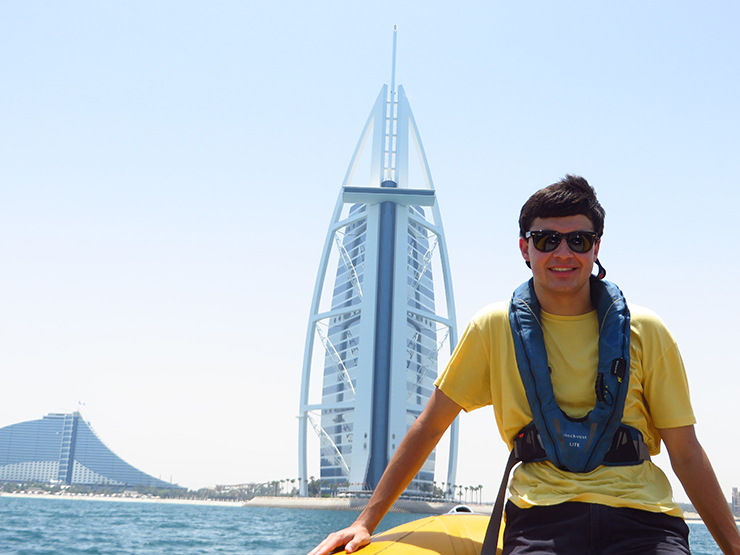 |
| In front of the world’s most expensive hotel, the Burj Al Arab |
My favorite experience speaking Arabic happened on a beach in Oman,
during a trip that some of my classmates and I decided to take on our
last weekend abroad. While in Oman we got the unique experience of
getting a personal tour of the country by some natives who were friends
with one of my classmates. They introduced us to some of their friends
who happened to be Bedouins, who lived in the Omani desert. They met us
for dinner out on that beach and I was able to talk with them, in
Arabic, about their views of America and what they liked to do for fun.
This ended up being one of the coolest experiences of the entire trip
and the best usage of my Arabic skills while abroad. These experiences
are only a small sampling of my entire seven-week adventure, but I
believe that they represent the overall experience well because they
show both the similarities and differences of the UAE and how I was able
to use what I was learning in the classroom to enhance my study abroad
experience.
While the experiences I had there were limited to a finite time
period, the lessons I learned gave me an infinite amount of
possibilities of how I can further expand my understanding of the Middle
East and hopefully be able to go back, either during college or
afterwards for a job opportunity.
--
For the full article and more information about scholarships for international
travel through the Honors College, please visit the
HonorsCollege blog.


