Search This Blog

Showing posts with label January Intersession 2019. Show all posts

05 December 2019

2019 #HogsAbroad Photo Contest Winners

The winners of the 2019 Study Abroad Photo Contest were announced and displayed during the opening session & International Bazaar during International Education Week.

During the previous school year, over 1,100 students studied abroad in 50 different countries.

These students submitted images capturing the places they visited, the people the met, and the wide range of "classrooms" they worked in -- including community clinics, cathedrals and temples, coral reefs, archeological sites and even a jungle or two.

This year’s photo contest was the largest ever, with over 400 photos submitted in 8 categories. The winners are displayed here and will be archived in the University Library’s ScholarWorks collection. The photos will also be displayed in Mullins Library throughout the winter.

Congratulations to all of the winners!

Selfie 
Agrodome Alpacas
Myles Joyce
U of A Faculty-Led: Human & Animal Interaction in New Zealand, January Intersession 2019
"The Agrodome, a massive farm in Rotorua, was home to the most photogenic alpacas known to man."

Trevi Fountain Wish 
Kalyn Jackson
U of A Rome Center: Summer Campus, Summer 2019
"This is a selfie of me throwing my coin in the fountain the wrong way at the Trevi Fountain. Even though my wish will not come true I still enjoyed my experience and loved the outcome of this photo!"

Selfie with the Pyramids
Timothy Burnett
U of A Exchange: Politecnico di Torino, College of Engineering, Spring 2019; Torino, Italy
"I traveled to Egypt for my spring break. This is my selfie from the pyramids in Giza, Egypt."

A Day In The Life 

A Day in Uyuni
Alex Duckworth
U of A Faculty-Led: International Photojournalism in Bolivia, Summer 2019; Uyuni, Bolivia
"The class spent three days traveling around the Uyuni salt flats."

Ciutadella Park
Hannah Taylor
AIFS Barcelona, Spain: Spanish Language and Culture, Summer 2019
"This park was a part of my friend group's daily lives in Barcelona. Whether we went for a picnic, to read a book, to take a walk, or to do a project, we definitely spent our time there."

Gelato Experiment
Austin Lawrence
U of A Exchange: Politecnico di Torino, College of Engineering, Spring 2019; Torino, Italy
"This was a class on gelato making using liquid hydrogen."

Events

The Dance
Crystal Smith
U of A Faculty-Led: Spanish Immersion & Service Learning in Puebla, Mexico, Summer 2019; Peubla, Mexico
"This photo was taken at a hotel in which we stayed in Cuetzalan and these young performers treated us to this display of traditional song and dance."

Battle of the Oranges
Kelsea Crabb
U of A Exchange: Politecnico di Torino, College of Engineering. Spring 2019; Torino, Italy
"Every year the city of Ivrea in Northern Italy hosts one of the oldest and strangest festivals in the country. Teams battle in the city piazza's throwing more than 500 tons of oranges at each other over the span of three days giving it the title of the largest food fight around."

A Holy Day
Margaret Woodruff
U of A Faculty-Led: Tibetans in Exile Today (TEXT), Summer 2019; Dharamsala, India
"We were fortunate enough to be in Dharamsala, where the Dalai Lama's private residence is located, during the holiday honoring the Buddha's birthday and the day of his enlightenment. Celebrations included large numbers of people circumambulating the Dalai Lama's temple, the hanging of prayer flags, and a free meal provided to everyone in attendance. In this photograph, two monks sit, praying for compassion for all sentient beings."
Global Classroom 

Sharing Their Stories
Margaret Woodruff
U of A Faculty-Led: Tibetans in Exile Today (TEXT), Summer 2019; Delhi, India
"The purpose of the TEXT trip to India is to work with the Tibetans in exile to share the stories of their lives. We conducted a series of oral interviews with Tibetans that had fled to India from their home country in hope of a better life, free from persecution. This photo was taken before we started recording our first interview of the trip, with TEXT student Andrew Kutchka conducting the interview and our friend Gesge Yeshi Choedup as translator. The woman that we spoke with ended the interview by saying how she hoped that one day she would be able to return to Tibet and that we would join her. At that point, it was clear to all of us how important it was to give these individuals a platform where they could share their amazing stories of resilience and compassion."

Ancient Classroom
Davis Campbell
U of A Faculty-Led: Honors Passport to Sicily- A Mediterranean Mosaic, January Intersession 2019; Sicily, Italy
"This photo is of us learning from a lecturer while sitting on ancient ruins on Mozia Island"

Sustainable Thinking Clothing Exhibit
Dominique Savage
U of A Rome Center: Summer Campus, Summer 2019
"With our weekend trip to Florence, our Economics class explored the wonderful exhibit called Sustainable Thinking in the Ferragamo Museum. The Ferragamo shoe company illustrated that some of their products and materials are sustainable conscious. This photo was taken in the "Transformation" room exhibiting "transformed fibers made from secondary raw materials."

Hogs Abroad

Hogs on Top of the World
Caleigh Cristensen
U of A Faculty-Led: Coastal Caribbean Biology, May Intersession 2019; San Ignacio, Belize
"Standing on top of a Mayan Ruin in Belize just after we called the hogs."

Hog on an Alp
Esther Heckmann
U of A Exchange: Regensburg Universitaet, Regensburg, Academic Year 2018-2019; Regensburg, Germany
"Reppin' UARK at the summit of one of the Alps in Southern Germany"

Woo Pig Sooie!
Lily Ledyard
Semester at Sea - Spring Voyage, Spring 2019
"Calling the hogs on the back of our floating campus!"
Miscellaneous 

Desert Sunset
Adrian Bradley
USAC Spain: Spanish Language, Culture, and STEM in Valencia, Fall 2018; Valencia, Spain
"This photo was taken during the sunset in the Sahara desert located in Morroco."

Young Chimp
Gopi Lukhi
U of A Faculty-Led: Tanzania - Ecology, Evolution, and Peoples of East Africa, Summer 2019; Gombe Nation, Tanzania
"Portrait of a young chimpanzee at Gombe National Park."

A Dinosaur Fight
Emily Wilson
U of A Faculty-Led: International Photojournalism in Bolivia, Summer 2019; Uyuni, Bolivia
"Because the Uyuni salt flats are so vast we were able to take all kinds of bizarre photos. This photo engages perception play while we fight and run away from a toy dinosaur."

People

Mäori Waka
Myles Joyce
U of A Faculty-Led: Human and Animal Interaction in New Zealand, January Intersession 2019; Auckland, New Zealand
"At the Mitai Mäori Village, the locals displayed their culture through various forms - one of them being a ride in a waka (Mäori for canoe). The warriors dressed in traditional attire as they chanted war songs accompanied by a drum. Meeting the Mäori people was the highlight of my time in Rotorua."

Doña Rosa
Crystal Smith
U of A Faculty-Led: Spanish Immersion and Service Learning in Puebla, Mexico, Summer 2019; Peubla, Mexico
"This photo was taken at a black clay workshop and Doña Rosa showed us how she worked the clay into a beautiful pot before asking for volunteers to learn a few of the techniques. Doña Rosa uses a special technique that is only found in her city of Oaxaca, Mexico to make the black clay shine.

Topkapi Palace - Istanbul
Dayton Thurn
U of A Rome Center: Architecture & Design, Spring 2019
"Topkapi Palace - Istanbul"

Places 

Beautiful Arch
Adrian Bradley
USAC Spain: Spanish Language, Culture, and STEM in Valencia, Fall 2018
"This photo was taken in a chapel in Austria. It was the middle of winter and we had walked in just to get out of the snow for a moment."

The Tower That Views the River
Demi Spencer
Intensive Mandarin Chinese and Chinese Culture, Summer 2019; Nanjing, China
"Yuejiang, or The Tower that Views the River, allows visitors a glimpse into the modern city of Nanjing, while preserving history and Chinese traditions."

Perspective Change
McLain Stalker
U of A Rome Center: Marketing in Rome, Summer 2019
"This photo was taken walking through a cave on our hike down the Dolomites. It was a trial for most and very lengthy. Seeing the light at the end of the tunnel, or challenging oneself to have a more positive outlook during trial is a game changer."

--
Don't miss your opportunity to study or intern abroad! Start your search at http://studyabroad.uark.edu/search/

24 January 2019

Top 4 #HogsAbroad in Vietnam

I work up December 27th, 2018 at 3:30 AM ready for 30 hours of traveling to Vietnam. Although this seemed tiring at first, reality hit, and we ended up arriving 4 days later to Vietnam due to American Airlines canceling our flight. With that being said though, I am appreciative of the delays because I can now say I went to Japan and ate some good sushi. After spending two weeks in Vietnam, I can confidently say I understand the country fairly well. Below you will find the top 4 activities with pictures that made my experience amazing.

1. The Food (specifically pho)
After leaving the Saigon airport in Vietnam, our first stop was to get some dinner of course. We went to a small restaurant in Saigon and ate pho. I remember when I received the bowl of soup I was surprised at the size because I had ordered a large and it looked like an extra small bowl. The Vietnamese eat small amounts of food and this adjustment took a while but I think I lost some weight from eating vegetables all day for 2 weeks so that was nice. One of the important and funny things I learned was if you pronounce the soup name “pho” wrong, you could be saying prostitute instead of the actual soup. A lot of Americans say it incorrectly, so I will have fun telling them this story I feel like. 

2. The English Club (TEC)
After Saigon, our group traveled to Can Tho University. During the night, we were invited to TEC to help the students with their English. I would say it was more of a Karaoke night than anything. Everyone was giving performances, taking selfies, and Susannah and I even joined in the singing and sang Uptown Funk You Up. Great song by the way. This was such a great experience, because we were able to learn about different Vietnamese traditions and help them understand words that might have been too hard to pronounce in English.

3. Floating Market
When I heard about the floating market, I didn’t think it actually meant on water. Surprise! Our group woke up at 5 AM and got on boats and headed out on the Mekong Delta to buy fruits, vegetables, coffee, and pho. Of course, we had never experienced this before, so it was interesting seeing how farmers on boats would just come up to you and sell you stuff. There was a lady that was making pho on a boat. We were all astounded honestly. The coffee was amazing because it’s completely different from American coffee.

4. Phu Quac Island (Coconut Prison)
While on Phu Quac Island, our group took a trip to the coconut prison where the Americans teamed up with the South Vietnamese to capture the North Vietnamese and South Social Communist Vietnamese and brought them back to the prison during the war. It was overwhelming being at the prison, but I was thankful to have seen the place. I learned so much about the prison and the Vietnam War. 

--
Mariam spent the 2019 January Intersession in Vietnam with the U of A Faculty-Led: Global Community Development in Vietnam program with the help of our Office of Study Abroad Scholarship and the Walton College of Business.

See more from the 2019 Global Community Development program in Vietnam on Facebook at https://www.facebook.com/VNHogs2019/

Get started today! Search for your study abroad opportunity at http://studyabroad.uark.edu/search/

18 January 2019

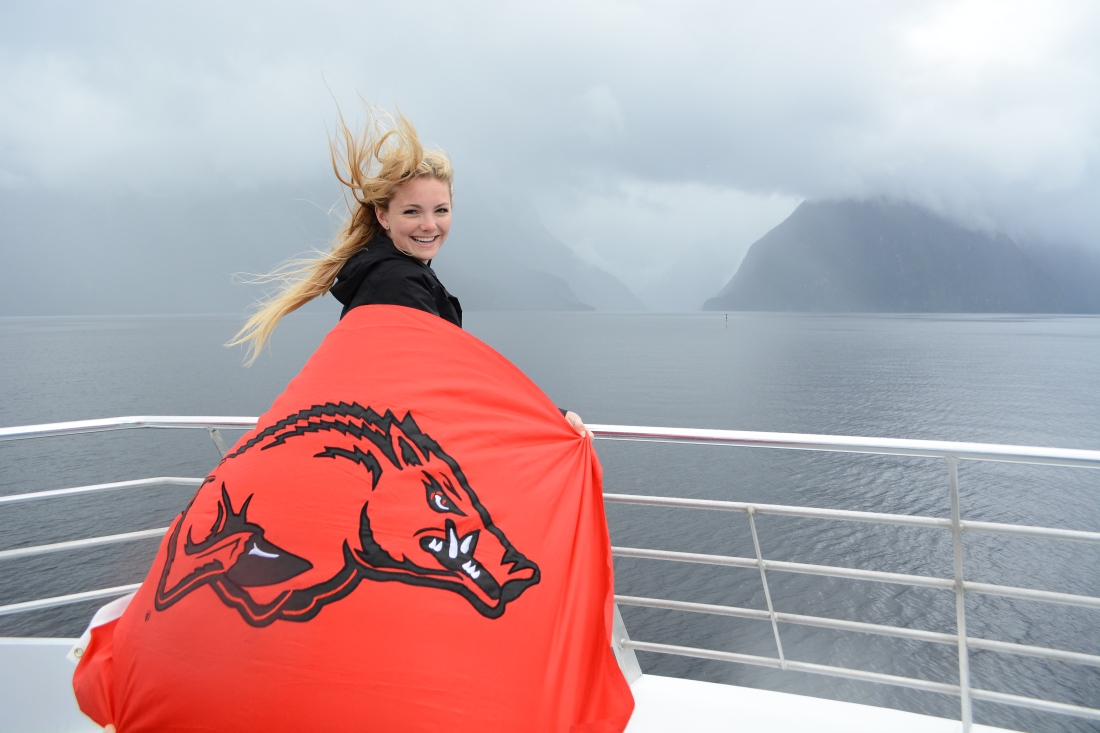
No Doubts in Doubtful Sound #HogsAbroad in New Zealand

Almost every day of this program, at least one of us has said, “I think this is my favorite thing we’ve done so far. But I say that every day!” And today at Doubtful Sound was no different.

Doubtful Sound is actually not a sound, but a fjord (or fiord, as it’s spelled in NZ). A fiord is a long, deep body of water with steep walls of rock on either side carved by glaciers. It’s the most inaccessible of New Zealand’s major attractions.

To reach it, we took a cruise over Lake Manupouri then bused through remote ranges before boarding a vessel on the water. Be sure to check out Olivia’s blog about our beautiful bus ride (on New Zealand’s most expensive road)!

Doubtful Sound is sometimes referred to as “Sound of Silence” because the lack of wind creates a quiet atmosphere, but honestly it could be because of how awe-inspiring it was — truly beyond words!

We boated past towering waterfalls, moody peaks, and mystic mountains. The neighborhood bottlenose dolphins came out to play, too, and one even jumped clear out of the water next to our vessel! There was a range of sun, clouds, mist, and rain, which made for an absolutely picturesque experience.

There’s no doubt about it, Doubtful Sound was my absolute favorite.

-Lydia Fielder

--
Read more from the 2019 Human and Animal Interactions students at https://uarkhumanandanimalinteractionsinnewzealand2019.home.blog/

Find out more about the U of A Faculty-Led: Human & Animal Interaction in New Zealand program.

Get started today! Search for your study abroad opportunity at http://studyabroad.uark.edu/search/

17 January 2019

Lake Pukaki #HogsAbroad in New Zealand

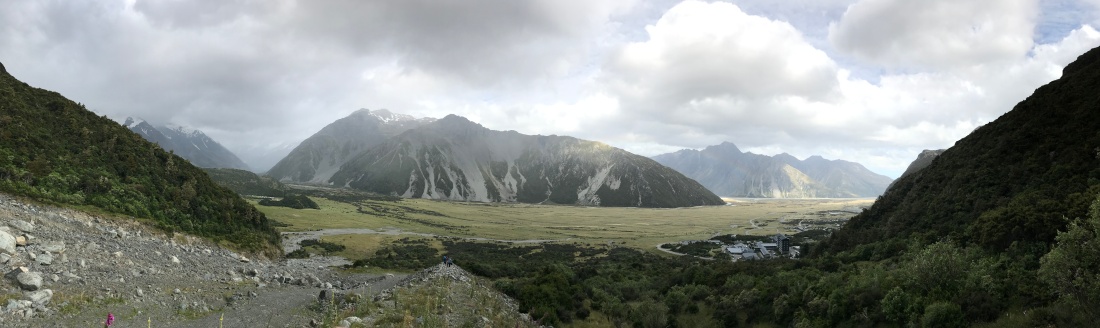
Before I even departed on this winter break adventure I was assigned to report on Lake Pukaki, a moraine dammed lake at the foot of Mt. Cook National Park. This lake is the largest of seven in the Mackenzie basin – a region that was completely dominated by glaciers 18,000 years ago. When these glaciers receded they scoured the earth and left behind large piles of moraine rock. Lake Pukaki is notable among these lakes due to its remarkable baby-blue hue. This coloration is due to the smallest moraine particles, often referred to as glacial flour. The lake is the headwaters of a massive hydropower scheme that powers most of the south island of New Zealand. Because of this, it was dammed to raise the elevation for energy storage and increased agricultural capacity.

My expectations of this lake were absolutely blown away. Its color is otherworldly and its size is a challenge to grasp. What made the lake all the better was the amazing backdrop of the Southern Alps and the mist shrouded peak of Mt. Cook at its Northern edge. I could harp on it all day, but pictures tell the best story. Enjoy!

-Zack Wofford

--
Read more from the 2019 Human and Animal Interactions students at https://uarkhumanandanimalinteractionsinnewzealand2019.home.blog/

Find out more about the U of A Faculty-Led: Human & Animal Interaction in New Zealand program.

Get started today! Search for your study abroad opportunity at http://studyabroad.uark.edu/search/

16 January 2019

Deer Genetics #HogsAbroad in New Zealand

It is January 5th and we went to see Deer Genetics NZ. It was incredible! They breed and raise red deer (Cervus elaphus) and are the largest exporter of deer genetics in the world. They primarily focus on trophy production, raising deer with massive and stunning antlers and selling them as breeding stock, with many going to Texas. To give you an idea of how prized these deer are, a three year old sold for $95,000 NZD last year!

Antlers are also harvested while in velvet, typically twice, between 55 and 60 days of growth. These antlers can sell for $130 NZD a kilo and typically go to China and Korea. The deer must be sedated when the antlers are harvested at this stage because growth is still underway. The antlers contain blood and removing them without sedation can hurt the animal. They are taken down to about an inch or two, with the remaining antler being called a button. This will continue to velvet and then fall off like normal at the end of the season.

Antlers are also removed to prevent fighting. During antler growth the deer become very docile. This is because their testosterone is at its lowest.

Unlike our region of the US, the deer on this farm are domesticated and in large paddocks which are quarantined. The deer are artificially inseminated in order to promote the genes they select as superior. The antler size on these deer was truly incredible. Our elk have some competition!

These deer are still in velvet but you can still tell that these guys will have huge antlers if left to grow.

– Austin Wise

--
Read more from the 2019 Human and Animal Interactions students at https://uarkhumanandanimalinteractionsinnewzealand2019.home.blog/

Find out more about the U of A Faculty-Led: Human & Animal Interaction in New Zealand program.

Get started today! Search for your study abroad opportunity at http://studyabroad.uark.edu/search/
14 January 2019

Pāmu Farms Dairy Tour #HogsAbroad in New Zealand

This tour aligned very well with the interests of all of those on the trip studying animal science, health, biological engineering (my major), and other related subjects. We toured a fully functional dairy production facility. Though they do not further process the raw milk and milk solids, the harvesting process to the farm gate was highly automated and monitored. The farm currently operates with a herd of roughly 1000 productive animals.

The system used to monitor the health and productivity of the herd was quite advanced, with the daily levels of milk production and productive temperatures for each animal being entered into a central computing system and tracked over time. Based on this the animals’ diets can be individually monitored and health concerns could be identified early.

All of the animals on the farm were grass-fed, utilizing a diet largely based on rye grass and sugar beet, with experimental fields looking into lacrene grass. Their diet, while largely based on crops grown on site, needs to be supplemented to enable them to produce the largest quantity and highest quality of milk. During their productive season this means supplementing their water and dusting the grass they eat with calcium and magnesium.

Lacrene grows with a much deeper root system than rye, because of this it uses water more effeciently, potentially reducing use by up to 50%. It also requires no artificial phosphorus fertilization, which could potentially reduce the nutrient pollution from the site. The sugar beet is very high in carbohydrates, serving as a great crop for feeding when the animals aren’t producing milk, leading to their calorie needs being higher but with lower nutrient and mineral needs.

One of the most interesting aspects of this farm is that their entire herd produces only milk with the A2 beta casein protein, while most needs in New Zealand have approximately a 50/50 split with animals whose milk contain the A1 beta casein protein. This protein causes severe digestive issues in many problem, and this sensitivity is often mistaken for lactose intolerance. Their goal is to achieve a herd of roughly 3000 productive animals, which could also be used as breeding stock.
Automated Sprinkler Irrigation Control Panel
Feeding Rye Grass to Dairy Cow
Sugar Beet Feed Crop Before Harvest
-Eli LaSalle

--
Read more from the 2019 Human and Animal Interactions students at https://uarkhumanandanimalinteractionsinnewzealand2019.home.blog/

Find out more about the U of A Faculty-Led: Human & Animal Interaction in New Zealand program.

Get started today! Search for your study abroad opportunity at http://studyabroad.uark.edu/search/

13 January 2019

Veterinary Medicine in Christchurch #HogsAbroad in New Zealand

Pacers and Trotters on the Race Track
On January 5th, we began the day by visiting with an equine veterinarian, Dr. Nairn, at one of the top standard breed horse facilities in New Zealand. As we arrived, it was easy to recognize the English style u-shape influence on the set up of the stables. After meeting the veterinarian, being greeted by several adorable jack russell terriers, and seeing the horses tacked up and prepared to work, we headed upstairs to watch the trotters and pacers circle around the track. It was really cool to distinguish between the trotting and pacing gaits and we discussed how they were trained to achieve each and the rules of the sport. As we continued, we were able to tour the entire facility, ask an incredible amount of questions, and see all of the award trophies and plaques. During the tour, we were able to walk over a vibration plate, in the colt area, which is used to ease or massage a horse with sore muscles. I was able to ask the veterinarian about any fly issues in New Zealand, and learned that they are not even remotely as much of a problem as they are in the United States. The horses were brought in after completing several loops around the track, and their harnesses were removed, they received a bath, and they were allowed to drink molasses water before being turned out to pasture. The barn manager then allowed us to hold and compare steel and aluminum horse shoes and the veterinarian discussed different common health issues and the importance of maintaining good health—which requires a highly skilled farrier. The stables were located on luscious green land with bay horses covered in thin burlap canvases—providing protection from the sun—frolicking around. It was beautiful day and experience that I will not soon forget.

--Kaylee Chambers
Trophies in Standard Breed Facility
Pacers and Trotters on the Race Track

--
Read more from the 2019 Human and Animal Interactions students at https://uarkhumanandanimalinteractionsinnewzealand2019.home.blog/

Find out more about the U of A Faculty-Led: Human & Animal Interaction in New Zealand program.

Get started today! Search for your study abroad opportunity at http://studyabroad.uark.edu/search/
11 January 2019

Kaikoura Seal Swim and Whale Watch #HogsAbroad in New Zealand

Seal Swim:

The second morning of our second day in Kaikoura brought us to a small dive shop on West End. Here, everyone in the group suited up in a wetsuit, grabbed a mask and snorkel, and loaded up on a reasonably cramped bus to head down towards a marina where two small boats awaited. After splitting into two groups, everyone loaded up on the boats, weighed anchor, and headed out to some rocky shallows, not without seeing some bonus little blue penguins along the way. After finding a small inlet with some wet seals on the rocks, our skipper told us we were clear to enter the water. I was very excited, so I immediately slid off the side of the boat, gently into the water. We swam up slowly to the shallows, and seemingly instantly there was a tail poking up above the water, and under the surface were two giant round eyes staring at all of us very curiously, and with a swift pump of the pectoral fins, it disappeared into the waters beyond. Over our time there, we were surrounded and approached by several seal pups and subadults, all of them just as curious about us as we were of them. Some of them were cheekier than others, as one of them swam up to my hand, reversed itself, and proceed to flatulate on my non-working camera, which I and several other people on that dive found incredibly hilarious. After spending about an hour, which flew by incredibly quickly, we boarded the boat again and headed off back to shore. On the way back, we saw another bonus chunk of wildlife, with our skippers spotting a group of orca in the distance. This got me very excited, because two things I thought I would have to wait years to actually do happened in one day. At that point, I could strike two major things off the bucket list: Swimming with a unique ocean mammal, the New Zealand Fur Seal, and seeing orcas in the wild and in their natural habitat.

Whale Watch:

After a cold and fairly tiring seal swim, the group had a free afternoon to spend how they pleased. Before even leaving for the trip, a group of us booked a whale watching excursion with Whale Watch Kaikoura. After a short safety video, we boarded a significantly more comfortable bus and headed to another marina, this one further away than the seal swim one. Once there, we boarded a waka, or boat, named the Tohoraha, the Maori name for the Southern Right Whale. Once on board, we listened to our highly energetic tour guide and narrator give us a run-down on what to expect on our trip out to sea, mainly that we should expect to see a sperm whale at the surface while it caught its breath after a long hunting dive, as well as showing us a few examples of the sounds the sperm whale makes when it echolocates or is actively hunting. The boat was incredibly quick, reaching 30 knots on the surface of the water, and taking us ten miles out into open water in just about fifteen minutes. Once out far enough, the boat quickly stopped from full speed in just one boat-length! After we had stopped, the captain stepped out onto the edge of the ship and lowered a hydrophone into the water to listen for the distinct sound of sperm whale echolocation. Our tour guide pointed out that when the captain said the water was silent, the whale was coming back up to the surface. After about 20 minutes of waiting, a couple on the other side of the boat saw the first spout, and the boat went up alongside the whale for the duration of its rest on the surface. After about 25-30 minutes of resting, the whale dipped its massive head down, lifted up the tail, and slipped back into the sea for another hunt in the underwater canyon system surrounding Kaikoura. Afterward, the waka started to move again, and we started to move around to see if we could find anything else interesting. Sure enough, some people spotted multiple spouts in the distance, so we headed over toward the spouts to see if we could see what was there. After a few minutes of chasing this new pod, I was excitedly seeing if I could identify what they were before the captain or the tour guide did. Sure enough, I saw a signature sickle-shaped dorsal fin emerge after a spout, when I shouted from the top of the boat, “They’re fin whales!” Seemingly no time later, our boat was in the middle of an entire pod of fin whales, with spouts emerging from the water from all directions possible. I was completely in awe, and in complete disbelief that not half an hour after witnessing the largest toothed predator on the planet, we were surrounded by several of the second largest being to ever exist on this Earth. In the words of our tour guide, “Mother Nature, cut it out!”

--
Read more from the 2019 Human and Animal Interactions students at https://uarkhumanandanimalinteractionsinnewzealand2019.home.blog/

Get started today! Search for your study abroad opportunity at http://studyabroad.uark.edu/search/

Community Health Learning in Dangriga #HogsAbroad in Belize

Our students started the week with presentations to Dangriga Community Health Workers. CHW identified that hand washing to prevent disease, feminine hygiene, general nutrition, childhood illness identification and prevention, were areas that required engaging teaching techniques that could easily be brought into their communities.

Of course, the training ended in a hog call!
Students also made house calls with the local Palliative Health Team (similar to Hospice) which provided the unique opportunity for students to enter Belizean homes, meet and talk with families, gaining firsthand knowledge regarding the effects of healthcare systems and policy in Dangriga.
These visits also ended in a hog call.
--
Find out more about the January intersession U of A Faculty-Led: Global Community Development in Belize program.

Get started today! Search for your study abroad opportunity at http://studyabroad.uark.edu/search/