- Outstanding Position Paper – China ECOSOC (Economic and Social Council)
- Outstanding Delegates in Committee – China ECOSOC
- Distinguished Delegation – China
- Distinguished Delegation – Republic of Korea (South Korea)
Search This Blog
Showing posts with label Model UN. Show all posts
05 December 2018
Closing Ceremony and Reflection #HogsAbroad in China
The last day of the conference included the awards and closing ceremony on that Friday morning. We had an awesome keynote presentation on the importance of United Nations peacekeepers. It is awesome to hear how our participation in the conference serves as a catalyst to changing the world. The University of Arkansas picked up 4 awards:
03 December 2018
Cultural Excursions #HogsAbroad in China
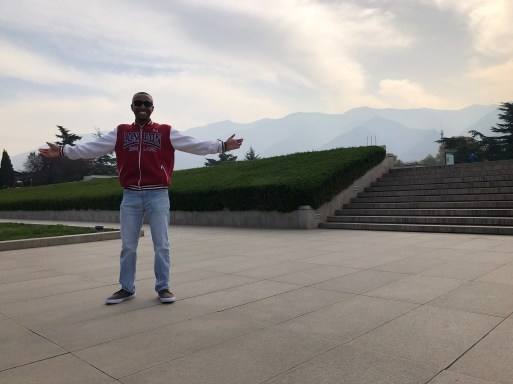
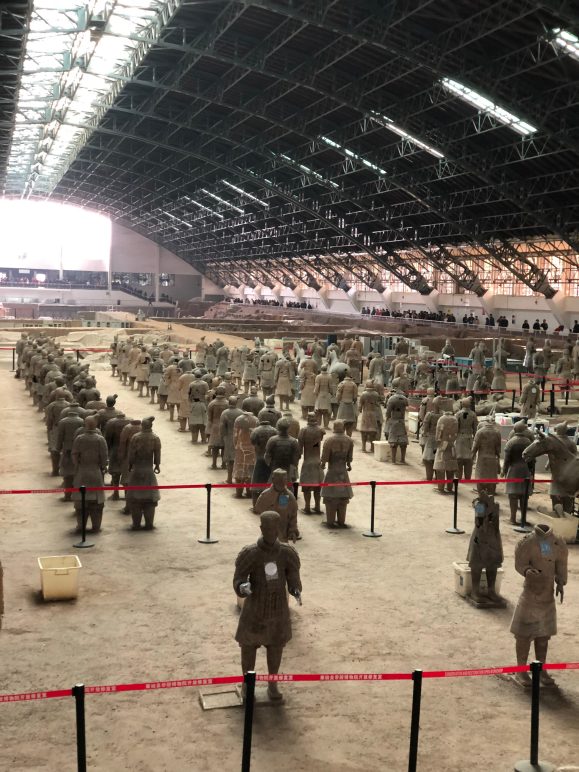
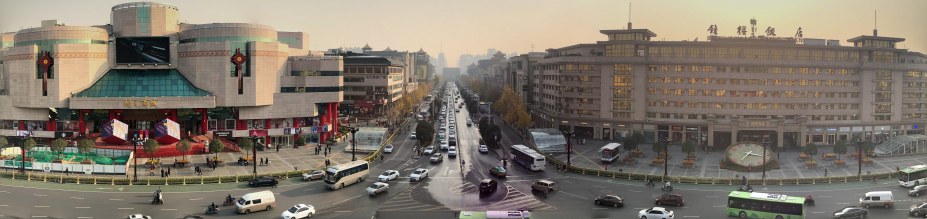
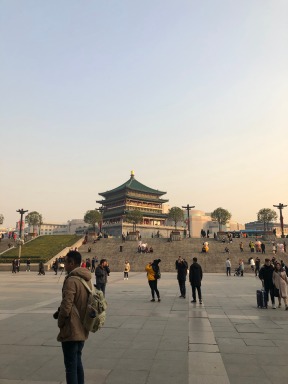
The first two days of our trip consisted of cultural excursions to various locations. On Monday, the group went to visit the Terra Cotta soldiers. It was about an hour drive outside of the city to the museum. The area to view the soldiers was divided into three pits, each of different sizes. We visited all three pits. It was a neat site to see. It was hard to get pictures because it was dark in several locations, but there were a ton of warriors. The figures also included chariots and horses. Monday also included a visit to the Bell and Drum Towers. These are located in the center of Xi’an. You could go inside the tower and up at the top was a great view of the city center. Not too far from the Bell Tower is the Drum Tower. The Bell Tower rung at dawn to start the day and the Drum Tower is struck at night to conclude the day. In the Drum Tower, there were multiple drums that signified certain things. For example, there was a drum for each solar term or weather phenomenon. My favorite was a drum for “slight heat.” I assumed this meant a period of the summer, but I wasn’t exactly sure. There is also a drum museum inside the tower. The Drum Tower also gave great views of the city.
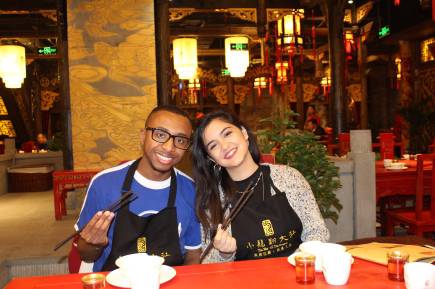
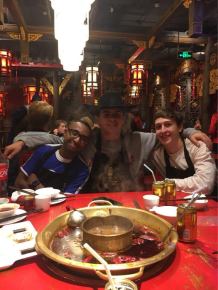
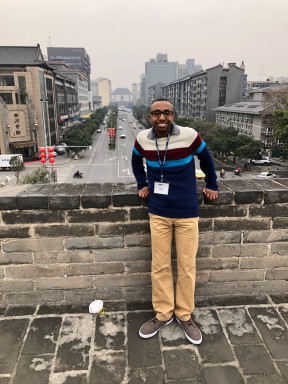
The next day, Tuesday, also consisted of cultural excursions. Our day started with a visit to the Xi’an City Wall. It looks a lot like the Kremlin in Moscow in my opinion. It was my favorite of the cultural excursions. It is situated at the end of the ancient Silk Road, which ironically is also located in the center of the urban district. We walked along one of the sides of the wall and got more good pictures of the city. We took a group picture at one end of the wall. After some free time at the wall, we walked to the Muslim Quarter. It was a short distance to the Muslim Quarter, since the district is located inside the City Wall. It is called the Muslim Quarter due to its large Muslim population. The area is most known for its culture, food, and shopping. We were given about two hours of free time here in addition to lunch. It was a fun area, very lively. Some of our group went again the last night of the trip. They were not disappointed.
--
Follow along with Eric and the Model UN delegation at https://esw2018nmun.home.blog/.
The next day, Tuesday, also consisted of cultural excursions. Our day started with a visit to the Xi’an City Wall. It looks a lot like the Kremlin in Moscow in my opinion. It was my favorite of the cultural excursions. It is situated at the end of the ancient Silk Road, which ironically is also located in the center of the urban district. We walked along one of the sides of the wall and got more good pictures of the city. We took a group picture at one end of the wall. After some free time at the wall, we walked to the Muslim Quarter. It was a short distance to the Muslim Quarter, since the district is located inside the City Wall. It is called the Muslim Quarter due to its large Muslim population. The area is most known for its culture, food, and shopping. We were given about two hours of free time here in addition to lunch. It was a fun area, very lively. Some of our group went again the last night of the trip. They were not disappointed.
--
Follow along with Eric and the Model UN delegation at https://esw2018nmun.home.blog/.
28 November 2018
Committee Working Sessions #HogsAbroad in China

![]() |
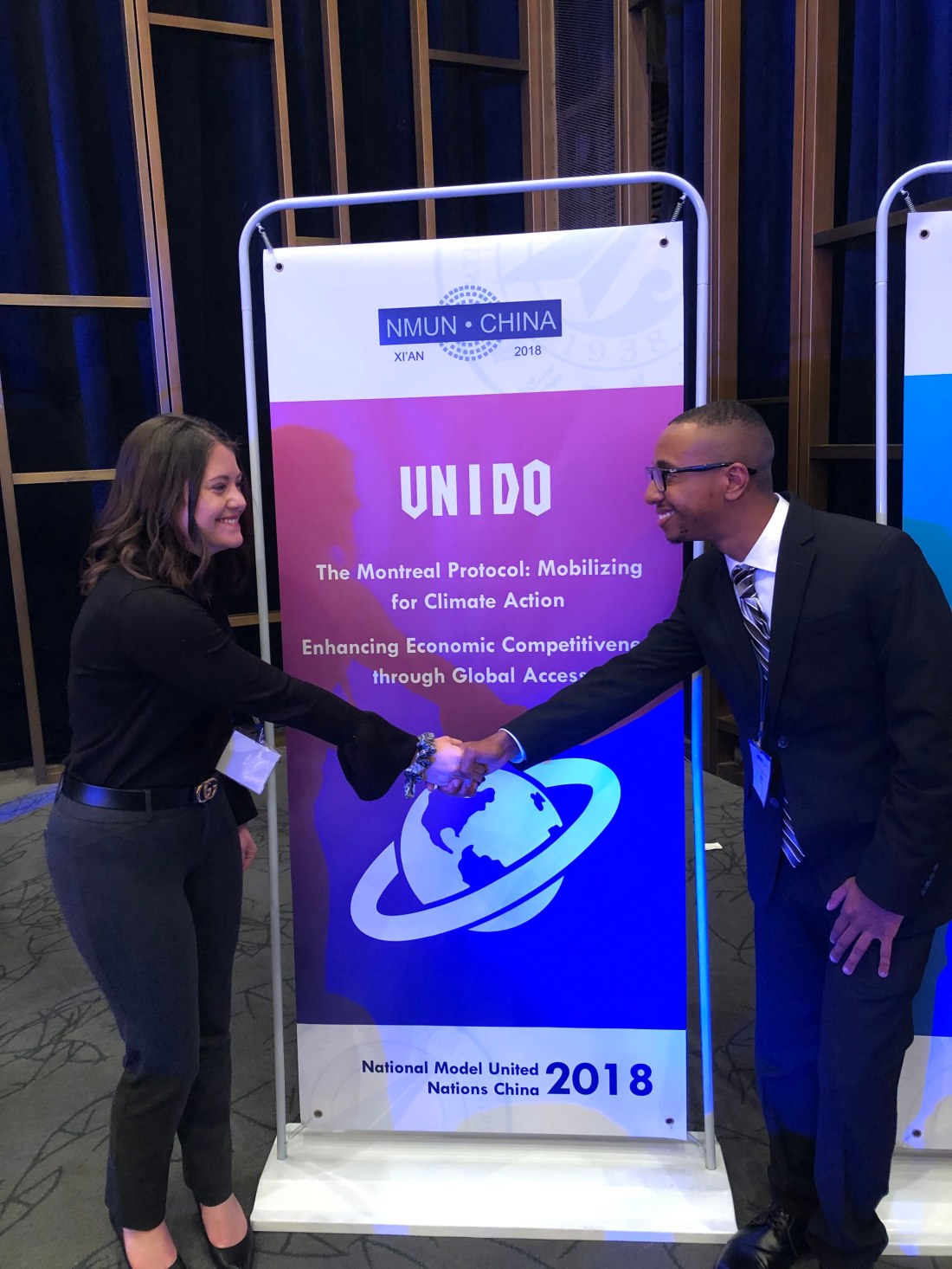
| My co-ambassador Kali Fleming and I representing Japan UNIDO at the opening ceremony. |
--
Follow along with Eric and the Model UN delegation at https://esw2018nmun.home.blog/.
26 November 2018
Journey to Xi’an #HogsAbroad in China

After landing, clearing customs, and getting my bag, I met my driver Bruce in the arrivals area. He had a sign with my name on it. He very politely carried my bag down several flights of stairs. Bruce acted as a guide on our long drive to the hotel. He talked to me mainly about the traffic in the city, which is very heavy. He also talked to me about the geography of the area. He was very nice. The drive was nearly two hours. The airport is only about 30 miles from the hotel if that gives you any ideas about how traffic is. We finally got to the Westin Hotel Sunday evening just before 6 PM. We all got checked into our rooms and we had a quick team meeting at 8 PM. It was nice to get some sleep after over 30 hours of traveling.
--
Follow along with Eric and the Model UN delegation at https://esw2018nmun.home.blog/.
16 November 2018
Preparation for Model UN #HogsAbroad in China
As mentioned in the intro, twenty students are representing three countries: Japan, China, and Republic of Korea (South Korea) across four committees: Economic and Social Council Plenary (ECOSOC), General Assembly Plenary (GA), Security Council (SC), and United Nations Industrial Development Organization (UNIDO).
Here is a list of the issues each committee will be discussing at the conference:
ECOSOC
Position Papers
Once students knew their assigned committees, preparation began with the position paper. The NMUN website provided a position paper guide and a committee background guide around July. Both of these resources are a critical part of doing sufficient research. Committees are required to submit one, two-paged paper stating their country’s position on both issues. The position paper guide gives strict guidelines on formatting that must be followed. This includes font type and size, Arial 10 pt. Position papers are typically in 3-paragraph format. In the first paragraph, you will set the stage for your issue and explain why it is important. In the second paragraph, you will talk about what’s already been done or discussed to remedy your issue. This is on a national and international level. The most important paragraph is the last paragraph. Here you will explain your proposals to fix or potentially fix the issues. The key here is you want your proposals to be convincing; something that will actually get the international community involved. Anything over the two page limit will not be considered. Students will typically type one page per issue. You don’t have to do this. The important part is just being clear and convincing on both issues in two pages. All the submitted position papers were posted November 2. This helps decide who you want to work with. Students downloaded and printed copies of every position paper for their committee and highlighted their proposals to determine the top 15 countries they wanted to work with. This is important for caucusing preparation.
The process of going through position papers is lengthy but essential to caucusing effectively at the conference. Here is where I highlighted every country’s proposals for my committee and ranked each based on their alignment with my paper. I made a list of what university represents each country in my committee. This will also help with caucusing.
Caucusing
This is arguably the most important part of preparation for the conference because it encompasses about 80% of what we’ll be doing at the conference. Caucusing is just simply a collaboration with other countries (same committee) on proposals to write resolutions. We will talk resolutions later. The goal of caucusing is to find other countries within your committee whose positions align with the position of your country. That way you can collaborate and potentially consolidate proposals and get them passed into resolutions. We spent several class sessions caucusing. This also helps you strengthen and sharpen your proposals.
Japan UNIDO is caucusing with Republic of Korea UNIDO to discuss effective measures to tackle climate change.
Speeches
Speeches are another important part of preparation for the conference. Students will give three main speeches: Setting the Agenda Speech, Position Paper Speeches, and Caucusing/Resolution Speeches. The Setting the Agenda speech is the speech that students have the lowest probability of giving, so we will talk about this one first. This one is self-explanatory. Each committee has two issues. Setting the agenda simply means discussing which issue is tackled first. In the set the agenda speech, you will try to convince the committee why you believe one issue should be discussed first over the other. Since this is the lowest probability speech, this one is practiced the least. There is a strong chance that you will be giving a position paper speech. These are roughly 90 seconds to 2 minutes, simply stating your position and your proposals. You want to sound convincing so other countries will want to work with you. Caucusing speeches are simply a synopsis of caucusing you did and what you worked on. You can also use this as an opportunity to talk about future caucusing and invite other nations to join you. You can also talk about any resolutions you are working on or want to work on. Speeches have to be good and convincing so these are practiced almost every class period.
Resolution Writing
The last part of our preparation is resolution writing. Resolutions are the result of conference research, debate, and negotiation. They are typically the typed results of a committee’s deliberation and will provide a committee’s statement on an issue. They will include suggestions and recommendations to the UN and other Member States. Sponsors are the principal authors of these working papers. Signatories are not authors, they just agree with the principles in the working papers. We want to be sponsors on as many resolutions and working papers as possible. Resolutions also have specific formatting requirements and will contain perambulatory (overview of the problem and past actions) clauses and operative (action to achieve in the future) clauses. We practice how to write these, but we are not allowed to come to the conference with any pre-written resolutions.
Groups of students working on resolutions within their committee.
Dress Rehearsal – November 6
The twenty students attending NMUN China are not only representing the University of Arkansas but also their respective country and committee. Therefore, it is important for delegates to act in a diplomatic fashion. This is not just for your committee. Delegation awards are given by country, not just committee. So it is important for all students on all committees to act as ambassadors. Part of acting and looking like an ambassador is dressing formally. Stapp required students to dress up once before the conference to simulate an actual conference performance. We practiced speeches, caucusing, and resolution writing in the procedures that will actually be in place during the conference. Students felt more comfortable and confident in their business professional attire.
Supplementary Information
Other prep includes designing our T-shirt, ordering our business cards, and securing our entry visas for China. Students collaborated on a T-shirt design for NMUN China. Students voted for their favorite color and design. Blue won! We have a team shirt and we should get them a few days before we depart for China. Here is our final design:
Stapp also required students make business cards for their committee to pass to other delegates for caucusing purposes. Visas are required to enter China. Sarah Malloy from the study abroad office was a tremendous help in securing those. We also had to pick roommates, give Stapp our contact information, and make sure the study abroad office had a copy of our flight itinerary and a photocopy of our visas. We also talked about the recommended typhoid vaccine for China. Staying healthy is a must and getting sick over there would be disastrous. We talked a lot about health, safety, money, adaptors, and all other necessary measures before departing overseas. Now that all the housekeeping, logistics, and prep are taken care of, we are now ready to depart for China!
This is an example of the student business cards. It has both students representing the committee, the committee itself, and an email to send resolutions and other working papers.
Here is a list of the issues each committee will be discussing at the conference:
ECOSOC
- People-Centered Climate Change Adaptation and Mitigation
- Harnessing Cultural Heritage for Sustainable Development
- Safeguarding the Health of Refugee Children and Youth
- Rebuilding Community Security in Post-Conflict Iraq and Syria
- Improving the Security of United Nations Peacekeeping Personnel
- The Situation in Ukraine
- The Montreal Protocol: Mobilizing for Climate Action
- Enhancing Economic Competitiveness through Global Access
Position Papers
Once students knew their assigned committees, preparation began with the position paper. The NMUN website provided a position paper guide and a committee background guide around July. Both of these resources are a critical part of doing sufficient research. Committees are required to submit one, two-paged paper stating their country’s position on both issues. The position paper guide gives strict guidelines on formatting that must be followed. This includes font type and size, Arial 10 pt. Position papers are typically in 3-paragraph format. In the first paragraph, you will set the stage for your issue and explain why it is important. In the second paragraph, you will talk about what’s already been done or discussed to remedy your issue. This is on a national and international level. The most important paragraph is the last paragraph. Here you will explain your proposals to fix or potentially fix the issues. The key here is you want your proposals to be convincing; something that will actually get the international community involved. Anything over the two page limit will not be considered. Students will typically type one page per issue. You don’t have to do this. The important part is just being clear and convincing on both issues in two pages. All the submitted position papers were posted November 2. This helps decide who you want to work with. Students downloaded and printed copies of every position paper for their committee and highlighted their proposals to determine the top 15 countries they wanted to work with. This is important for caucusing preparation.

Caucusing
This is arguably the most important part of preparation for the conference because it encompasses about 80% of what we’ll be doing at the conference. Caucusing is just simply a collaboration with other countries (same committee) on proposals to write resolutions. We will talk resolutions later. The goal of caucusing is to find other countries within your committee whose positions align with the position of your country. That way you can collaborate and potentially consolidate proposals and get them passed into resolutions. We spent several class sessions caucusing. This also helps you strengthen and sharpen your proposals.

Speeches
Speeches are another important part of preparation for the conference. Students will give three main speeches: Setting the Agenda Speech, Position Paper Speeches, and Caucusing/Resolution Speeches. The Setting the Agenda speech is the speech that students have the lowest probability of giving, so we will talk about this one first. This one is self-explanatory. Each committee has two issues. Setting the agenda simply means discussing which issue is tackled first. In the set the agenda speech, you will try to convince the committee why you believe one issue should be discussed first over the other. Since this is the lowest probability speech, this one is practiced the least. There is a strong chance that you will be giving a position paper speech. These are roughly 90 seconds to 2 minutes, simply stating your position and your proposals. You want to sound convincing so other countries will want to work with you. Caucusing speeches are simply a synopsis of caucusing you did and what you worked on. You can also use this as an opportunity to talk about future caucusing and invite other nations to join you. You can also talk about any resolutions you are working on or want to work on. Speeches have to be good and convincing so these are practiced almost every class period.
Resolution Writing
The last part of our preparation is resolution writing. Resolutions are the result of conference research, debate, and negotiation. They are typically the typed results of a committee’s deliberation and will provide a committee’s statement on an issue. They will include suggestions and recommendations to the UN and other Member States. Sponsors are the principal authors of these working papers. Signatories are not authors, they just agree with the principles in the working papers. We want to be sponsors on as many resolutions and working papers as possible. Resolutions also have specific formatting requirements and will contain perambulatory (overview of the problem and past actions) clauses and operative (action to achieve in the future) clauses. We practice how to write these, but we are not allowed to come to the conference with any pre-written resolutions.
Groups of students working on resolutions within their committee.
Dress Rehearsal – November 6
The twenty students attending NMUN China are not only representing the University of Arkansas but also their respective country and committee. Therefore, it is important for delegates to act in a diplomatic fashion. This is not just for your committee. Delegation awards are given by country, not just committee. So it is important for all students on all committees to act as ambassadors. Part of acting and looking like an ambassador is dressing formally. Stapp required students to dress up once before the conference to simulate an actual conference performance. We practiced speeches, caucusing, and resolution writing in the procedures that will actually be in place during the conference. Students felt more comfortable and confident in their business professional attire.
Other prep includes designing our T-shirt, ordering our business cards, and securing our entry visas for China. Students collaborated on a T-shirt design for NMUN China. Students voted for their favorite color and design. Blue won! We have a team shirt and we should get them a few days before we depart for China. Here is our final design:

Stapp also required students make business cards for their committee to pass to other delegates for caucusing purposes. Visas are required to enter China. Sarah Malloy from the study abroad office was a tremendous help in securing those. We also had to pick roommates, give Stapp our contact information, and make sure the study abroad office had a copy of our flight itinerary and a photocopy of our visas. We also talked about the recommended typhoid vaccine for China. Staying healthy is a must and getting sick over there would be disastrous. We talked a lot about health, safety, money, adaptors, and all other necessary measures before departing overseas. Now that all the housekeeping, logistics, and prep are taken care of, we are now ready to depart for China!
This is an example of the student business cards. It has both students representing the committee, the committee itself, and an email to send resolutions and other working papers.
--
Follow along with Eric and the Model UN delegation at https://esw2018nmun.home.blog/.
10 November 2018
Introduction to Model UN #HogsAbroad in China
For those of you who don’t know me, my name is Eric S. Williams. I am a graduate student in the Masters of Accountancy (MAcc) program at the University of Arkansas. During my time at the U of A, I have had the privilege of studying abroad three times. I went to Vietnam for the January Intersession 2017 and Ireland Summer 2017, both with the Walton College. Now, I am attending National Model United Nations (NMUN) 2018 Conference from Sunday, November 18 to Friday, November 23, 2018. Twenty students will be traveling to Xian, China led by Dr. Robert Stapp to represent the U of A and discuss issues across various committees. The conference will take place at the Westin Xian Hotel throughout various ballrooms. Our journey will also include cultural excursions to the Muslim Quarter, Xian City Wall, and other cultural sites.
The students representing each committee are:
Japan ECOSOC -- Paul Newman & Kate Hedgecock
Japan UNIDO -- Kali Fleming & Eric S. Williams (me)
Japan GA -- Tenley Getschman & Victoria Lawson
China ECOSOC -- Kait Turner & Odessa Elie
China UNIDO -- Christine Carroll & Amanda Funderburg
China GA -- Ethan Edwards & Katrina Erickson
China SC -- Indy Hudec & Dalton Jones
Republic of Korea ECOSOC -- Sadie Bryant & Arianna Kiaei
Republic of Korea UNIDO -- Jared Pinkerton & Marco Gargano
Republic of Korea GA -- Gunner Gilbert & Hailee Hampton
Note: Japan and Republic of Korea (South Korea) are not members of the Security Council.
This is an excellent opportunity for twenty students to enhance their research and public speaking skills. Hopefully, we all do well and come away with many awards. I hope we all display passion and knowledge about important international issues. I hope to network with other students who see merit in our proposals. Most importantly, I hope we all come back with an unforgettable experience. Please follow my blog and join me on my extraordinary journey to China.
The students representing each committee are:
Japan ECOSOC -- Paul Newman & Kate Hedgecock
Japan UNIDO -- Kali Fleming & Eric S. Williams (me)
Japan GA -- Tenley Getschman & Victoria Lawson
China ECOSOC -- Kait Turner & Odessa Elie
China UNIDO -- Christine Carroll & Amanda Funderburg
China GA -- Ethan Edwards & Katrina Erickson
China SC -- Indy Hudec & Dalton Jones
Republic of Korea ECOSOC -- Sadie Bryant & Arianna Kiaei
Republic of Korea UNIDO -- Jared Pinkerton & Marco Gargano
Republic of Korea GA -- Gunner Gilbert & Hailee Hampton
Note: Japan and Republic of Korea (South Korea) are not members of the Security Council.
This is an excellent opportunity for twenty students to enhance their research and public speaking skills. Hopefully, we all do well and come away with many awards. I hope we all display passion and knowledge about important international issues. I hope to network with other students who see merit in our proposals. Most importantly, I hope we all come back with an unforgettable experience. Please follow my blog and join me on my extraordinary journey to China.
--
Follow along with Eric and the Model UN delegation at https://esw2018nmun.home.blog/.
Subscribe to:
Posts (Atom)