Search This Blog

Showing posts with label Summer 2021. Show all posts

09 December 2021

It was for the Plot #HogsAbroad in Denmark

Blog post courtesy of the Honors College

My name is Mallory MacDonald, and I am a senior honors student double majoring in biology and psychology with a minor in statistics in the J. William Fulbright College of Arts and Sciences. While that sounds like I should be going to medical school, studying abroad changed my trajectory. I took classes outside my comfort zone and fell in love with International Humanitarian Law. I will now be attending law school in my future.

There is this new phrase that I’m trying to add to my everyday vernacular. Kinda similar to YOLO, it goes something like, “It was for the plot.” Sadly, I stumbled onto this saying after I was back in the states on TikTok. However, it still describes my experience wonderfully.

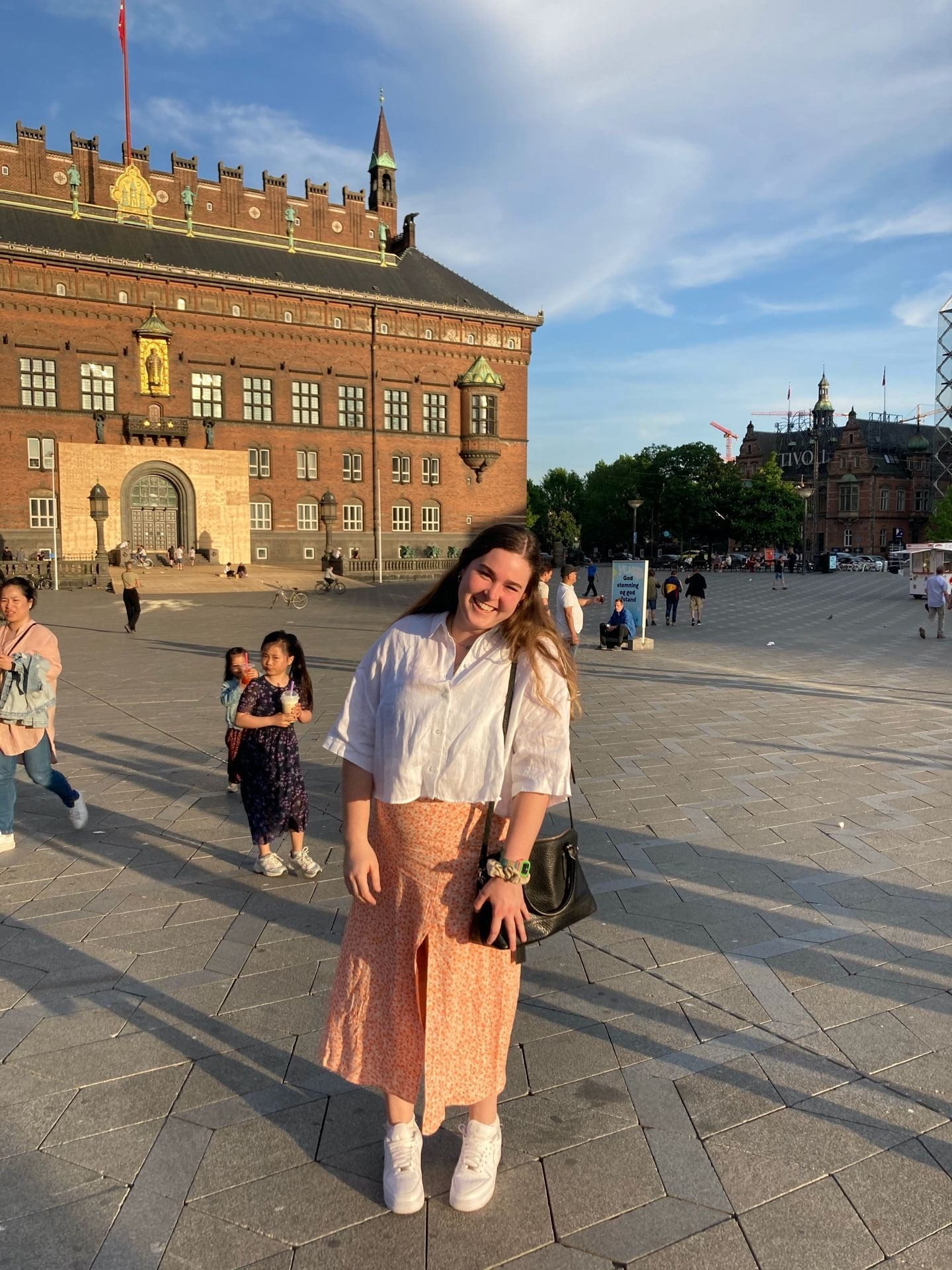
To begin, this expression indicates that I have control over how I write my story. That’s exactly what I was able to do during my study abroad experience. This past summer, I took classes in Copenhagen, Denmark, through the Danish Institute of Study Abroad, or DIS for short. Originally, I choose this program in the Fall of 2019. The class that drew me in was called The Neuroscience of Fear. The program had added in a weeklong study tour to Munich, Germany where students were going to have a tour of Dachau, the first concentration camp. As a biology and psychology double major, this class was going to be an amazing opportunity. Due to COVID-19, I went during the Summer of 2021 when this class was no longer offered due to travel restrictions. This gave me my first time to change up my plotline! The class I took instead was Humanitarian Law and Armed Conflict. During the class, I thought maybe I would go into law as a joke; however, now, I don’t think it’s a joke anymore. I just took my first practice LSAT two days ago.

While I was in class for four hours a day (which felt like the biggest inconvenience), most of my day was spent exploring the city. I spent afternoons walking up and down Stroget, a walking street dedicated to shopping, in different museums learning about the history and culture of Scandinavia, or exploring castles. While roughly 40% of their workforce travels to work by bicycle, I decided to get a metro card. I made it a goal, though, to ride a bike at least for a full day to get as close to the experience as possible. One of my favorite days! The story starts when I mentioned to a classmate of mine that I wanted to ride bikes to a small fishing village south of Copenhagen. She wanted to come and invited a couple of her flatmates. From there, I rode 40 minutes on a bike to a town I didn’t know much about with people that I just met that morning. We ended that adventure by going to eat at Reffen. I have never had parmesan fries as tasty as these. Reffen is the largest street food venue in the Nordic! It sits right on the harbor with a wonderful viewpoint of the sunset if you stay late enough (the sun sets around 9:58 p.m. which also happens to be when the last bus leaves the area too). My roommate got a tattoo here. I talked to some Danish Royal Guards. Good food, good times, and a great place to make TikToks. I’ll end this story with some advice. Take the random classes. Invite the stranger. Try the food. Say yes (but be safe).
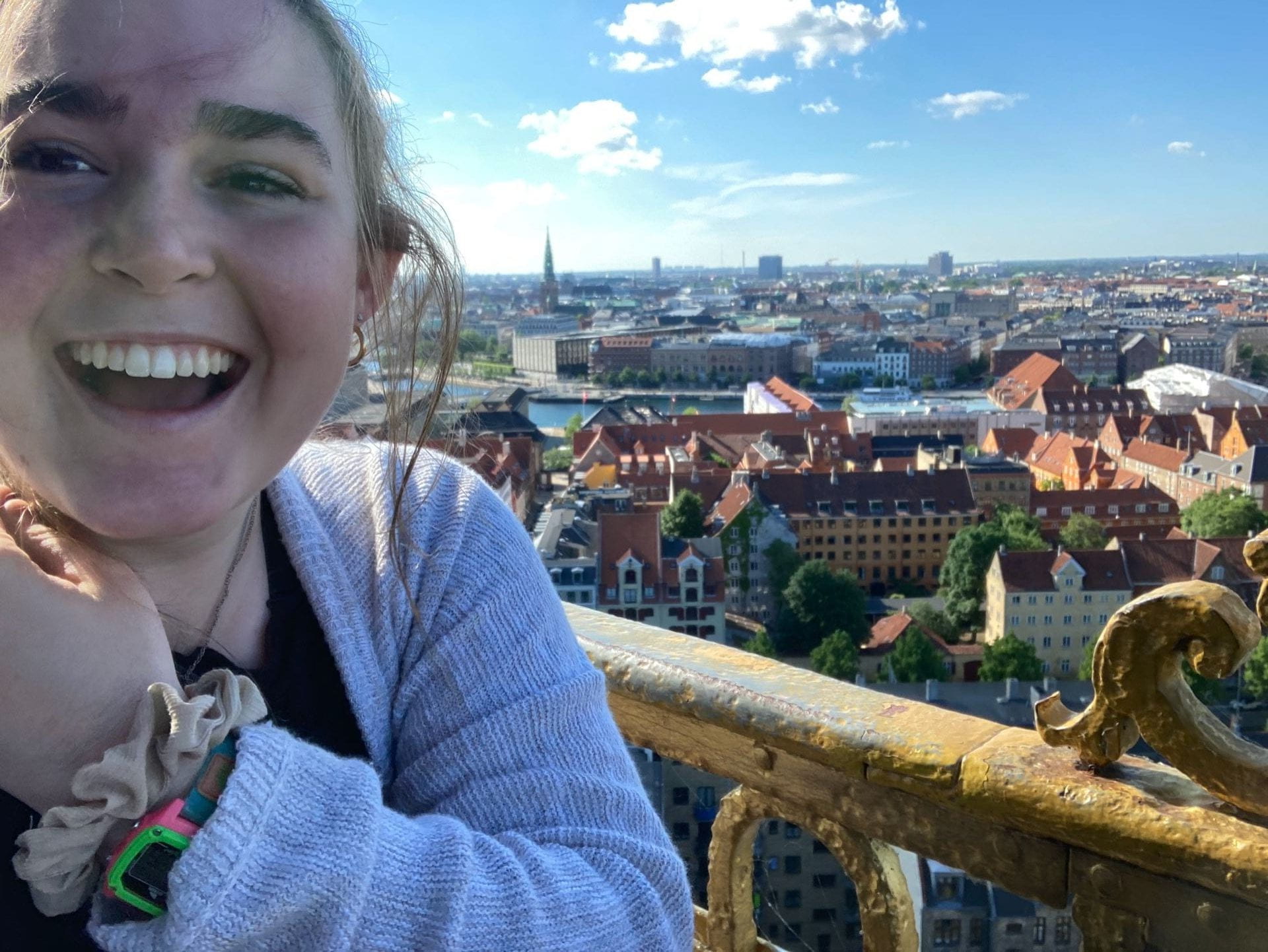
The second reason I use the “It was for the plot” expression is because it’s a positive outlook for when something does not go right. For example, your tour bus gets stuck in the sand – it was for the plot. You rent a car and make a wrong turn and end up somewhere you didn’t plan to – it was for the plot. One Tuesday, I planned to have a quiet night finishing homework. That was before some friends from the building walked in and asked if I wanted to jump into the harbor. How could I say no? The plot was going to be better if I said yes. Also, I just love the water. I changed into my swimsuit so quickly. There were about five of us that jumped in all at once. We quickly learned that the water was about 58 degrees Fahrenheit, a.k.a cold! After that experience, I soon learned that most Danes jump in on a hot day after they get off work (not at night after an average temp day).

Another aspect of my study abroad experience that I could not control was COVID-19. I was lucky enough to be one of the students to get to travel in 2021. The first five days that I was in Copenhagen were spent in quarantine in my flat. This gave me that opportunity to get to know who I was living with very well. I experienced jet lag during this time the most. I got the opportunity to see how another country dealt with COVID, how they loosened their restrictions and their attitudes towards the vaccination. COVID-19 has added to my study abroad experience. Before studying abroad, I heard of students traveling all around Europe on their weekends off, going to Paris, Barcelona or Amsterdam. It would have been amazing to get to travel to all those places. Instead of spending 48 hours traveling to and spending time in another county, I got to visit different cities and towns within Denmark. About a two-hour drive south of Copenhagen is a nature reserve called Mons Klint where about 30 DIS students went camping one weekend. Roskilde is about an hour and a half train ride and houses the Viking Ship Museum. During the week-long class trip, we went all across Denmark on the tour bus. During this week, I saw the second-largest city in Denmark, stayed a night in my teacher’s hometown, and went to a beach near the northernmost point of the country.

All in all, the stories that you remember most aren’t going to be the adventures that you planned for but the ones that you stumbled upon.

--
Learn more about Mallory's program in Copenhagen, Denmark with DIS.

You can start planning your adventure abroad today! Dive in to our Explore page at https://studyabroad.uark.edu/explore/index.php, and start your program search at http://studyabroad.uark.edu/search/

22 November 2021

Cathedrals, Cadavers, and Checkpoints #HogsAbroad in Cyprus

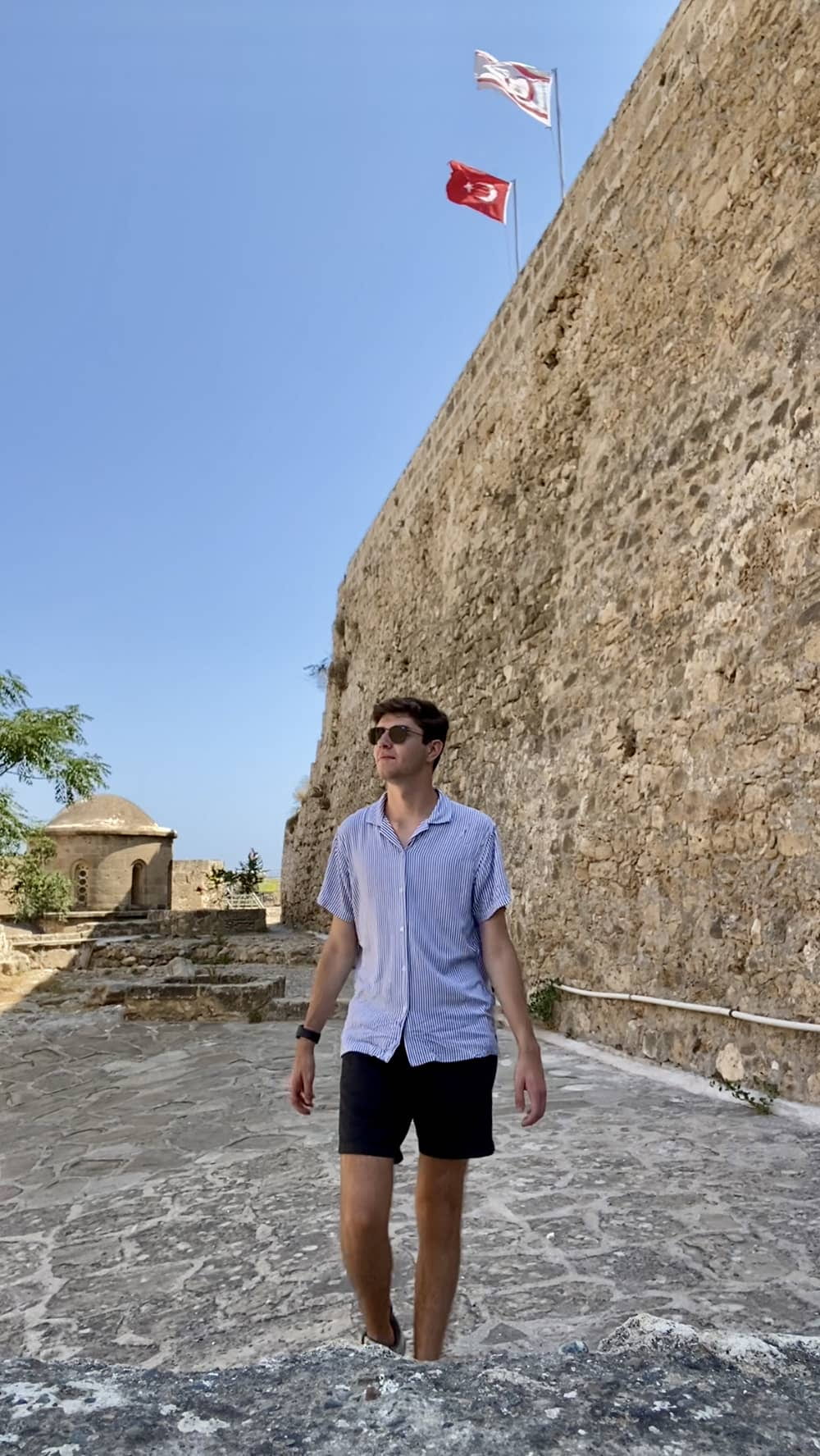
Tyler visits Kyrenia Castle in the Turkish Republic of North Cyprus.

Blog post courtesy of the Honors College

Bodenhamer Fellow Tyler Merreighn, an honors public health and biology major, signed on to study abroad at the University of Nicosia in Cyprus because the program offered a rare opportunity for undergraduates to study anatomy on a med school campus. This included access to cadavers and hands-on (literally!) practice in conducting physical examinations. Tyler also found fascination in the rich interplay between Western and Eastern influences in Cyprus, and the stark contrasts in cultures along the U.N. buffer zone that divides the country.

Situated in the eastern Mediterranean Sea only an hour’s flight from Athens and the Middle Eastern cities of Beirut and Tel Aviv, Cyprus’ history has largely been shaped by Western and Eastern influences. Studying abroad in a Greek-speaking country with such a complex interplay of cultures was an incredibly rewarding experience.

Exploring East and West on One Island
Each weekend, Global Semesters, the University of Nicosia’s study abroad program provider, brought the members of our program to a different city in Cyprus. One weekend, we traveled to Larnaca in the south of the island. Our first stop in Larnaca was the Hala Sultan Tekke, a mosque that houses the tomb of Umm Haram, who theologians currently theorize was the nurse of the prophet Mohamad when he was a baby. Our next stop was Saint Lazarus Church, built around 890 A.D. and regarded as one of the best examples of Byzantine architecture in the world. Lazarus of Bethany, who the church honors, is the biblical figure who Jesus resurrected four days after his death. Although the vast majority of southern Cyprus is of the Orthodox Christian faith, seeing these two religious structures provided context on the strong influences in Cyprus of two of the world’s Abrahamic religions — Christianity and Islam.

Politics in Cyprus is different than anywhere else in the world. The only United Nations buffer zone on the planet runs east-west across Cyprus and divides the island nation roughly into northern and southern halves, the result of a Turkish invasion of the island in 1974. The south is controlled by the Cypriot government. The northern region, known as the Turkish Republic of Northern Cyprus, is a de facto state still controlled by the Turkish government and recognized by the rest of the world as Cypriot territory nearly 50 years after the invasion. It is only possible to get from one side of the U.N. buffer zone to the other through checkpoints located along the zone. On our last weekend, my newfound friends and I chose to travel independently from the program to the north through the checkpoint in the island’s capital of Nicosia. On the northern side, it seemed as if the city had been frozen in time. The streets were empty and storefronts were shuttered and outdated, but you could hear the call to prayer echo throughout the streets. The Turkish Republic of Northern Cyprus is almost entirely Muslim, and it was an unparalleled experience to see such a stark contrast in way of life walking a few hundred feet through the checkpoint from one side of the U.N. buffer zone to the other.
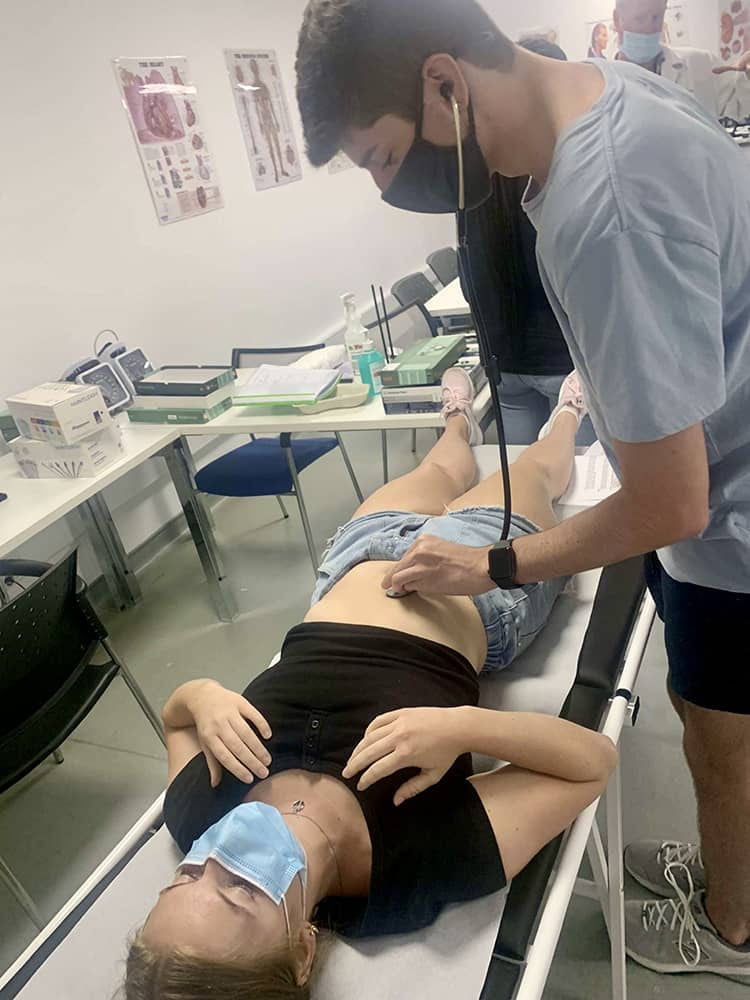
Tyler conducts a practice respiratory exam on a classmate.

Hands On Practice for Pre-Med Students
Cyprus not only offered a unique cultural and historical experience, but it also provided a unique academic experience. The month I spent in Cyprus will undoubtedly be a learning experience I cherish for the rest of my life. During my time abroad, I studied Special Topics in Anatomy and Clinical Skills and Management of Care. Instruction of our anatomy course took place on the medical school campus, and I had the opportunity to learn from cadavers. When I found out about this while exploring programs online, that fact alone almost sold me on the program. Learning in an actual cadaver lab is not an opportunity that’s often found at undergraduate schools in the United States and I’m certain it’s not one at the University of Arkansas, so it seemed like an obvious choice to go experience this in Cyprus. The knowledge I gained from the more than 20 cadavers at the medical school is invaluable, and it was a humbling experience having the opportunity to learn from them.

The other portion of our anatomy course revolved around clinical skills, and it instilled in me a confidence that I’m sure I can bring with me to the medical school application process. In this section of the course, our instructors demonstrated how to perform clinical skills such as respiratory, intermediate cardiovascular, abdominal, and rectal examinations, and then they allowed us to practice those skills on each other and on mannequins. Learning anatomy and clinical skills from instructors at the University of Nicosia Medical School turned out to be an experience that further solidified my decision to pursue medicine and gave me a confidence to continue.

The other course I was enrolled in while in Cyprus was titled Management of Care. In this course, we explored complex topics like physician-assisted suicide, determinants of health and perceptions of health. We were also guided in exploring the health system in Cyprus and other health systems within the European Union. Our challenge was to then compare the various aspects of these systems, such as insurance, price regulation, government spending, efficacy and equity with the United States. This course provided an opportunity to critically analyze the health system we rely on daily in the United States and find ways in which we can improve on it by comparing it to systems found within the European Union. There’s not a course like this at the University of Arkansas, so I’m thankful for this unique touch to my undergraduate experience.

If you’re reading this and looking for a cue to study abroad yourself, then you can consider this your cue. My study abroad experience in Cyprus was an opportunity that I wouldn’t trade for the world, and I know it’s an experience that will help me stand out in my medical school applications. If you’re reading this and hoping to experience a study abroad program that is culturally, academically and personally enriching, then you can look no further. Cyprus was just that for me, and I’m sure it can be that for you. Oh, and if you’re wondering what I did as soon as I got home: I ate at the nearest Raising Cane’s. The gyros were good, but there were just SO MANY!

--
Learn more about Tyler's program in Nicosia, Cyprus.

You can start planning your adventure abroad today! Dive in to our Explore page at https://studyabroad.uark.edu/explore/index.php, and start your program search at http://studyabroad.uark.edu/search/
25 October 2021

Studying Abroad: It Can Be Overwhelming #HogsAbroad in Spain

Hi! My name is Caroline Jennings, I’m a senior studying Math with a concentration in Applied Math and English with a concentration in Creative Writing. I’m also studying Spanish as a minor, which is part of what led me to study abroad in Salamanca, Spain this past summer. With COVID still messing the world up, I wasn’t sure I would ever make it to Spain. Even when I was actually given the opportunity, I hesitated; I wondered if traveling abroad would be too stressful, considering the circumstances.

Was I wrong? Not entirely. But after six weeks of immersion into Spanish culture, I have zero regrets. In fact, after being home for two months, I’m just disappointed that I can’t remember every moment!

To be fair, not everything was perfect every single second. Living in a homestay, trying new foods, struggling with language, etc. can take a toll on a person—I don’t want to try to convince anybody that their study abroad experience will be 100% perfect. But, after experiencing it myself, hopefully I can give some tips that will help make your study abroad experience 100% worth it!

Too Much All at Once
My biggest problem throughout the six weeks was feeling overwhelmed. There wasn’t necessarily much that I disliked, it just felt like I was experiencing SO MUCH in such a short period of time. I couldn’t take any of it in. I would lay in my bed at night feeling like I blinked and missed it all, and I hated it. In an effort to remedy this issue, I called a friend and asked for advice.

Some people may tell you (as they told me) to simply “live in the moment.” Okay but…how? What does that even mean? I took my friends advice as the answer to that question. She told me that if I didn’t feel like I was able to absorb everything at once, then I needed to find ways to keep track of things so that I could check them out later.

Take Notes
One way she said to do this was to write every possible thing down. So, I bought a little journal. Even though I was busy, I tried to write something at the end of each day. I ended up writing down every single thing I ate, fun things that happened in class, and experiences with my host family. There were days that I chose sleep instead of notetaking, of course, but I did my best to catch up when I could.

Don’t just write down the literal stuff, keep your feelings in mind as well! When you’re in the middle of something overwhelmingly exciting (like a special excursion), try to take note of certain things. Do you feel hot? Cold? Scared? Shaky? Giddy? Latch onto those feelings and attach them to the memory.

Take Pics
Aside from that, my friend told me to keep visual reminders of everything I experienced. When I went on excursions, I took pictures of EVERYTHING, shamelessly. Yes, it’s good to put the phone down and look with your own eyes, of course, but I wanted to save memories in a physical place outside of my brain, and my phone camera allowed me to do that.

Don’t Underestimate Your Senses!
Another tiny but related tip she told me was to hang onto smells. Smell is an underrated sense when it comes to memory—a simple nostalgic sniff can bring you back to a memory you thought you had lost. Take advantage of this when you study abroad! I did my best to take note of any delicious foods I smelled in hopes that I could one day make something similar and end up (momentarily) back in Salamanca. It sounds crazy, but it’s possible!

The Bottom Line
It may be easier said than done, but try not to get too sad if you feel like you’re letting life fly past you while you’re abroad. Your brain will be trying to take in 5000 different things, so it’s perfectly reasonable to struggle with feeling present and engaged. All you can do is take note, take pics, take time to breathe, and have fun! That way, you’ll be able to spend time with all of the memories later.

--
Math & English major Caroline Jennings spent the Summer 2021 term in Salamanca, Spain with AIFS with support from the Office of Study Abroad Scholarship.

You can start planning your adventure abroad today! Dive in to our Explore page at https://studyabroad.uark.edu/explore/index.php, and start your program search at http://studyabroad.uark.edu/search/

21 September 2021

Traveling Abroad During COVID-19 #HogsAbroad in Cyprus

This summer I went to Cyprus to study in the pre-medical program at the University of Nicosia. I took a special topics and clinical skills anatomy course and a public health course. We also took group trips every weekend to different places on the island. I learned so much and had the most amazing time while I was there, however trying to get there, was a big of a struggle for me.

This was my first time traveling to Europe alone and I was very nervous to fly by myself. I had spent several weeks preparing and packing for my trip, and thought I had everything organized and all good to go. On the day of my flight, I had my mom take me to the airport three hours early to be safe. Once I got to the airport so many problems started happening. My mom came in with me and the line to check in at the American Airlines desk was super long, so we tried to check me in on the kiosk machines instead. Those did not work though because I was flying out of the country. We got in the line and tried to download the Veri-fly app so we could switch to a much shorter line but that would not work either. It took well over an hour for us to get to the front, but I was still doing okay on time since I had come so early to the airport. My bag ended up being exactly fifty pounds and I thought everything else was going to go smoothly. The lady at the desk started to get me checked in but then said there might be a problem. She started calling all these people and trying to look up stuff since all the guidelines and regulations were constantly changing. She stopped to tell me my COVID-19 test would not work because it had the result handwritten. She kept calling more people for about another hour before she finally got off and told me that she was pretty sure I could not go to Germany, where my connecting flight was, because I would have to stay there because of how I bought my tickets and did not know if my test would be accepted there. I had gotten a ticket through American Airlines to go to Germany, then a flight on Lufthansa, a German airline, to go from there to Cyprus. When I had got my ticket several months before I left, there were not any flights on American that would connect me from Germany to Cyprus, but since they had added one, she told me I had to be on that flight and the tickets had to be bought together. She said my only option was to buy a completely new ticket if I wanted to get there. I almost started crying because I thought I was not going to be able to go at all and there was maybe ten minutes before my flight left. Luckily since I was with my mom, she was nice enough to buy another ticket right then and worry about figuring everything out later. I ran to security and was able to cut the line, then run to my gate. I was the last person to board, but I made it on the plane.

Thankfully, the travel to get there was pretty much the only trouble I had during my trip. When I got to Germany, there were no problems with my COVID test, I only had to show my vaccine card. The American flight from there to Cyprus ended up being the same Lufthansa flight I originally had a ticket on. While I was away, my mom had to repeatedly call American Airlines for several days, but she was able to get refunded points for my original ticket. Traveling during COVID-19 was a lot different and way more difficult to navigate, but it was totally worth it. Studying abroad allowed me to experience an amazing new culture and meet so many new people. I also learned to speak a little bit of Greek! Cyprus was incredibly beautiful, and I made so many amazing memories that I will always treasure.

--
Hospitality management Major Chase Webb spent the Summer 2021 term in Nicosia, Cyprus with the University of Nicosia with support from the Office of Study Abroad Scholarship.

You can start planning your adventure abroad today! Dive in to our Explore page at https://studyabroad.uark.edu/explore/index.php, and start your program search at http://studyabroad.uark.edu/search/

06 August 2021

...And it for sure changed my life! #HogsAbroad in Denmark

Outside Kronborg Slot.
I’m Mallory MacDonald, a rising senior honors student. I study psychology and biology in the Fulbright College of Arts and Sciences. During the summer of 2021, I studied in Denmark through the Danish Institute for Study Abroad.

Ok, I’ve finally made it to Denmark after 15 hours of travel, three plane rides, and standing in a 2-hour long line to get a COVID test. But, I still have five days of quarantine in my apartment. I’m one of the lucky students that get to quarantine with 8 other strangers instead of a hotel by myself. But, maybe hotel food would have been better than learning to online shop in a foreign language. One of those first nights, the nine of us gathered around our dining table (probably bought from IKEA) and played a drinking game called BUZZED with water. One of the cards said, “Drink if you have ever studied abroad and it changed your life.” At this point, none of us could say anything. However, that is still one of the most iconic moments of the trip. It was the first time that any of us were actually in another county doing the thing that people talk about changing their whole life.
My flatmates.
During Summer 2021, I went to Copenhagen, Denmark for six weeks through the Danish Institute for Study Abroad, or DIS. I choose this program because of the classes they offered. However, once in Denmark, I fell in love with the location. My classes were on the busiest streets in the middle of Copenhagen. There was no AC in our classrooms, so we kept the windows open. This probably got in the way of my learning because I was listening to the city pass by outside. The first three-week course I took was The Psychology of Criminal Behavior. Each day we had a guest speaker come in to talk about their experience with criminals in Denmark. It was an interesting class because criminal behavior and how it is treated is very different in Scandinavia. This course covered a psychology elective I needed for my degree. The second course, Humanitarian Law and Armed Conflict, I took because it sounded very interesting and unlike any class I have taken before. My advice: take the random class. I learned more in this class than … than … my intro to psychology course.

My housing building mostly held other DIS students, which I enjoyed. DIS offered two other types of housing options: staying with a host family or a Kollegium, where you would live with other Danish students. Each offers different pros and cons. However, there is a multitude of reasons why I love my housing. For starters, it was two blocks away from Nyhavn, the most pictured place in Copenhagen. Secondly, the first thing I saw out of quarantine were trampolines. Yep, you read that correctly! Copenhagen has sidewalk trampolines right along the harbor.
Me on the trampolines.
To travel around the city, I get a metro card. While 40 percent of the Copenhagen workforce uses their bikes to get to work, I thought using a metro card would be a big enough lesson for me while I was there. And I was right! The first day we had in-person classes I got on a train going the opposite direction. Being late to the class taught me to know to take the right train with more time than needed. Public transportation also became the one place that I needed to wear a mask after my first three weeks there. COVID-19 did not take away from my study abroad trip but added to it. It was very eye-opening to see people’s attitudes towards different policies put in place or the vaccination. My program also limited the travel that we could do to other countries. While it was not appreciated during the moment, I’ve come to appreciate it since I’ve been back, allowing me to explore Denmark. I went to Aarhus, the second-largest city, where one of my teachers grew up, a nature reserve with beautiful cliffs called Mons Klint, a Viking village, a fishing town, Kronborg Slot (aka Hamlet’s Castle). All places that I would not have seen if I would have been allowed to travel to different countries.
Friends biking in the small fishing village.
My study abroad experience was not what I dreamed how it would be in 2019 when I first applied. However, in 2021, it was so much better than I could have ever imagined! And it for sure changed my life!

--
Psychology & Biology Mallory MacDonald spent the Summer 2021 term in Copenhagen, Denmark with DIS with support from the Honors College Study Abroad Grant & our Office of Study Abroad Scholarship.

You can start planning your adventure abroad today! Dive in to our Explore page at https://studyabroad.uark.edu/explore/index.php, and start your program search at http://studyabroad.uark.edu/search/

30 July 2021

Community and Connections #HogsAbroad in Spain

Hi everyone! My name is Allison Primm and I am a rising Junior. I am studying International Business Marketing and Political Science. This summer I am studying abroad in Madrid, Spain! I am studying through an external program called CEA at La Universidad Antonio de Nebrija. At Nebrija I am taking classes in both Spanish and English. During the June term I took both Panorama of Spanish Literature and International Management. This month in the July term I am taking Advanced Spanish and International Marketing. My experience at Nebrija has been amazing and I absolutely love my classes and my teachers. One thing that has been particularly encouraging to me has been the understanding attitudes of my teachers. Though I have only been here a relatively short time, I have been able to develop close personal relationships with each of my instructors. All of them have shown me immense kindness and genuinely want me to succeed. They focus on creating positive learning environments in the classroom and they encourage participation and campus community through their teaching styles. This approach has helped me become more confident in not only my Spanish abilities, but also my interpersonal skills among my peers.
Before I arrived in Spain, I took a 2-part placement exam to help me enroll in the right courses at Nebrija. I would say that this exam was one of the biggest stress factors for me leading up to my arrival, however looking back, it shouldn’t have been. The teachers and advisors at Nebrija are all so helpful and kind. I was nervous for my speaking interview, but I relaxed so much once it began, and I realized that there was no judgement, and they were only there to help me. One of the biggest things I would recommend doing to prepare for a language placement exam is to practice speaking the language with a friend beforehand to get more comfortable with responding to questions on the spot. I would also recommend listening to Spanish music or podcasts or watching Spanish movies and TV shows so that you can get used to hearing the language. When I got here, one big adjustment that I had not anticipated was just the extra effort my brain was using towards listening to and translating the conversations I heard on the street or the announcements on the metro. Giving yourself time to practice listening to Spanish in your daily life will definitely help your transition.
Life in Madrid is different from life in Fayetteville of course, but the adjustment to a more urban setting was very easy for me. One huge help is the metro system in Madrid. The metro runs all around the city and can take you anywhere you need to go. It is very simple, clean, and safe. Within the first two days of living in Spain, I was navigating the metro and the city like a local! I was shocked by how easily I settled in to daily life once I got here. This is in huge part to the incredible kindness of the Spanish people. An integral part of Spanish culture is the focus on friendship and community. There were times where I was lost or confused and a total stranger came up to me and offered their help. This was surprising to me, as in many cultures, people tend to keep to themselves, but in Spain, it has been the people that I know the least who have helped me through some confusing times.
Another thing that helped ease my adjustment period was that I was connected with people in my program from the beginning, and I have roommates in the apartment I live in. This was crucial to navigating the first few weeks as I had people who could easily relate to me and go with me through the uncertainties. If you are interested in participating in a study abroad experience, I would encourage you to try and meet as many new people as you can. It may surprise you how much you have in common with people you never knew before. I am very thankful for this time I have spent abroad, and I look forward to keeping in touch with my new friends when we all return home!

--
International Business Marketing & Political Science major Allison Primm spent the Summer 2021 term at in Madrid, Spain with CEA with the help of the Honors College Study Abroad Grant & our Office of Study Abroad Scholarship.

You can start planning your adventure abroad today! Dive in to our Explore page at https://studyabroad.uark.edu/explore/index.php, and start your program search at http://studyabroad.uark.edu/search/

10 May 2021

Studying Abroad During a Pandemic #HogsAbroad in Thailand #MondayMotivation

Blog post courtesy of Fulbright College Honors Program

With all the chaos that is the pandemic, studying abroad can seem especially scary and impossible right now. There are a lot of misconceptions and even miscommunication floating around that is making the process of studying abroad appear more intense than it truly is.

Granted, when I started looking into studying abroad, I was very overwhelmed. Many questions were buzzing around my head like: “Where do I start?” “Can I even study abroad?” “Will it get canceled?” “Is it even worth it?” “What about COVID-19?” If you are asking similar questions, they are very valid concerns. We are living in a time where nothing is certain, and we need to be prepared. I know many people whose programs were canceled due to the pandemic and/or had to file a petition just to get permission from the university to travel abroad. Sometimes I even have the feeling of “is all this work worth it” when I see other programs getting canceled. Despite this, I know that this will be a once-in-a-lifetime experience that is worth all of the stress and uncertainty. So, if you are even considering the thought of studying abroad, do not be discouraged by all the mayhem, it will be an experience that truly is not worth giving up because of the “what ifs”.
Screenshot of the Office of Study Abroad & International Exchange Website

Visit the Study Abroad Website
The first piece of advice I would give is to visit the UARK Study Abroad website. When you first come across the opening page, there are a plethora of links that take you to extremely important portals you will use frequently as you prepare to study abroad.

From there, you can explore all the available programs through the university (i.e faculty-led) and external programs such as USAC, ISAbroad, CIS Abroad, etc. In addition to traditional study abroad programs, the university has also established several Virtual International Programs that you can take advantage of! Even if you have no idea where to start, there are parameters you can choose to narrow down the search. For myself, I knew I wanted to study abroad in Thailand and could only be there for a limited time, but I had no clue what program to choose. So, I put in the location and duration parameter and the USAC Thailand program popped up. This resource is especially important because location, cost, availability, courses, possible internships, duration, etc. are all factors that drive the decision to pick one program over another.

Work with a Study Abroad Advisor
Another resource to use is utilizing the study abroad advisors. They are there to answer any questions or concerns you will have, so do not hesitate to reach out to them at studyabr@uark.edu! Once you apply for a study abroad program, from there you will be assigned an advisor that will run through the whole process with you. I know this is where most of my stress and anxieties disappeared because I sat down with my advisor and we went over the ENTIRE timeline of studying abroad. This ranged from things as simple as filling out the UARK application to major deadlines such as program payments. Granted, this is a lot of work, but it is extremely beneficial to have a professional in your corner who knows what they are doing. If you are short on time and just have a quick question, you can always use their online chat option. Taking the initiative to reach out to the study abroad office will help you so much more in the long run and you will be glad that you made that step.

Find Scholarships to Help Fund Your Trip
Once a program has been selected and the application process has begun, the next thing to think about is scholarships. During my initial meeting with my study abroad advisor, my advisor also gave me a huge list of scholarships I am eligible for. This, especially, relieved more stress because figuring out what scholarships to apply for is one of the most time-consuming things to do. If funding and cost are important to you, it is never too early to start looking at scholarships. There are truly so many available whether through the university or external. There are also scholarships that you can apply to through your programs of study, including the Honors College, so I highly suggest reaching out to your program advisor to ask them which scholarships you are eligible for! Another great scholarship resource to utilize is on the HogsAbroad Portal is the “Scholarships and Aid” tab. On that webpage, they have all the available UARK study abroad scholarships you can apply for and their requirements.

Keep Track of COVID-19 Protocols
Finally, the COVID-19 part…the best way to know what safety protocols you need to take before and after you study abroad is to ask your program advisor. They will be super transparent on the steps you need to take to get to your destination. These protocols could be as easy as providing a vaccination card upon arrival or more involved such as quarantining for two weeks before you travel and quarantining again once you reach your destination. For my study abroad in Thailand, I need to provide a negative COVID test upon arrival and I need to quarantine for two weeks in a designated hotel after I arrive. This is a mandatory rule instated in Thailand as of now, but the information is always changing so the best way to keep up is to follow the CDC’s travel website. They have up-to-date information regarding COVID regulations in most countries.

I also suggest signing up for the “Smart Traveler Enrollment Program” (STEP). Once enrolled, the program will send out important information from the Embassy about safety conditions in your destination country as well as help the U.S. Embassy contact you in an emergency, whether natural disaster, civil unrest, or family emergency. And these are just the resources I am using—there are many other resources out on the web to find, you just have to look.

Studying abroad is not just a “spur of the moment” type decision, it is a seemingly never-ending journey of applications, scholarships, documents, etc. I, personally, know this because I have been preparing for the trip for the past two years of my life. It seemed like it was never the right time, but I made a pact to myself that I will travel to Thailand before I graduate, and I did everything I could to make this plan a reality. Having the realization that I will study abroad this summer makes it all worth it. Take that leap into the unknown because who knows, you might just embark on a journey that will change the rest of your life!

More helpful links:
Search for Programs: https://hogsabroad.uark.edu/index.cfmFuseAction=Programs.AdvancedSearch
Hogsabroad Portal: https://hogsabroad.uark.edu/index.cfm?FuseAction=Security.LoginWizardStepOne
Scholarships and Funding: https://studyabroad.uark.edu/scholarships.php
Smart Traveler Enrollment Program: https://step.state.gov
CDC Travel Website: https://wwwnc.cdc.gov/travel

--
Chloë Benton, a Physics major with minors in Mathematics and Philosophy, is headed to Thailand this summer. Learn more about Chloë's USAC program in Thailand.

You can start planning your adventure abroad today! Dive in to our Explore page at https://studyabroad.uark.edu/explore/index.php, and start your program search at http://studyabroad.uark.edu/search/.

28 October 2020

Critical Language Scholarship Webinar Thursday, October 29

The Critical Language Scholarship (CLS) Program is a fully-funded intensive language and cultural immersion study abroad program for American students at U.S. colleges and universities. Each summer, students spend eight weeks abroad studying one of 15 critical languages, 9 of which require no previous language study. The program includes intensive language instruction and structured cultural enrichment experiences designed to promote rapid language gains.

The application is now live and available online at: https://www.clscholarship.org/apply and an overview of application tips can be found at: https://www.youtube.com/watch?v=WENN81o9WS

With the summer 2021 application closing on Tuesday, November 17 at 8:00pm Eastern, program staff are hosting one final information session for students in Arkansas to learn more about the CLS Program and the application process. This session will be on Thursday, October 29 at 12:00pm CDT and the registration link can be found at: https://us02web.zoom.us/webinar/register/WN_Kwsz0FTOQRWfwqeFHhgQ_A

31 August 2020

2021 Critical Language Scholarship Program Application Now Open!


The application is now open for the 2021 Critical Language Scholarship (CLS) Program. The CLS Program is a fully funded study abroad program sponsored by the U.S. Department of State that provides intensive overseas language and cultural immersion and is open to U.S. students enrolled in all degree programs at the University of Arkansas.

Through CLS, students spend eight to ten weeks abroad studying one of 15 critical languages and earn academic credit for their work. The scholarship includes travel expenses, coursework, group excursions, and even a small stipend to cover your daily living expenses. Most languages offered by the CLS Program do not require applicants to have any experience studying critical languages.

The CLS Program seeks participants with diverse interests, and from a wide range of fields of study and career paths; students from all academic disciplines, including business, engineering, law, medicine, science, social sciences, arts and humanities are encouraged to apply.

They're hosting a series of information sessions for students, including sessions for students with no language learning experience, students interested in studying a certain language, etc. You can check out the full schedule and register to attend one here: https://clscholarship.org/events

The Office of Study Abroad is here to support you in applying for this and other study abroad opportunities! Please reach out to us to set up an appointment if you’re interested in more information, or want help brainstorming how learning a language could benefit your future career! Email us at studyabr@uark.edu or call the office at 479-575-7582.