Search This Blog

Showing posts with label Spring 2012. Show all posts

07 October 2016

Being At Home in Madrid #HogsAbroad

Lexa Black
Antonio de Nebrija University, Madrid, Spain, Spring 2012
Article courtesy of University of Nebraska-Lincoln


"I lived with a host family in Madrid, Spain.  Neither of my Spanish parents knew how to speak English at all, so it was very difficult at the beginning.  But as I grew more accustomed to their way of life and to only speaking in Spanish, we became very close.  My host mom, Concha, was a former chef and owner of her own restaurant.  I was very lucky to have the opportunity to try a variety of traditional Spanish dishes.  
 
Since I studied abroad for a full semester, I had more opportunities to travel.  A group of friends and I traveled to Venice, Florence, and Rome for 5 days. While in Rome, we visited the Trevi fountain. It is said that if you stand with your back to the fountain and throw a coin in over your shoulder while making a wish, that wish will come true.   
 
My wish was to have a positive study abroad experience that I would never forget.  Without a doubt that wish came true and I would do it all over again if I had the chance. 
 
I studied abroad in Madrid, Spain with International Studies Abroad (ISA), which is program provider.  Through ISA, we went on excursions all throughout the country including Granada, Salamanca, Segovia, and Toledo. Through these excursions, I was able to see different parts of the country and experience many of the different cultures that are represented throughout Spain."

Lexa Black
Lexa enjoying the views of Toldeo, Spain with a few friends.


To find out more about the Exchange program with University of Nebrija, visit http://studyabroad.uark.edu/exchange/nebrija

Search for study abroad opportunities in Spain and over 40 other countries at: http://studyabroad.uark.edu/search

09 October 2013

Cheap Flight....Priceless Results

During the spring 2012 semester I was lucky enough to study abroad in Madrid, Spain. Now that it’s been over a year since I started that adventure I catch myself remembering the crazy experiences I had, and it wouldn’t have been a study abroad experience without a few mishaps haha.
On March 2nd 2012 my friend Elise and I embarked on our 10 day trip to Munich and Budapest that we had been planning since the beginning of the semester. We spent our first four days in Munich and everything was amazing, minus the minor camera breaking, but that couldn’t stop us from exploring the city. Then on March 6th we took a two hour bus ride to the small German airport where would were going to catch our cheap (and I emphasize cheap) Ryanair flight. As we approached to check-in desk to get our tickets we were hit with a huge shock. After a few minutes of complete confusion we were told that the flight had been cancelled for a while and my friend realized she had been checking the wrong email. After checking with the only travel agent booth at the airport we were told that a new flight to Budapest would cost, wait for it…over $300. So that was out of the question.

So now my friend and I are stuck in a random and very small German airport that we had just paid $20 and taken 2 hours to get to. To top it all off my friend then begins to have a panic attack. Holding back my desire to just give up and start laughing at our situation I went over to the corner of the airport had my friend sit and watch our luggage. Then I called my parents (at about 4 or 5am in the US time) and told them about our situation and that there would be a charge made on my card because I was planning to head back to the main train station in Munich to buy some tickets to Budapest. After our conversation I realized there was another factor that needed to be handled, the bus ride back. So my friend and I went over to the booth for the shuttle bus and I told them about our situation. I don’t know if it was my skills that convinced them or the sad look on my friends face but either way we were able to ride the bus back into Munich for free.

Once we arrived at the main train station in Munich our luck was back. We went to the ticket office and we were both able to get round trip train tickets to Budapest for half price. So we spent the rest of the day in Munich and then hopped on a night train to Budapest.

Looking back at that day now I can’t help but laugh. Now it seems like such a simple problem that can be solved in seconds, but when you are a 19 year old and living and traveling through foreign countries simple problems like this one don’t seem that simple. My semester would not have been the same or as memorable as it was without the unexpected moments like this one. 

14 February 2013

Meet One of Our Study Abroad Peer Advisors!

İBuenos días! My name is Antoinette Longcrier; and I am a Junior Spanish major at the University of Arkansas.

I knew I wanted to study abroad ever since I was young. I was lucky enough to grow up in Norman, Ok a college town, full of diversity. My family took part in the host family program at the University of Oklahoma so I grew up around the international community. After my first mini study abroad experience for one month in Spain when I was seventeen, I knew that I would find a way to experience it again for a more extended period of time during my studies at the University of Arkansas.

Madrid, Spain
This past spring 2012 semester I was fortunate enough to get to study in Madrid, Spain through the USAC program. Those six months were the best I have yet to experience in my life. I was able to meet students from Korea, Morocco, Australia and Africa. During the semester I was able to visit four different European countries and go to places I would never have thought I would have the opportunity to visit. For me the opportunity to study abroad changed my life in so many ways and helped me to develop into a more independent and confident person.

Studying abroad, no matter what you study or where your go, is an amazing experience that will change your life in the most amazing ways. It is something I wish every student could experience during their time in college. I am so excited for this opportunity to be a peer advisor in the Study Abroad office, to learn more about the many programs offered and to work with students who want to experience something new.

Antoinette Longcrier
USAC Ambassador
University of Arkansas Office of Study Abroad

08 October 2012

Meet One of Our Study Abroad Peer Advisors!


Hola! My name is Kelsey Ferguson and I am an economics and Spanish major here at the University of Arkansas. I studied abroad the spring 2012 semester in Seville, Spain, with the company International Studies Abroad. 

Snapshot from Seville

To say that my experience was positive is a serious understatement; my time in Europe was the single most exciting, challenging and gratifying of my life. While living in Seville, I learned a lot...including what it feels like to truly understand a new language. To read more about my experience, check out: http://honorsblog.uark.edu/2012/08/31/postcard-from-spain-kelsey-ferguson/

Since my return to Arkansas, I have gotten involved with the Office of Study Abroad as a peer advisor, as well as entered the Global Ambassador program hosted by ISA. I've officially caught the "study abroad bug"; I'll be heading off again somewhere next summer! Until then, you can find me in the office bothering the rest of the staff.  


Kelsey Ferguson
ISA Global Ambassador
University of Arkansas Office of Study Abroad

03 May 2012

4 month reflection…lessons learned in Rwanda

Today marks the beginning of my fifth month in Rwanda. Can you believe it’s been 4 months already? I cannot. I can’t say my life is completely changed but I can say this experience is definitely one of the defining moments in my life and I am sure it will have a significant impact on my growth and development as I continue to become the person I envision myself to be.
Honestly, the day I left America I was TERRIFIED. I was terrified of being thousands of miles from my family, being alone, figuring out a new culture and language, contracting malaria, feeling unsafe, and getting Traveler’s diarrhea. Today as I reflect on that day and my time here thus far, I thought I would share with you all some of the life lessons I have learned and things that Rwandans have taught me.
1. How to Appreciate Others— as I mentioned in my previous post about greetings in Rwanda, greetings are a really big deal here. When I first arrived, I thought it was the most inconveniencing thing ever. But within a month’s time, I adapted to greeting all 500 people (clearly I’m exaggerating) at an event and realized that it feels awesome to be acknowledged. I also noticed that taking the time to greet people instead of just plowing into questions will completely change your experience with that person and the service you receive. Actually, this is my number one tip for bargaining. I’m less likely to get the ‘muzungu price’ if I greet and have a conversation with the driver first.
2. How to not take myself so seriously—I usually avoid situations where I’ll make a fool of myself but in order to survive everyday life here I’ve had to make a fool of myself. I don’t have an accent when I speak Kinyarwanda and quite frankly I sound ridiculous when I speak it. When I first began speaking Kinyarwanda, people would laugh at me. (actually, they STILL do) and I would become way to embarrassed to speak. But what I soon realized is that they’re not laughing at me. Their laughs are a sign of appreciation and gratitude that I am making a genuine effort to learn the language even though I’m completely butchering it. Completely embarrassing myself has helped me get around the few times I’ve been lost, make new friends, and so much more.
3. How to smile even when I don’t feel it.—when all other attempts to get communicate fail…I have learned to just smile. We all smile in the same language. One of the things, I have struggled with throughout my life is my non-verbal communication. My facial expressions totally give away my mood. What I’ve learned since being here is smiling even when I am frustrated gets me a lot further than scowling. People are way more willing to help me if I smile instead.
4. How to be Patient— I have always been a very patient person but being here has put me to the ultimate test. Waiting for public transportation, electricity, YouTube videos to stream, for a server to get my order correct, for someone to understand my English, etc. have really taught me how to be patient.
5. How to be a better listener—Because of the communication challenges, I’ve been forced to listen in a whole new way.
6. How to choose joy and appreciate the small things— People here laugh, sing, and dance in the midst of their trials, setbacks, and hardships.  If they can choose joy when they're dealing with so much, how can I not choose it just because I'm having a minor setback?  
7. How to be resourceful—it’s amazing what a cotton t-shirt, swiss army knife, bobby pin, or band-aid can become. I’ve really learned how to find new uses for things I have and use the things I have in replacement for things I can’t get access to.
8. How to forgive—learning about the reconciliation process and seeing it in action has taught me a lot about forgiveness.
9. The importance of family—living with my homestay family and watching my Rwandan friends interact with their families has reinforced the importance of family in my life.
10. How to share— Often times people offer to share their food with me no matter how little they have. There are is no greater example of sharing than that. No matter how little I think I have, I will ALWAYS have enough to share with someone else.   

24 April 2012

IBIRYO!— food and eating in Rwanda

I don’t know the best way to describe food (ibiryo) in Rwanda. I guess that most accurate description would be that it lacks variety and is very carb-y and starch-y.
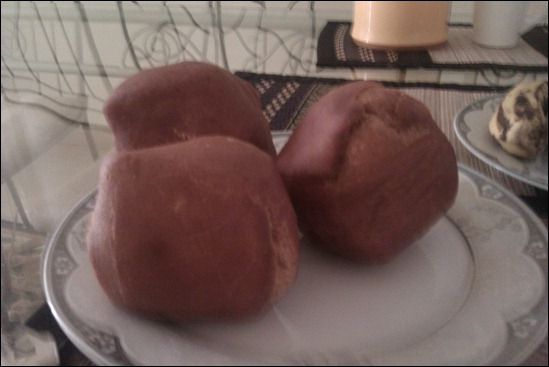
Breakfast typically consists of tea and bread (or if you’re lucky like my classmates you get hotdog buns). Sometimes there’s fresh fruit, avocados, and eggs. Oh and sometimes…MANDAZI (the African version of doughnuts, the second picture).
SAM_2394
IMAG0456
Lunch is typically eaten at a local restaurant. The buffet options always includes: umuceri (rice), ibishyimbo (beans), chips (french fries), matoke (plantains), sombe (manioc: smashed leaves of cassava or yucca), ubugali (porridge like dish made from cassava roots), Irish potatoes, nyama (meat; usually beef or goat), and sausi (sauce). At one of my favorite buffets, they also serve mushroom soup with a broth consistency, fresh bread, fresh fruit, and pasta salad. Lunch buffets cost around 1200-3000 RWF (~1.97-4.94 USD).
SAM_2094
Dinner (read my absolute favorite meal of the day) is AMAZING. Mostly because my family has an AMAZING chef! The dishes are pretty much the same as lunch but the food tastes 1 million times better and there is more variety. Dishes include: rice (sometimes with green beans and carrots mixed in), meat (fried fish, chicken, or beef! YAY for protein!), sauce, potatoes, veggies (peas, carrots, belgians which are green eggplants, mixed leafy greens, or salad), and my favorite dish MATOKE in sauce! Home is my def. my favorite place to eat!
IMAG0451
Also, chicken here taste very different and I am not a fan. So in order to get protein sometimes I eat beef at my house and eat a lot of macadamia nuts. Lately, I have not been feeling very hungry. I think the monotony of the food has gotten to me and my appetite. So every Thursday, my classmates and I have a dinner night at the only American-like fast food establishment (Mr.Chips) in Kigali.
Mealtimes are really different here also. This took a little bit of time for me to get accustomed to. Breakfast is around 6-7:30 am. Lunch is typically anytime between 12-2. Dinner is 9-10. There is at least 6-8 hours between dinner and lunch and most people do not eat snacks! [insert GIRL WHAT?! face here] Without eating snacks and doing so much walking…I realized I was starting to get really HANGRY (hungry + angry)! So I usually keep pringles, fresh fruit, nuts, or biscuits (cookies) on me at all times.
random cultural note about eating in Rwanda: it is unacceptable to eat while walking down the street. Unless of course, you enjoy being glared at. As one of my Rwandan friends said, “why would any respectable person eat on the street?” O_o
I know this sounds like I hate eating here but that is not true. Like any relationship we have our ups and downs. I  really really really enjoy the fact the majority of the food I consume is locally grown, that I have home cooked meals every night, fresh fruit is available everywhere, avocados are absolutely amazing here!, and when I do not feel like eating a huge meal I can always find ROLEX (chapati and omlette!). Also, I should note that there are a few restaurants that serve other cuisines (but no Mexican food).

01 April 2012

academics abroad

Muraho! Hello! Bonjour! Hujambo!   My name is Tameshia and I'm an International Relations/African & African American Studies major, minoring in Latin American Studies/Spanish.This spring, January-May, I'm studying abroad in Kigali, Rwanda.
 -----------------------------------------------------------------------
The academic portion of my program is quite different from what I am accustomed to at the YOU of A. 

classrooms and campus
It’s a two-story home that’s been converted into a make-shift campus. It consists of 2 bathrooms, 3 offices, 1 small ‘classroom’, 1 large ‘classroom’, an outdoor classroom/covered parking area, library/study room, and the most magnificent front and back yards (banana and papaya trees)!  


The classroom area, my program generally uses, consists of a small flipchart, 6-8 white plastic patio chairs, a portable projector, white walls, African inspired ikat curtains, and one medium-sized desk.

lecturers/professors

I’m not really sure where to begin to here. Let’s just say our lecturers have ranged from very engaging to absolutely ridiculously awful with most of them being in the latter than the former. Most of our lecturers are not professors but are experts in their fields. We’ve also had lecturers who never showed up or arrived hours late.

I guess the lecturers are only given a copy of our syllabus for each course and then asked to present a topic that pertains to that field of study. Therefore, most of the lectures have been very introductory, repetitive, not engaging, and definitely not thought-provoking which has been very disappointing for me. Lectures last way longer than usual  (1 hour and 30 mins to 3 hours) Also, many of our lecturers read directly from their PowerPoint or never fully answer the questions we raise. I often find myself designing random things in Photoshop or daydreaming about frolicking in the amazing backyard or being anywhere else but class.

structure of my program

what’s structure? For me, this has been the most frustrating part of my program as I am mostly a fan of structure when it comes to school. I like getting my syllabus and being able to plan accordingly for the semester. I think it took about three weeks to a month for us to receive a syllabus. Then, after we received it, almost nothing went as planned. I am almost never able to make plans for after class because I have no clue what time class will finish each day. It’s basically a 9-5 (or later) job. So I have learned to be extremely flexible but I can’t say I have mastered this completely.

Also, I think a lot of the structure doesn’t exist because this is the first semester my program has been in existence.

assignments and grading
For our Kinyarwanda class, each night we were assigned homework. Our homework included creating dialogues, learning and practicing new words with our homestay families, visiting the market to learn the name of different food or writing paragraphs. All of my other classes typically assign weekly synthesis papers, academic excursion essays, and comprehensive course essays. No long-term assignments or busy work. I appreciate that.

The grading system is also very different from U of A. Some of our course advisors employ the European grading system which is quite different from the US. Making at least 70% is a good grade and making an A- is exceptional.        

However, what is dramatically different and refreshing is that there’s a lot of experiential or hands-on learning. This gave my classmates and me the opportunity to go on LOTS of academic excursions (where we visit places and organizations that pertain to the courses we are taking). I can honestly say most of the things I have learned since being here have not occurred in the classroom.

But after all, I signed up for an experiential learning program and not an academic program, so I guess that means mission accomplished.

Academic Excursion: The Last King's Palace

Muraho! Hello! Bonjour! Hujambo! My name is Tameshia and I'm an International Relations/African & African American Studies major, minoring in Latin American Studies/Spanish.This spring, January-May, I'm studying abroad with the School of International Training/Hendrix: Rwanda Presidential Scholars Consortium Program.
------------------------------------------------------------------------

For our 'Rwanda: History, Culture, and Arts' we visited the Last King's Palace in Nyanza (south of Kigali) which was the capital of the Kingdom of Rwanda from 1958 to 1962.


The ancient palace of the king (mwami in kinyarwanda) was reconstructed on the grounds of the 'modern' palace built for Mwami Rudahigwa Mutara III by the Belgians in 1932. The ancient palace, 
serves as a representation of the way of life before colonial invasion. It was being remodeled when we visited so we also visited. So we weren't able to go inside. We were able to visit the milk and beer huts. The huts were constructed from grass and animal skin. The interior consisted of wooden columns, a sitting room with small stools and a firepit, and an adjacent bedroom with a 'king sized' bed. (It was spacious enough for the king and his many wives.) Overall, the place was pretty cozy and would make an awesome tent for a camp-out.


random facts about the Kingdom of Rwanda:

1. the king, queen, and visitors to the palace each had separate entrances. also, no man was allowed to use the same entrance as the king or turn his back to the king. 

2. the king's mother chose which wife would sleep in the king's hut each night.

3. the Kingdom of Rwanda encompassed Burundi and parts of  Uganda, Tanzania, and the Democratic Republic of Congo (Zaire).

The 'modern' palace was constructed for the last king (Mwami Mutara III) prior to Rwanda's independence in 1962. The palace was built by Belgians in a western style. It consists of a super spacious sitting room, dining area, several bedrooms, a kitchen with an underground storage room to keep things cool, and an amazing front yard/patio area. In my opinion, this palace wasn't as inviting as the ancient palace. (We weren't permitted to take pictures inside)


10 March 2012

Taking the Road Less Traveled -- Philip Murry


I've traveled a lot in recent years, but I've always called Arkansas home. While I've had some incredible experiences, they've all been relatively short, and they're all referent to my 19 years in the Natural State. And if I'm being honest with myself, maybe that's the reason I decided to come here, to leave everything behind (at least for a little while) and discover a life I could never live at home. I chose to walk down this road and take advantage of an opportunity many people never get to have. And, after two months here, I know that I'll never be the same Philip that I was in December.

With that in mind, I told myself that when I stepped off the plane in Madrid, I would be ready and willing to soak in as much as possible. And my goodness, has it paid off. Most of my friends here are other international students, but very few are actually from the USA. I think that's a real advantage for me because I've gotten to talk American politics with Europeans (especially my German friend, Laura). I'm amazed by the understanding and awareness that they have for what's going on in our political world--sometimes more than I do myself. It's also really interesting to hear the European perspective on our politics over the past several years (the War in Iraq, George Bush in general, Obama's term, the upcoming election, etc.)

I love the opportunities that I get to talk to Spaniards about anything and everything (it's surprisingly rare--at least for me.). Not only do I get the chance to use my Spanish, but I also learn about Spanish culture while sharing a little bit of my own background. It's probably one of my favorite parts of this experience. There's always something to learn, always something to share. And as I get closer to people from all all parts of the world, it just reaffirms my belief that all of us are essentially the same. Despite all of our cultural differences (and honestly, those seem pretty insignificant to me now), we can all come together and become really good friends. 

I tell you all this because I think that, so far, keeping an open mind has kept me from feeling an overwhelming sense of the dreaded Culture Shock. As a matter of fact, I think readjusting to the USA will be harder than it was coming here. I have become accustomed to a new way of living--a world of massive networks of public transportation, afternoon siestas that close down entire towns (but not Madrid, mind you), and the metric system--and I don't know how easy it will be to leave it behind. I guess it won't really be left behind though. This a journey that's shaping the way I see the world, and I will carry it with me forever.

--Philip

If you enjoyed this post, you can find more of my experiences on my own blog.

02 March 2012

Kickin it in Kigali! (Rwanda)

Muraho! Hello! Bonjour! Hujambo!

    My name is Tameshia and I'm an International Relations/African & African American Studies major, minoring in Latin American Studies/Spanish.This spring, January-May, I'm studying abroad with the School of International Training/Hendrix: Rwanda Presidential Scholars Consortium Program.

   While in Rwanda (and Uganda), I'll take courses in:  Kinyarwanda (the official language), 'Rwanda: History, Culture, and Arts', 'Ecology and Sustainable Development', 'Microfinance and Poverty Reduction', and 'Internship and Field Methods'. I will also do a homestay with a Rwandan family and intern for three months at a NGO or government office.

   This is my first time studying abroad and traveling internationally, so I'm excited to share my adventures and experiences with you all.

From time to time, I'll post on this blog but I will also blog on my personal blog. Please feel free to comment, ask questions, and share!

Turasubira! (See you soon!)

27 January 2012

Blogging from Spain!

Hello, everyone! My name is Philip Murry, and I'm an International Business major, with a concentration in Economics and a Spanish minor. I'm studying abroad for the first time this spring, spending five months in Madrid, Spain. I went to Europe over Spring Break a few years ago, so at least international travel isn't something completely new for me. But five months? Yeah, that's something I'd never dreamed of.


I'm participating in a direct exchange program with the Universidad Carlos III de Madrid (UC3M). It seems like I'm all on my own; there's no program director, tour guide, or anyone like that to plan my days for me. Talk about independence! Luckily there are a lot of tools at my disposal: at home through the Study Abroad Office, at UC3M in their office for international students, and also through a student-run organization called Erasmus Student Network (ESN). It's great for finding social activities with other students in Madrid and getting discounts all across Europe!

There are a lot of challenges heading my way (and many I've already encountered, but I'm ready to face them! I know I'm going to make some incredible connections and friendships, and I know I've got a lot to learn. But I'll welcome them with open arms!

To make it easier for my friends and family to follow my journey, I set up my own blog that you should see on the right hand side, or you access it here. Experience the best of my travels with me!